
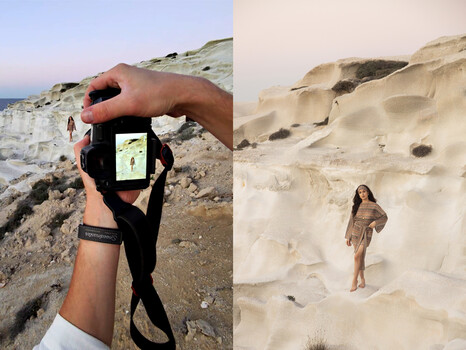
I just wrapped up a fashion campaign shoot at Sarakiniko Beach in Milos, Greece. Here is how it went, what I learned from the experience, and how we approached getting the shots.
This particular project was for the launch of the resort wear brand Isla Mer, and we were looking for that golden hour glow. On timing alone, we aimed for the end of the season so there wouldn’t be as many tourists around. That said, there were still a good amount out there — we even encountered another fashion shoot happening at the same time, and they seemed to have largely the same approach we did.
Hitting the ground running, we started shooting parts of two looks the night we arrived while also doing a location scout for the next day. We would then wake up before sunrise to handle all the prep — hair, makeup, and figuring out which looks we were going to shoot that morning. Although we already had the spots scouted, we left a little room for flexibility in terms of which looks went where, based on what worked together visually. That spontaneity matters, because you never really know how something will look until it’s on the model in the location — and then suddenly you think, oh, maybe this spot would be really cool.
To get the best light, we were set up in place as the sun was just beginning to come up. We shot for about two and a half to three hours before the light climbed high enough in the sky — around 9:30 or so — that going any further would have taken us outside the aesthetic we were after.
For some of these shots, we did embrace the harsh shadows of direct sunlight. This worked especially well for the darker-colored looks — the blacks and browns — which I found lent themselves well to harder light. We would then take a break around midday to rest and get some lunch, before coming back around 2 p.m. With sunset around 5:30, that gave us another two and a half to three hours of shooting. During that afternoon session, I would be pre-planning locations for the next looks — either for the following morning or the next evening.
During our first-day location scout, in addition to finding good spots, we mapped out how to best traverse the terrain, which can be a little treacherous depending on where you go. The other shoot we encountered mostly stuck to the flatter, more accessible areas. We went pretty much everywhere, because we wanted to capture the full variety of the beach. If you’re planning to shoot here, you’ll want something close to hiking shoes — definitely something with good grip — because depending on where you venture, it’s not exactly for the faint of heart. There was some amateur rock climbing involved at times, but we made it through just fine.
If you’ve never been to Sarakiniko before, the landscape is absolutely remarkable — one of the most amazing places I’ve seen in my life, and without question the most visually stunning place I’ve ever shot. We went through about three looks in the morning and three in the evening, totaling six looks per day, across roughly two and a half days of shooting: three evenings and two mornings. The first evening was split between the location scout and shooting a couple of looks, and then we had two full days from there with a midday break built in each day. The other shoot, incidentally, was following the same schedule — breaking during the flat midday light and returning for the golden hour.
Worth noting: the mornings were quite cold when we were there. Since a lot of the clothing didn’t cover much, we kept warm-up layers on hand between shots to keep the model comfortable, which made a real difference until the sun came up and things warmed naturally.
Going during the off-season worked strongly in our favor — especially given that we weren’t just shooting stills. We were also capturing video in a similar style to the stills, plus drone footage for the campaign video. Had we gone during peak season, the beach would have been far busier during sunrise and sunset, and keeping people out of the frame — particularly in the drone footage — would have been significantly harder. Even in the off-season we had to maneuver the drone carefully, but we were able to pull it off cleanly.
As for what I would have done differently: I was shooting on the Canon EOS R with the Canon RF 24-105mm f/4 L IS USM, and I had a few extra lenses along, including a Canon EF 85mm f/1.8 USM. The one thing I wish I’d had was my variable ND filter. Without it, maintaining a shallow depth of field once the sun came up got trickier — I would just push my shutter speed higher, which worked fine since I wasn’t using flash, but having the ND as an option would have been a bonus. Not a deal-breaker, and I’m happy with how the shots came out, but something to remember for next time.
I also didn’t use strobe on this shoot, which is very out of character for me. I wanted to work purely with the landscape’s light, and honestly, the light was so beautiful that I never felt the need to supplement. The client wanted a natural feel — no flash look — and while I normally work hard to make strobe look like motivated natural light rather than flash, here I simply didn’t need to. Shooting fully in natural light was a genuine creative challenge for someone who primarily works with flash, but I enjoyed it. If you want to sharpen your own approach to working with natural light on location, Photographing the World: Landscape Photography and Post-Processing is worth a look.
This was a location the client picked, and after being there I completely understand why. It’s a famous beach for a reason — visually stunning and endlessly photogenic. I also captured some personal landscape shots while we were there, plus additional branding material: B-roll of waves, cliffs, and the surrounding terrain.
I’m curious — what locations like this stand out for you, either places you’ve shot or places you’ve been wanting to shoot? Sarakiniko wasn’t on my radar before this project, but it absolutely should have been. If you’re considering it, I’d wholeheartedly recommend it — as much as part of me wants to keep it to myself. Whether you’re shooting fashion or landscape, having the right glass matters; a Canon EF 85mm f/1.8 USM or a versatile zoom like the Canon RF 24-105mm f/4 L IS USM will serve you well out there.