
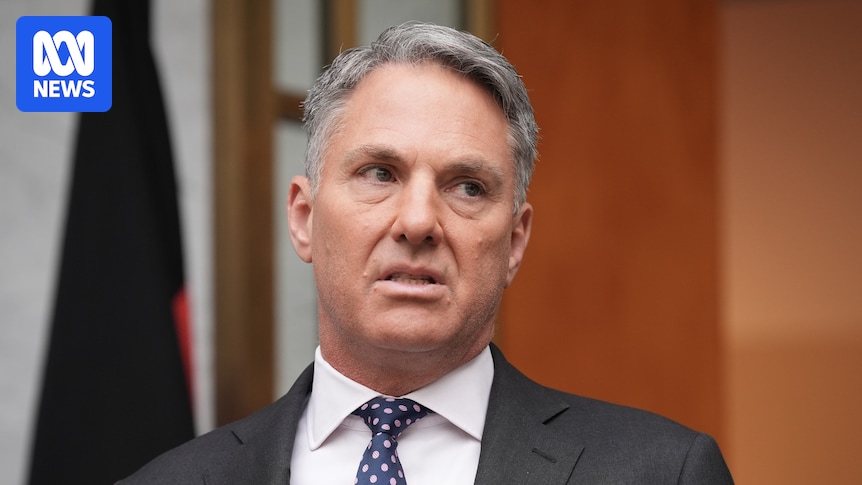
Deputy Prime Minister Richard Marles says Iran’s re-closure of the Strait of Hormuz is “disappointing” and “every diplomatic angle” should be used to secure a permanent ceasefire in the Middle East.
But he did not express outright support for the United States’s retaliatory blockade of Iranian ports, as Australia weighs how it can contribute to securing the key shipping route in future.
Overnight, Iran announced it would re-block the strait, about 24 hours after it said it would be opened to commercial vessels in response to the ceasefire in Lebanon.
Iran war live updates: For the latest news on the Middle East crisis, read our blog
Asked repeatedly whether Australia backed the United States’s actions, Mr Marles said he “understood the American reaction” to Iran’s blockade.
“They are the ones who are in the midst of whatever negotiations are happening right now, and ultimately what we want to see is the Strait of Hormuz open,” he told Insiders on Sunday.
“I know that that’s what the United States wants, and I’m not about to second-guess their decisions in relation to this specific reaction because it is a reaction to the fundamental decision that Iran has made to block the Strait of Hormuz.”
Mr Marles, who is also defence minister, added that freedom of navigation was “paramount to Australia’s national interests”.
“And it is really important that it apply in the Strait of Hormuz.”
Australia-US relationship under scrutiny
The government’s relationship with the Trump administration came under scrutiny on Friday when the president once again lashed out at Australia for allegedly failing to provide support in the strait.
“I’m not happy with Australia because they were not there when we asked them to be there,” Mr Trump said in response to a question from an Australian journalist.
Senior Australian government ministers have repeatedly said that the United States has not made a “formal” request for assistance in the Strait of Hormuz.
“I can really only tell you what the situation is from Australia’s perspective. We’ve not had a specific request,” Mr Marles said.
But he added that Australia was working with the United States as well as other allies in “respect of what the future may hold”.
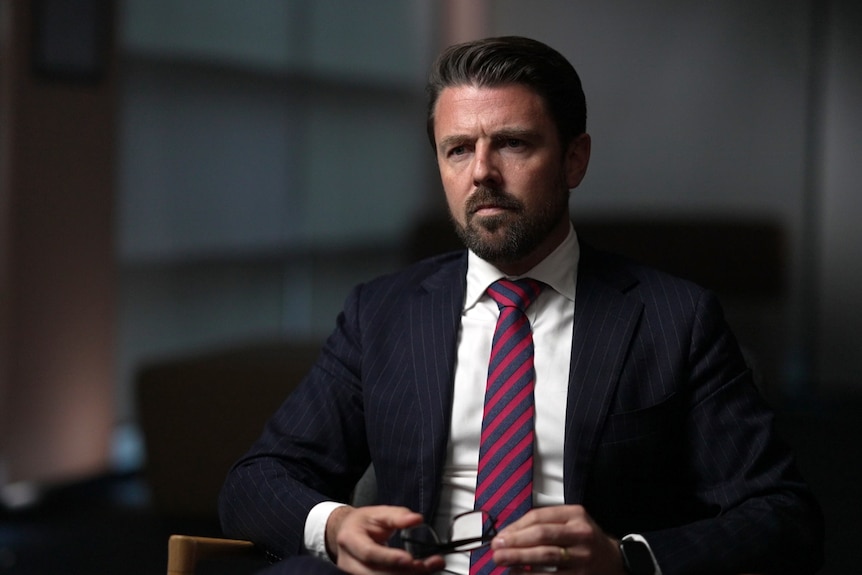
Jonathon Duniam has called on the government to provide more clarity on what has been requested. (Four Corners)
Shadow Home Affairs Minister Jonathan Duniam called on the government to provide clarity on any requests for assistance, whether formal or otherwise.
“What’s happening in the Strait of Hormuz and more broadly in that region is having an impact on our way of life here and indeed the cost of living,” he told Sky News.
“To that end, if requests are being made one way or another … then we should know about it and of course our response to them should be equally transparent.”
No details on future assistance
Late on Friday, the prime minister joined dozens of world leaders for a call to discuss how the Strait of Hormuz would be secured, once the conflict is over.
About 40 leaders attended the summit, which was jointly chaired by the United Kingdom and France, but the United States did not.
Mr Marles said he would not speculate on what Australia’s contribution was likely to be.
“Obviously, we will help. It does not serve for me to speculate about a whole lot of scenarios when we don’t know,” he said.
“But we will be participating in these conversations, along with these other countries, and we will work that through.”