
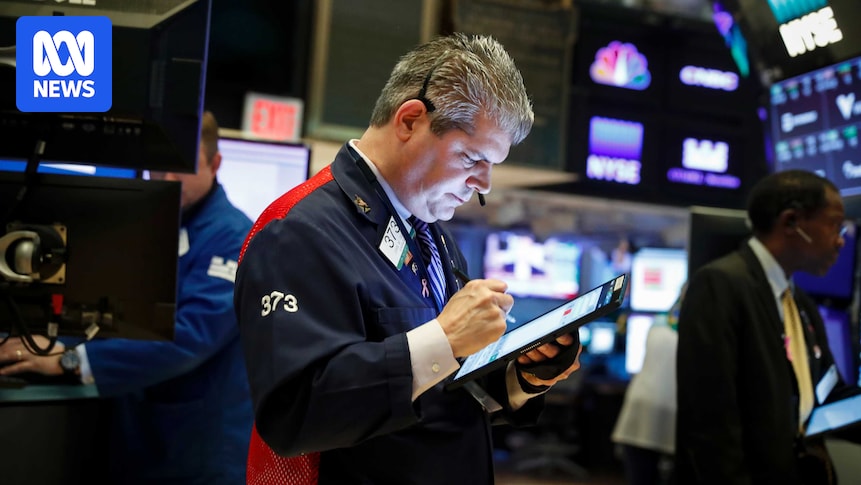
Risk was back in town in a big way on Friday’s global markets as hopes of US-Iran peace deal saw traders bid up just about everything — except oil, which was dumped.
The benchmark S&P 500 and Nasdaq indices hit record highs, while the Dow finished not far off one to close at its highest point since late February.
The small cap Russell 2000, which is more sensitive to interest rates, outperformed the lot and closed at a record.
S&P 500: +1.2%Dow: +1.8%Nasdaq: +1.3%Russell 2000: +2.1%
While the course of the war has raised and dashed hopes on global markets numerous times over the past seven weeks, the buying this time around was sparked by US President Donald Trump saying he expected to reach a deal to end the war soon and Iranian Foreign Minister Abbas Araqchi tweeting that passage for all commercial vessels through the Strait of Hormuz was completely open for the remainder of the 10-day truce brokered by the US between Israel and Lebanon.
European stocks continued to rally, marking their fourth consecutive week of gains, with the pan-European Stoxx 600 index picking up 1.6% to close at levels not seen since the beginning of the conflict.
At the time, on Saturday morning, ASX 200 futures pointed to a 0.9% gain on opening.
Over the week, US shares rose 4.5%. Japan (+2.7%), Europe (+2.1%) and China (+2.0%) also saw solid gains, while Australia was a laggard, down 0.2%.
Oil crashes (again)
The cooling of tensions on Friday saw oil prices tumble.
Brent futures -9.1% to $US90.38/barrelWTI futures -11.3% to $US83.85/barrel
But a cooling of tensions and comforting headlines can only last so long in this conflict.
After the markets closed and a few ships had steamed through the Strait, the Islamic Revolutionary Guard Corps announced it was re-closing the vital waterway as long as the US naval blockade remained in place, reportedly firing on at least two tankers in the process.
Trump responded that the US would not be blackmailed and said the naval blockade would stay in place until a comprehensive, long-term deal was reached.
Soon enough, the US Navy flexed its muscle, seizing an Iranian cargo ship attempting to run the blockade set up outside the strait.
IG market analyst Tony Sycamore said despite the re-escalation, the market reaction may be relatively contained.
Oil futures are likely to rise, and equities may be under a bit of pressure. The continually traded cryptocurrency Bitcoin fell 2.5% on Sunday and is down again this morning.
“These modest moves, reflect a growing sense of Middle East headline fatigue and a broader market view that the deadline will likely just be pushed back yet again,” Mr Sycamore said.
Aussie dollar climbing
US Treasury yields slipped as optimism that the war might be nearing an end eased concerns about renewed inflation and raised hopes about a rate cut.
The oil price drop was “driving the whole move,” according to the managing director of global rates trading at Mischler Financial Group, Tom di Galoma.
“Do we actually get a prolonged ceasefire and a strait reopening? I don’t know,” Mr di Galoma told Reuters.
“This seems like it’s going to take some time to work itself out. But right now, I think that’s what’s going on … It’s all the good news coming out of the gulf,” he said.
On currency markets, the Aussie dollar pushed higher against the Greenback (its third consecutive week of gains), at one stage breaking through 72 US cents before easing back.
“Friday’s retreat from the 0.7221 high came as traders squared up following an impressive 5.7% rally from the late-March low of 0.6831 [US cents],” Mr Sycamore said.
“The retreat is in line with the view the Aussie appears a little overbought and after some consolidation which may see the AUD/USD fall back towards support at .7050ish we then expect the Aussie to resume its rally towards the next stop at 0.7400 [US cents].”
However, the risk-off sentiment this morning has seen the Aussie retreat against the supposed safe-haven of the US dollar.
On metals markets, gold made a modest gain while aluminium fell as the re-opening of the Strait improves the prospects of gulf exports, which account for around 9% of global supply may resume.
Copper was flat and iron ore eased down on Friday.