
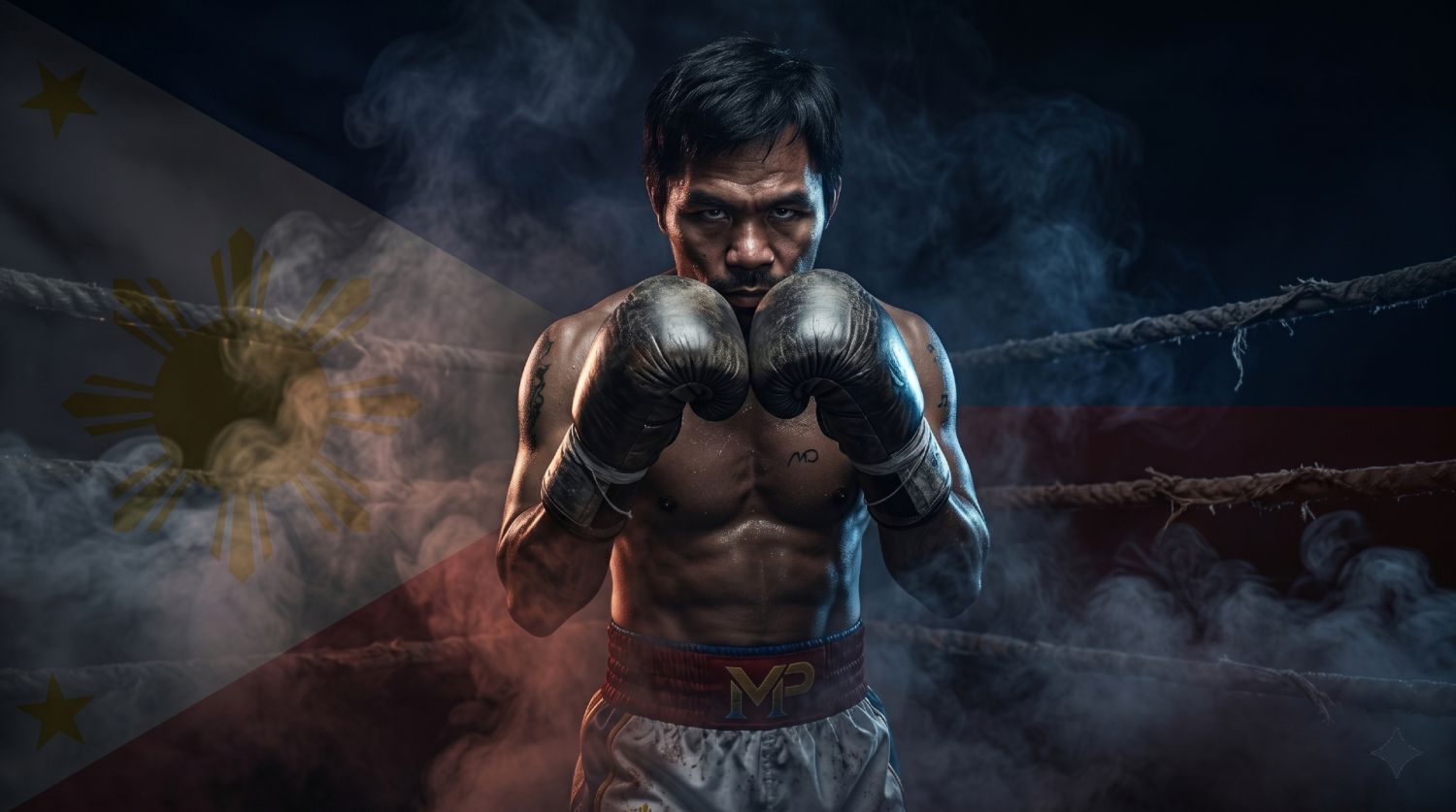
By Charles R. Saunders
(Updated 2026 by Darril Fosty)
Note by Darril Fosty: I was reading old writing from Charles, which he sent to me when we were working on Boxscore World Sportswire together. I looked this over, recognizing how timeless his analysis truly is, and decided to update it. What follows is his definitive 2009 ‘Four Kings’ comparison, preserved in full, followed by a fresh look at how that prime Pac-Man would have fared against the elite fighters of today’s landscape.
The Pac-Man “Rookie” Conundrum
When profiling Pacquiao through the lens of the hobby, pinning down his definitive “rookie” is a complex discussion. His absolute earliest printed appearance is the ultra-rare 1999 World Boxing Magazine hand-cut card (#143) issued in Japan. Because it was hand-cut from a magazine, finding one with clean edges is a massive challenge, and a pristine PSA 10 copy reached over $22,000 at the market’s peak.
However, for mainstream North American set collectors, the de facto rookie is the 2011 Topps Allen & Ginter #262. As his first widely distributed US pack-pulled card, finding well-centered, gem-mint examples of the base card—or hunting down the coveted mini variants—remains a major pursuit for boxing enthusiasts.
Even in 2026, with a new generation of pound-for-pound kings ruling the welterweight and middleweight divisions, Manny “Pac-Man” Pacquiao’s 2009 demolition of Miguel Cotto still feels like yesterday’s lightning. Cotto hit the canvas twice early, then simply collapsed under Pacquiao’s nonstop blitz until the referee stepped in during the twelfth round. That night Pacquiao claimed a title in a record seventh weight class, locked down his second straight Fighter of the Year honors, and cemented his place as the most electrifying fighter of his time.
Looking back from today’s rings, where switch-hitters, body-punchers, and defensive wizards have taken center stage, it’s impossible not to wonder how that 2009 Pac-Man—blazing southpaw speed, relentless pressure, and a chin forged in fire—would have stacked up against the legends who came before him. George Kimball’s book Four Kings remains the definitive chronicle of the 1980s welterweight-to-middleweight wars waged by Sugar Ray Leonard, Thomas Hearns, Roberto Duran, and Marvelous Marvin Hagler. Their rivalries produced a golden age that only the heavyweight epics could overshadow.
Pacquiao started as a 16-year-old light-flyweight. By 2009 he had grown into a legitimate, ripped 147-pounder who carried his extra forty pounds like armor rather than baggage. Here is the same speculation Saunders offered in 2009—preserved in full—followed by a fresh look at how that prime Pac-Man would have fared against the elite fighters dominating today’s landscape.
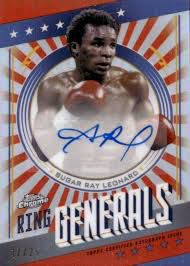
PACQUIAO–LEONARD
If Pacquiao could channel Duran’s performance against Leonard during Leonard-Duran I, and Leonard was determined to fight Pacquiao’s type of battle rather than his own, then the Pac-Man would prevail by a close, hard-fought decision. But Leonard came into Duran I, stubbornly determined to beat Roberto at his own game because a disrespectful Duran got under his skin before the fight. Unlike the way Duran was then, Pacquiao is a nice guy outside the ring. Leonard would be unlikely to come into the ring with a chip on his shoulder, and he would use his size and speed to keep Pacquiao at a distance. But if Sugar Ray allowed himself to be lured into rat-a-tat-tat exchanges, he could find himself on the short end of the combinations—beaten at his own game. The matchup between Leonard and Pacquiao’s trainers—Angelo Dundee and Freddie Roach, respectively—would be almost as fascinating as the fight.
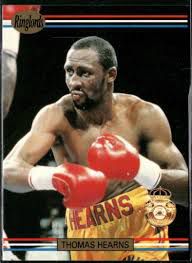
PACQUIAO–HEARNS
Hearns was two fighters in one: the consummate boxer who outpointed defensive wizard Benitez, and the power-punching “Hitman” who crushed Duran in two one-sided rounds. Pacquiao would have his hands full with either version. A boxing Hearns would have kept his long left jab in Pacquiao’s face all night. A slugging Hearns would put a lot of hurt on Pacquiao as the Filipino warrior struggled to force his way to close quarters. It’s no disparagement at all to say that Pacquiao would have stood only a small chance to beat Hearns, whose physical attributes made him the proverbial “bridge too far” for his brave but outmatched foe.
PACQUIAO–DURAN
If the Pacquiao who beat Cotto fought the Duran who beat Leonard in their first fight, it would have been a case of the irresistible force meeting… the irresistible force. Pacquiao would have been faster; Duran stronger. If Duran’s chin held up, he might have been able to break Pac-Man down in a manner similar to what Antonio Margarito did to Cotto. There would not have been any question about what Duran had in his gloves—he had “Hands of Stone.” Duran was at his best in Leonard I and would probably have been just a bit too much for Pacquiao. But Pacquiao beats the Duran who said “No Mas” in the second Leonard fight, the Duran who was cold-cocked by Hearns’s right hand, and the Duran who was unable to catch up with Benitez.
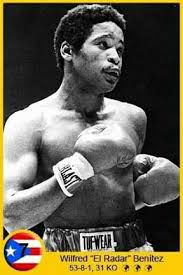
PACQUIAO–BENITEZ
As a defensive fighter, Benitez earned the nickname “Radar” because of his uncanny ability to sense and avoid incoming punches. But the best radar in the world loses its effectiveness when there’s not enough firepower to back it up. That would have been Benitez’s problem against Pacquiao. Sure, the Pac-Man would miss a lot of punches. But, knowing that Benitez couldn’t hurt him, Pacquiao would just keep firing away until some of his incessant bombs eventually got through. He would have beaten Wilfred in a manner similar to Leonard’s victory over the ultra-talented Puerto Rican.
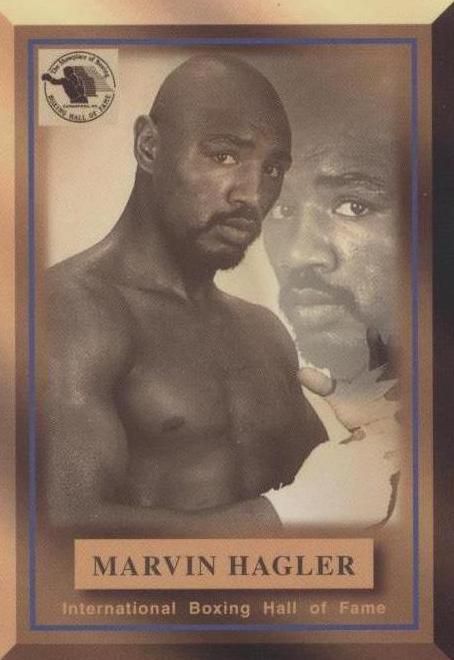
PACQUIAO–HAGLER
Not only was Marvelous Marvin a full-fledged 160-pounder; he was one of the greatest fighters of all time at that weight. Pacquiao has not met anyone remotely close to the size, skill, and power of Hagler. So, Pacquiao-Hagler would be an unconscionable mismatch, right? Not necessarily. There were two ways to beat Hagler. One was to fight him in Philadelphia, where he suffered some tough losses early in his career. The other was to make him hesitate. That was how Vito Antuofermo held Hagler to a draw in their first fight, how Duran almost stole a decision from him, and how Leonard actually did come away with the verdict in their controversial super-fight. If Pac-Man’s rapid-fire flurries could confound Hagler’s “Destruct and Destroy” offense, Manny would have had a chance to pull off an upset similar to Leonard’s. On the other hand, if Hagler were able to march unscathed through Pacquiao’s firepower, it would be a short, painful night for the Filipino—even in Philadelphia.
PAC-MAN AND THE NEW KINGS
Fast-forward to 2026. The welterweight division once again belongs to a handful of extraordinary talents who, like the Four Kings before them, define excellence through contrasting styles. Floyd Mayweather Jr. remains the defensive gold standard. Terence “Bud” Crawford is the undisputed welterweight king, Errol Spence Jr. the massive, pressure-oriented powerhouse, and Canelo Alvarez the modern-day size-and-power outlier. Even at lighter weights, the early-2020s lightweight division produced its own “New Four Kings”—Gervonta Davis, Devin Haney, Teofimo Lopez, and Ryan Garcia—explicitly branded that way by the media in direct homage to the 1980s. Here is how the 2009 Pac-Man might have fared against this current crop.
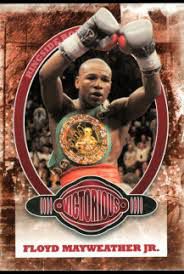
PACQUIAO–MAYWEATHER
Mayweather was the ultimate defensive foil to Pacquiao’s offense, a modern Benitez with Leonard’s ring IQ and Hearns’ precision. A prime 2009 Pacquiao would have come barreling forward with the same southpaw blitz that overwhelmed Cotto. Mayweather, however, would have used the shoulder roll, the check hook, and that uncanny sense of distance to make Pacquiao miss and pay. The fight would have been closer and more violent than the 2015 reality (when both men were past their absolute peaks), but Mayweather’s ability to control range and counter cleanly would likely have earned him a hard-fought decision. Pac-Man would have landed the flashier combinations; Mayweather would have landed the ones that counted.
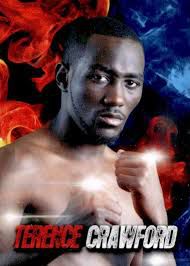
PACQUIAO–CRAWFORD
Crawford is the complete modern technician. He is a switch-hitter and clinical finisher; however, against the 2009 iteration of Pacquiao, Crawford’s notorious tendency to start slow in the early rounds would be his undoing. The 2009 Pac-Man didn’t give opponents time to figure it out. Instead, he would have overwhelmed them with blazing speed, unorthodox angles, and nonstop southpaw pressure from the opening bell. Before Crawford could establish his timing or switch stances to find his rhythm, he would find himself caught in a typhoon of combinations. While Crawford’s superior versatility might allow him to make late-fight adjustments, the sheer volume and ferocity of Pacquiao’s early assault would likely force a referee stoppage or build an insurmountable lead on the scorecards. In a clash of 2020s calculation versus 2000s ferocity, the Filipino dynamo overwhelms the technician.
PACQUIAO–SPENCE
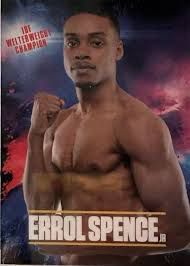
Spence was the massive, fundamentally sound welterweight who actually had a Pacquiao fight on the table in 2021 before an eye injury forced him out. Prime-to-prime, Spence’s size, piston-like jab, and vicious body attack would have posed a different kind of test. Pacquiao’s hand speed would have given him early rounds, but Spence’s pressure and ability to absorb and return fire would have worn the smaller man down the way Margarito once did to Cotto, but with only cleaner technique. Spence’s southpaw-friendly defense would blunt many of Pac-Man’s best shots. A grueling, high-volume war that ends with Spence taking over in the championship rounds.
PACQUIAO–CANELO
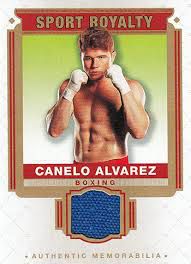
If Hagler was the unconscionable size mismatch in the 1980s, Canelo Alvarez is the modern equivalent. Even fighting at a catchweight, Canelo’s physical strength, counter left hook, and iron chin would have been too much for Pacquiao to overcome. Pac-Man’s blinding speed would have created chaotic early exchanges and maybe even a knockdown or two, but Canelo’s ability to walk through fire, cut off the ring, and punish with body shots would eventually turn the fight into a one-sided beating. The smaller, faster man would have moments of brilliance; the bigger, stronger man would have the final say.
A NOTE ON THE LIGHTWEIGHT NEW FOUR KINGS
The media’s “New Four Kings” tag for Gervonta Davis, Devin Haney, Teofimo Lopez, and Ryan Garcia was no accident. It was a deliberate echo of the 1980s. At 135–140 pounds, they fought at lighter weights than the welterweight Pacquiao of 2009, yet their collective brilliance mirrored the old rivalries. Prime Pacquiao would have been too physically strong and explosive for any of them in a hypothetical cross-division war. He would have overwhelmed Haney’s boxing with sheer volume, out-slugged Garcia’s flash, and matched Lopez’s power with faster hands. Only Tank Davis’s one-punch knockout threat might have kept things interesting but in the end, 2009 Pac-Man would have looked like the bigger, more experienced king stepping down to school the princes.
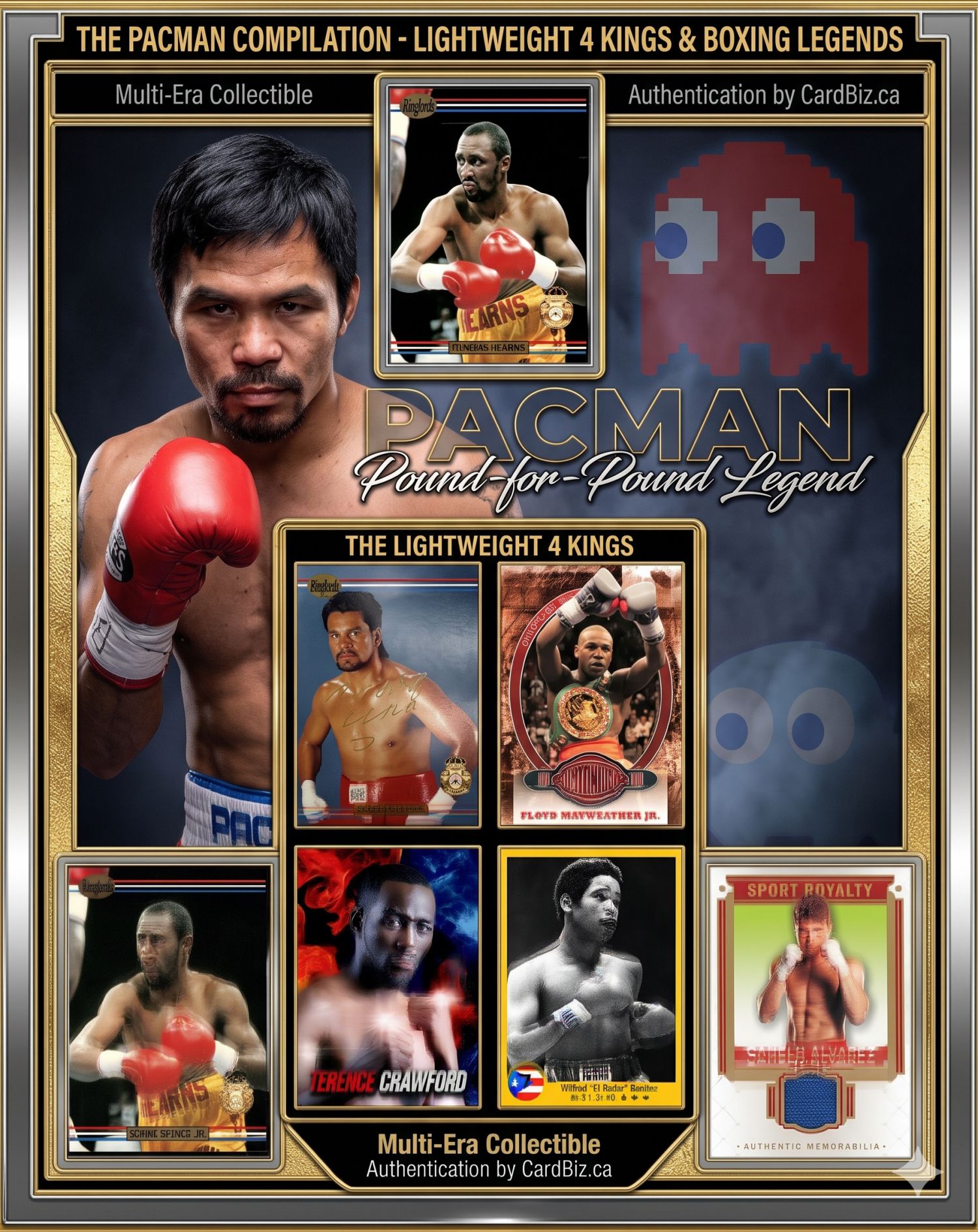
Pacquiao’s 2009 peak remains a high-water mark that still echoes through today’s gyms and arenas. He would have lost some and won some against the old Four Kings—just as he would have against the new ones. But the conversations we’re still having in 2026 prove one thing: the Pac-Man didn’t just belong in those eras. He would have helped define them.
About Charles R. Saunders
Charles R. Saunders was an esteemed author and journalist, widely known for his deep historical knowledge and analytical approach to boxing. He and Darril Fosty shared a profound friendship and collaborated extensively, frequently discussing the intricacies of the sport. His original analysis remains a benchmark for evaluating the timeless nature of boxing’s greatest champions.
About Darril Fosty
Darril Fosty is an author, journalist, and the founder of CardBiz.ca. Having worked closely with Charles Saunders to build Boxscore World Sportswire, Darril continues to champion historical preservation and sports journalism. This updated piece honors their shared history and ongoing dedication to the sweet science.