
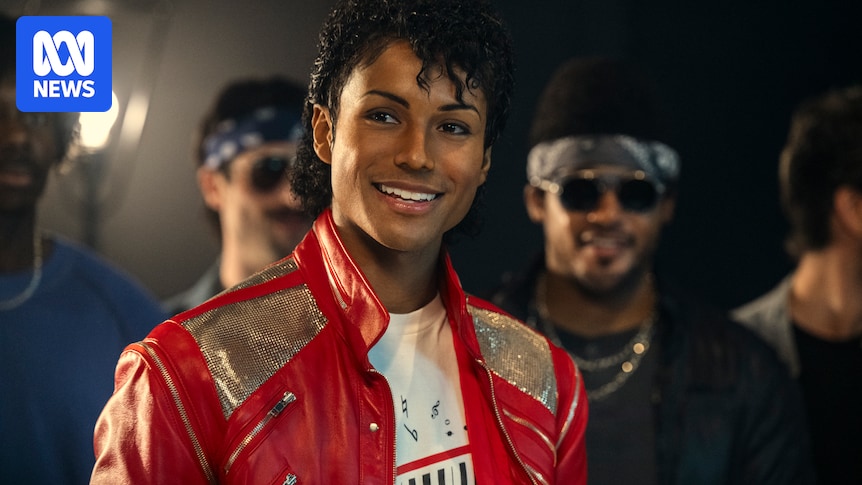
There was — and is — no-one like Michael Jackson.
Nearly 17 years after his death at age 50 in 2009, the pop superstar’s music and art continues to electrify, even as his unprecedented fame, shrouded in rumour and unsettling allegations, confounds and mystifies.
Fast facts about Michael
What: The rise of pop superstar Michael Jackson, from his musical beginnings in the 1960s to the heights of his 1980s fame
Starring: Jaafar Jackson, Colman Domingo, Nia Long, Kendrick Sampson, Miles Teller, Juliano Krue Valdi
Director: Antoine Fuqua
Where: In cinemas April 23
Likely to make you feel: Entertained — and frustrated
He’s been exalted and excoriated, deified and dragged through the mud, and yet — like the shapeshifting trickster of Remember the Time — he remains elusive, a contradiction whose truth, whatever it may be, will likely never be known.
There’s little doubt that the slick, celebratory new biopic Michael — produced under the aegis of the Jackson estate and shepherded by Bohemian Rhapsody impresario Graham King — is a careful exercise in brand management from a robust $US2 billion enterprise.
That it’s been beset by legally mandated reshoots and resistance from both Jackson’s daughter Paris and his superstar sister Janet (who opted out of being portrayed on-screen) only raises more questions over the project’s intent.
But while the media would have you believe the movie is an attempt to rehabilitate a tarnished image, anyone who’s been paying attention knows the resurgent Jackson hardly needs the PR makeover; his monthly Spotify streams alone sit at 68 million, far surpassing any so-called legacy artist.
1982’s irrepressible, world-conquering smash Thriller continues to capture listeners barely conceived when he died. His influence on modern pop, from The Weeknd to BTS, is everywhere.
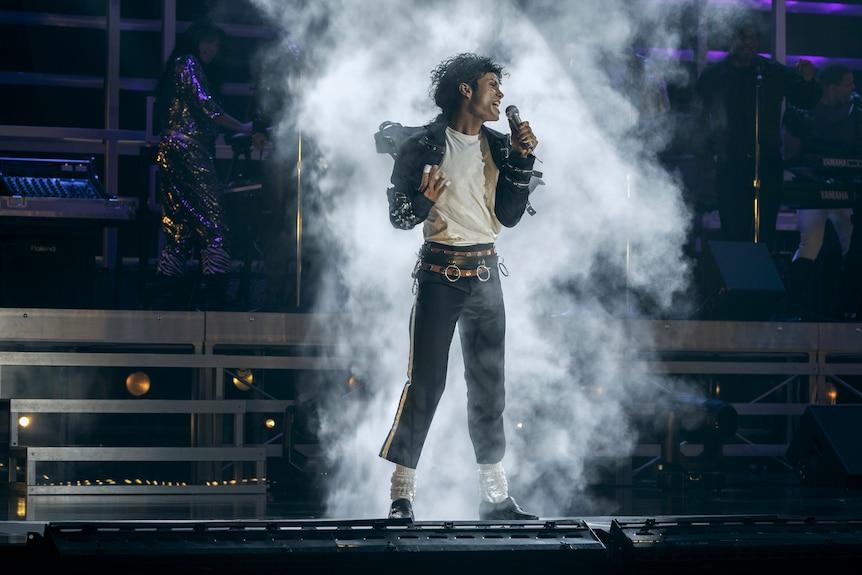
Michael cuts the King of Pop’s story short, ending around the time of his 1988 Bad tour. (Supplied: Universal)
Jackson’s enduring popularity is almost unthinkable in the wake of 2019’s Leaving Neverland, a harrowing if one-sided film in which two men alleged Jackson had abused them as children.
Mainstream media — for whom the star has long been a reliably lucrative freak-show — fell over themselves to endorse it, but the music proved more powerful.
Michael, the movie, can only gesture at such paradox, but it also faces a more significant hurdle: how to effectively dramatise a life lived almost entirely in front of the camera — a life that Jackson, with his media savvy and visual artistry, fashioned into his own, real-time mythology?
Unfolding at a breakneck clip, the movie certainly wastes no time playing the hits.
It picks up in 1966, in a Dickensian-looking Gary, Indiana, with eight-year-old Michael (a dynamite Juliano Krue Valdi) and his brothers literally whipped into musical shape by taskmaster patriarch Joseph (Colman Domingo, valiantly battling a two-dimensional cartoon), all while saintly mother Katherine (Nia Long) looks on.
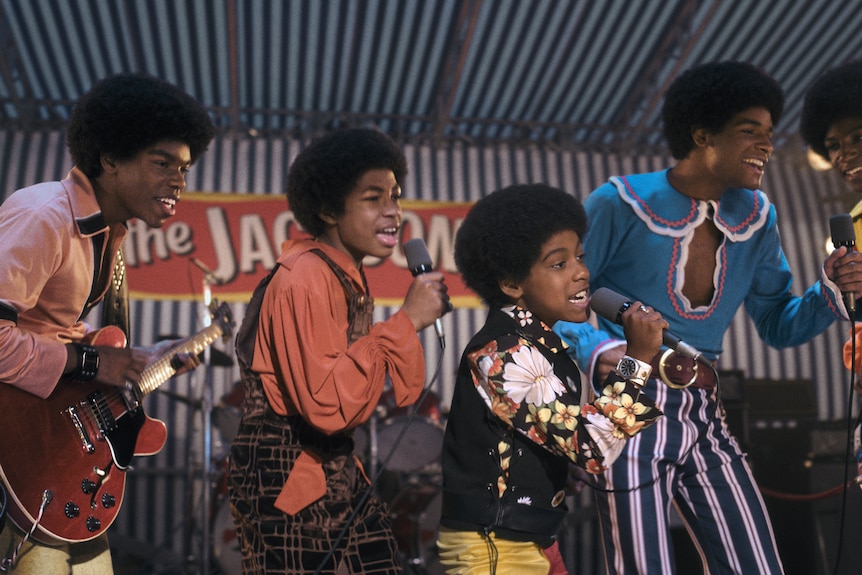
Newcomer Juliano Krue Valdi (centre) features as a young Michael, during his time in the Jackson 5. (Supplied: Universal)
Christened the Jackson 5, the boys dance for pennies on the Chitlin’ Circuit, find Motown stardom with their miraculous early hits, and — faster than one of his signature spins — the emergent solo Michael (played as an adult by Jaafar Jackson) is recording his breakthrough record Off the Wall with Quincy Jones (Kendrick Sampson), welcoming Bubbles the chimp to his burgeoning menagerie at the Encino family home, and plotting world domination with Thriller.
Doing an uncanny impersonation of his uncle, Jaafar Jackson — who shares Michael’s lithe moves and his contagious smile — gives a warm, sometimes soulful performance, at least to the extent that the film permits him to stretch dramatically.
Whenever he’s performing — which is often — the movie finds its transformative charge by keeping the focus on the music, which remains among the wonders of the pop world.
Experiencing the isolated vocals of songs like Who’s Lovin’ You, I Want You Back and Don’t Stop ‘Til You Get Enough is almost worth the ticket price alone.
At the same time, the film struggles to find a dramatic point of view on its subject — let alone anything resembling insight.
Before the reshoots, the muscular action filmmaker Antoine Fuqua (Training Day) had bookended his story with a 1993 police raid on Jackson’s Neverland estate, a bold gambit that engaged directly with the first round of allegations and positioned the film as a reclamation — however controversial — of the star’s legacy.
Trailer for Michael Jackson biopic released a year behind schedule — with a glaring gap
Minus that dramatic sauce, the film plays as a series of polished montages that barely summon a through-line, thanks in part to a screenplay (from Gladiator scribe John Logan) that’s riddled with biopic cliche — and a bizarre self-insert from Jackson’s estate lawyer John Branca, played by Miles Teller, as the unsung hero of the movie.
Fatally, the film leans into a standard daddy-issues drama: Joseph berates and beats Michael, and Michael retreats into a childlike fantasy world of toys and stuffed animals that foreshadows his future home.
It’s not that it isn’t significant — as an adult, Michael would speak of how his father’s presence would cause him to throw up — rather the movie doesn’t know what to do with any of it.
In one starkly fumbled scene, a bandaged Michael returns home from the plastic surgeon — minus the nose for which Joseph had taunted him — and encounters his father in a hallway. It’s a charged moment that goes nowhere.
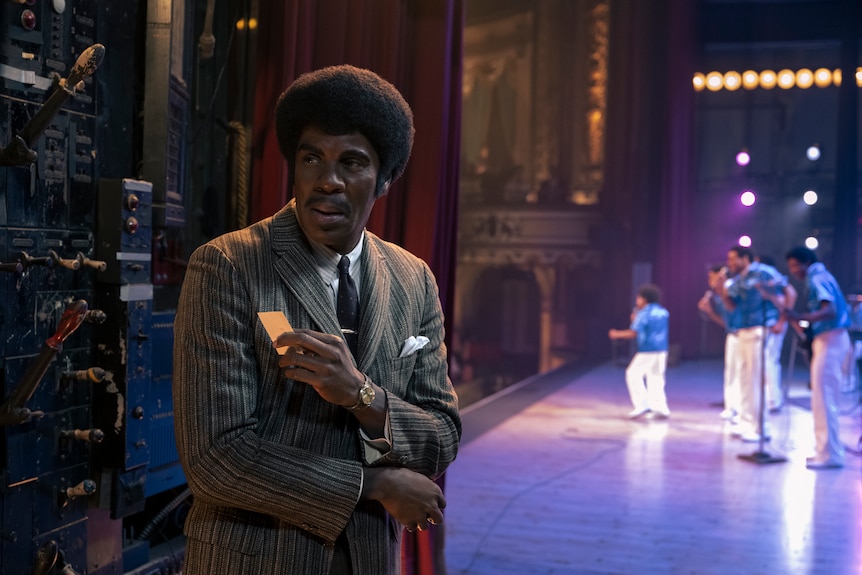
Oscar-nominated actor Colman Domingo steps into the shoes of Joseph Jackson, Michael’s domineering father and manager. (Supplied: Universal)
Similarly, the seamier side of child stardom — the darker intimations of abuse, the adult world to which young Michael was prematurely exposed — are absent.
“I was far too young to grasp the meanings of most of the words in these songs,” Jackson wrote in his 1988 autobiography Moonwalk.
Is it any wonder the pint-sized child-man, thrust into performing lover-man soul as grade-schooler, would pursue an adult life of childlike wonder?
Sure, he composes Beat It after watching a gang report on TV and Thriller while deep in the throes of horror movie fandom, but what psychic demons drove him to the breathtaking ambiguity of Billie Jean, or the exhilarating, multi-faceted exhortations of Wanna Be Startin’ Somethin’?
Jackson’s desire to break music’s racial barrier, meanwhile, is paid perfunctory service; by the time the movie gets to his battle to have his videos played on MTV, it’s relegated to a cameo that’s practically contemptuous in its in-joke winking.
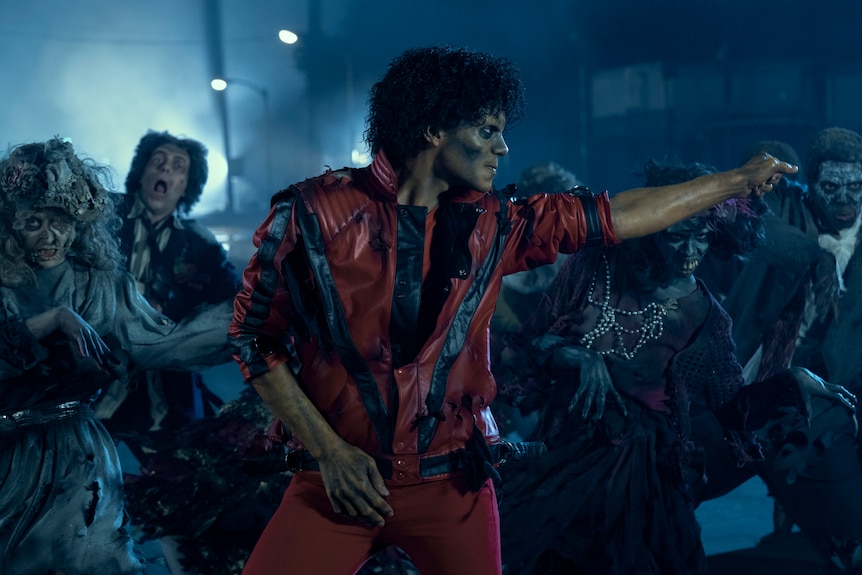
Michael recreates the filming of the Thriller music video, which referenced multiple horror movies. (Supplied: Universal)
“I have to shine my light,” asserts Michael at one point, “spread love and joy, to heal — that’s my destiny”.
But at what cost to himself, and to those around him? What of the increasingly paranoid superstar trapped in fame’s gilded cage, for whom James Baldwin once wrote — at the height of Thriller’s cultural and commercial success — “He will not swiftly be forgiven for having turned so many tables”?
Only occasionally does the movie evoke a sense of Jackson’s immense loneliness, an isolation that led him to create the fantasy world that would be his undoing.
Ironically, it’s the film’s abrupt closing sequence that finally teases something vital.
Intended as a victory lap for the emancipated solo star, the recreation of Jackson’s 1988 Bad performance bristles with defiance and rising aggression.
Michael leaves us with an unreadable image of its subject, his eyes hidden behind an outstretched hand, his mouth locked in a hardened grimace, as though readying himself for a turbulent future to come.
Perhaps it’s just as Jackson himself would have wanted — to remain a mystery.
Michael is in cinemas now.