
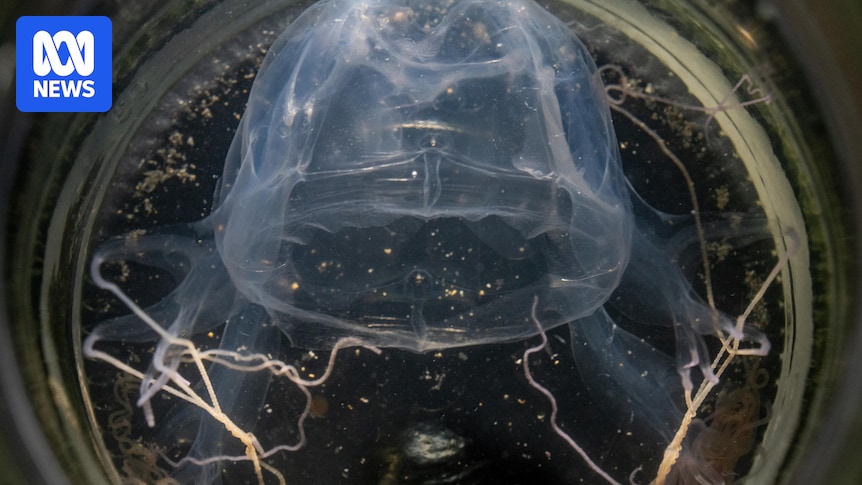
Dozens of box jellyfish have been spotted off Western Australia’s Pilbara coast, thrilling scientists in their quest to name and classify a rare local variety.
The box jellyfish label describes multiple species of the invertebrate, grouped together for their rounded, cube-shaped bodies and lengthy venomous tentacles.
They include the Australian box jelly, or chironex fleckeri, a creature that is native to northern waters and one of the most poisonous on the planet.
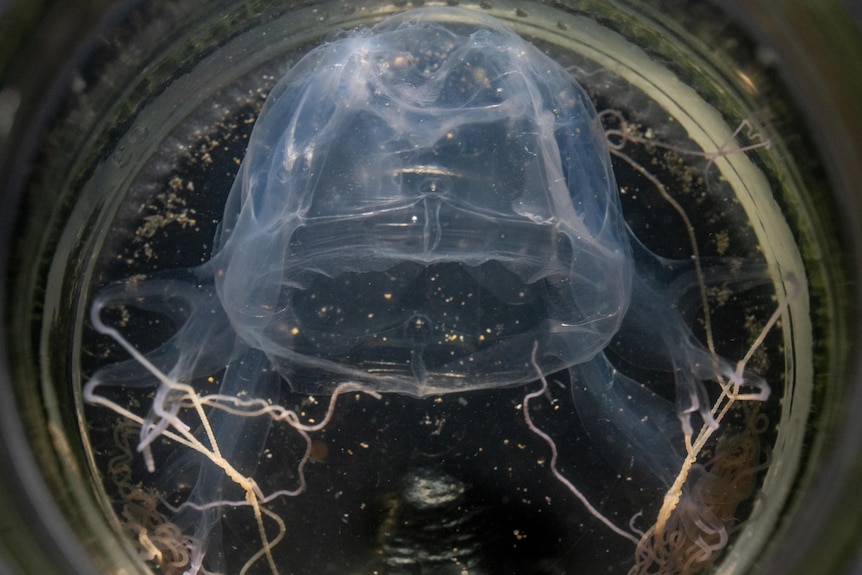
The WA box jellyfish is thought to be a close, but distinct relative of the world’s most venomous sea creature. (Supplied: Brett Lobwein)
This reputation sprang to mind as Dampier port worker Ben Walkington watched almost 100 ghostly shapes congregate beside the jetty he was on, 1,530 kilometres north of Perth.
“It’s not ideal,” he said.
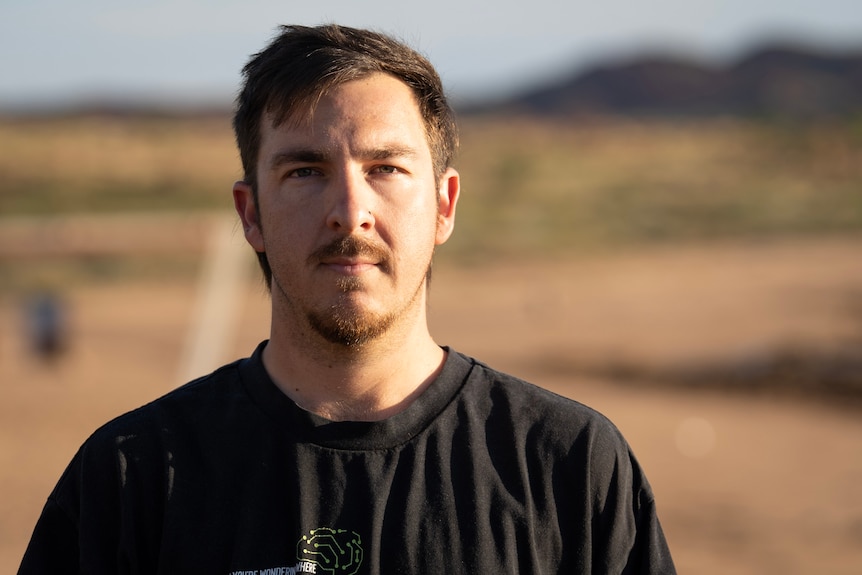
Ben Walkington filmed the swarm from the Parker Point iron ore loading terminal. (ABC Pilbara: Alistair Bates)
He said he had never seen one in the harbour before.
“I’ve seen (box jellyfish) growing up, but it’s the first time in a long time I’ve seen them.”
‘Probably new to science’
The reaction of marine biologist Lisa-ann Gershwin was far more enthusiastic.
“This one we’ve thought for a while is probably new to science,” she said.
“It’s not yet named and classified, but this is the one that I’ve been trying to find.”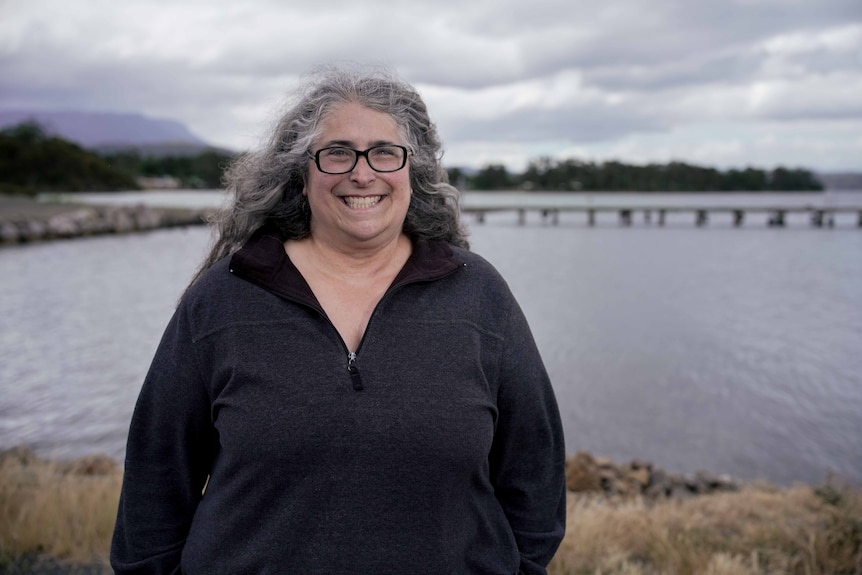
Lisa-ann Gershwin is one of Australia’s leading jellyfish taxonomists. (ABC News: Ebony ten Broeke)
Dr Gershwin said the animal was likely different from the box jellyfish found in the Northern Territory and Queensland, which have caused the deaths of about 80 people since records began.
“We generally consider the WA box jelly to not be, and I’m putting that in arm-waving quotes there, probably not be as dangerous,” she said.
“I wouldn’t trust it, so don’t go and give it a cuddle.”
Loading…
The only other time Dr Gershwin could recall such a “swarm” in WA was more than a decade ago, during an offshore survey in the Kimberley region.
Leading that expedition was CSIRO senior principal research scientist John Keesing.
“They do occur as far south as Exmouth, but to get reports of large numbers of them is unusual,” Dr Keesing told the ABC.
“We’d be very interested to see whether this population persists around Dampier for some time.”
Classification gap a ‘public health issue’
Dr Keesing said it was “quite an endeavour” to scientifically distinguish one jellyfish from another, involving the collection of several specimens and DNA samples.
The challenges were compounded by a dwindling number of researchers with the knowledge and means to embark on the work.
“In Australia, we have a declining number of marine taxonomists,” he said.
“So the pool of people who have the expertise to describe a new taxonomy of all sorts of animals in the marine environment is quite limited.”
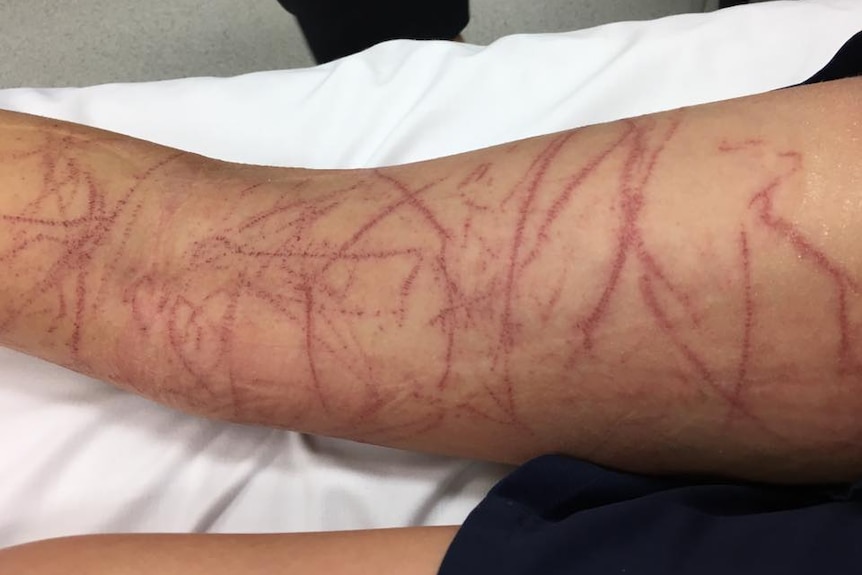
John Keesing said learning more about WA’s box jellyfish could help the public better understand the risks. (Supplied: Belinda Rule)
But the effort, he argued, was still worthwhile.
“It’s a public health issue for sure when it comes to jellyfish.
“More generally, if we don’t have the capacity … to describe new species, then we don’t fully understand our biodiversity.
“There are lots of reasons, economic and social, why we would need to be able to do that.”