
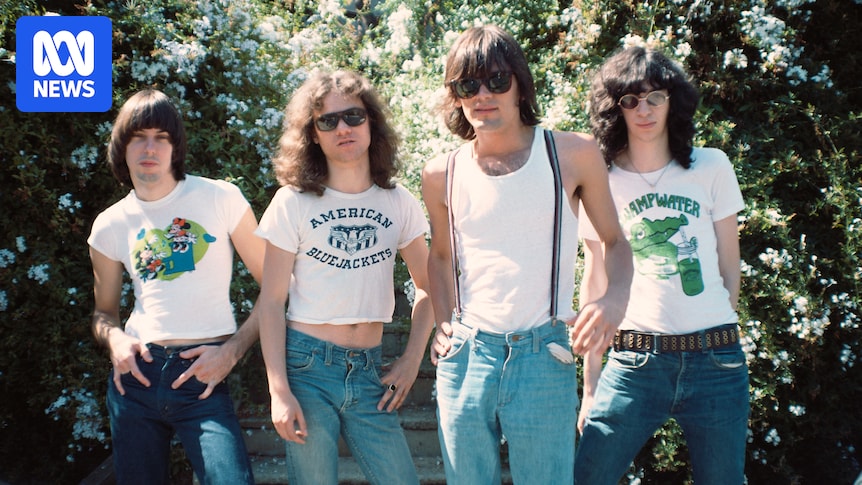
Hey! Ho! Let’s go!
Is there a more powerful clarion call in rock’n’roll?
That catchy, four-word refrain opens Blitzkrieg Bop, the first song on Ramones’s eponymous debut album, released 50 years ago today.
Hear all about the first Ramones album
The phrase is now arguably bigger than the band.
It’s a rallying cry at sporting events around the world, features in ads flogging pharmaceuticals, video cameras and soft drinks. Along with Ramones’s iconic logo, the phrase has adorned countless T-shirts worn by people well beyond punk’s original audience.
Most importantly, it has been an on-ramp to the punk counterculture for 50 years.
This galvanising opening chant introduces us to 29 minutes of sticky pop hooks and loud, distorted punk played at breakneck speed by four young men with floppy hair and leather jackets. Half an hour of noise that changed music forever.
Recorded fast, but built to last
By the time they entered the studio in early 1976, the Ramones had already developed a keen following thanks to their incendiary live shows. Capturing that magic on tape, however, would be another challenge.
“A lot of people were interested because they were making a buzz in the newspapers and drawing crowds in New York,” the album’s producer Craig Leon recalled in Steven Blush’s 2016 book New York Rock.
“But at the time, they were seen as ‘Oh, they can’t play’. People were afraid to sign them because they thought they could never make a record.”
That was kind of the point.
Loading Instagram content
Turn on rock radio in 1976 and you’d have heard songs from Peter Frampton, Boston, Eagles, Led Zeppelin, and Queen. They were great musicians, but their work didn’t speak to the Ramones.
“Things had gotten so far away from everything that was happening in the mid ’60s when we’d all fallen in love with music,” drummer and co-producer Tommy Ramone told Mojo Magazine in 2011.
“We were going to revive the pop song mentality.”
Even if they’d wanted to compete on those other bands’ terms, the Ramones couldn’t. That limitation became a strength.
“Johnny said, ‘I’d have to sit in my bedroom the rest of my life to sound like Jimmy Page and Jeff Beck,'” Linda Ramone, guitarist Johnny Ramone’s wife, told Double J in 2016.
“So, he decided he wasn’t gonna do that, picked up a guitar, got his own style and sound and influenced so many kids to go start bands and be a guitar player.”
It wasn’t just technical proficiency that rankled the emerging punks. To them, the very spirit of rock’n’roll went stale when bands became more self-indulgent.
“It was becoming a hodgepodge of a mess of things and what the Ramones did was sort of take it apart and reassemble it,” Joey Ramone told Steve Harris in 1988.
“We put the fun and excitement back in and the spirit and the emotion and the raw energy, raw emotion.”
In an era rife with rock star excess, Ramones’s debut was cut in just a few days, at a reported cost of USD $6,400.
“Some albums were costing a half-million dollars to make and taking two or three years to record, like Fleetwood Mac and stuff,” Joey Ramone said in Legs McNeil and Gillian McCain’s 1996 book Please Kill Me.
“Doing an album in a week and bringing it in for sixty-four hundred dollars was unheard of, especially since it was an album that really changed the world. It kicked off punk and rock and started the whole thing — as well as us.”
Bubblegum with a buzzsaw
Their 14-song, 29-minute debut served as both a loving tribute to the classic pop of the ’60s and a middle finger to the music of the day.
With a handful of rudimentary chords lathered in fuzzy distortion, and hooks that would make Brian Wilson proud, Ramones were doing their bit to resurrect the pop music they loved.
The doe-eyed I Wanna Be Your Boyfriend, the lovesick Listen to My Heart, and a stomping version of Chris Montez’s 1962 Let’s Dance were proof.
“They loved the Bay City Rollers,” longtime manager Danny Fields told the New York Times in 2016. “Dee Dee’s favourite band was ABBA. They were trying to be ABBA.”
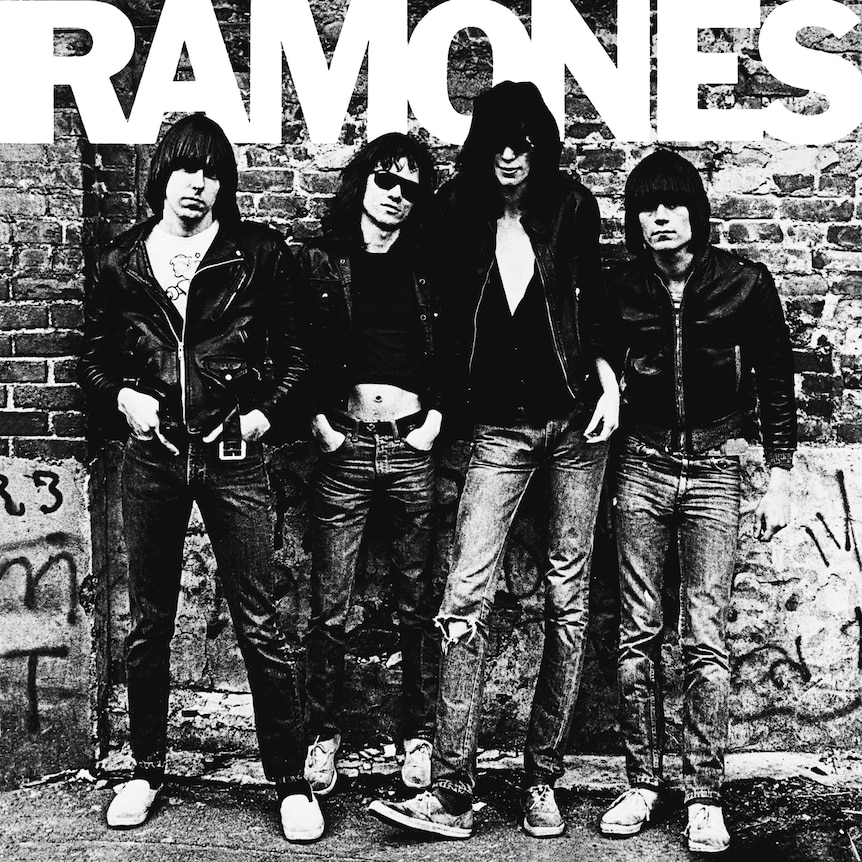
Punk Magazine’s Roberta Bayley shot the iconic photo of Ramones that adorned the front cover of the band’s debut album. (Supplied: Warner Music)
Their technical simplicity led some to consider Ramones asinine. But critics like Lester Bangs recognised that this was more than naivety. Ramones were tapping into one of the moods of the moment. They were classic outsiders.
“Ramones were playing with the concept of being dumb, but not dumb, and being all-American, but yet alien mutant — feeling different, an outsider yet yearning for that all-American cars, girls, surfing and all that when you can’t even drive,” he told the ABC’s Sue Matthews in 1980.
It wasn’t all girls and dancing and sunshine. Ramones countered the sunnier themes with grimmer songs that at times reflected the reality of New York City in the ’70s.
“It was the aftermath of the ’60s, a deep recession, where everyone had $60 apartments and lived on food stamps,” CBGB owner Hilly Kristal told Glide Magazine in 2005. “That’s why everyone wore cheap jeans and T-shirts.”
What’s most important about the Ramones’s legacy?
These hardships were best captured in 53rd & 3rd, which alludes to Dee Dee Ramone’s experience as a drug-addicted teenage sex worker on those streets.
Another Dee Dee song, Today Your Love, Tomorrow The World, caused a stir for other reasons.
“I’m a Nazi, schatzi, I fight for the fatherland,” Joey Ramone sings in the song’s verses, which had already been altered at the insistence of label boss Seymour Stein.
Having grown up in post-war Germany, Dee Dee was no stranger to Nazi associations since he’d come back to the States.
Then there were songs like Beat On The Brat and Now I Wanna Sniff Some Glue, whose titles alone were enough to cause a stir.
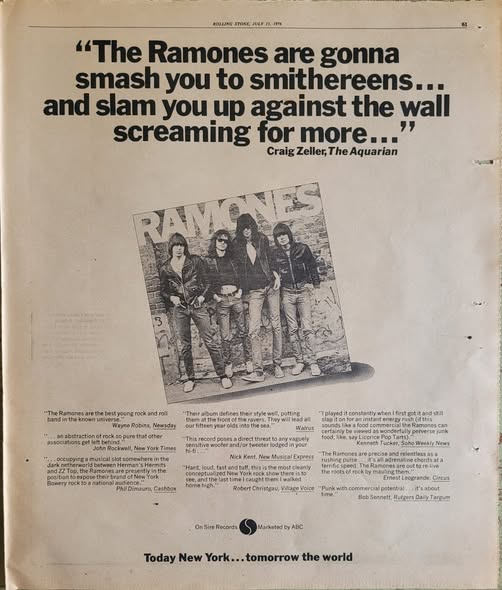
A vaguely threatening advertisement for the debut Ramones album ran in all the rock magazines of the time. (Facebook: Craig Leon)
In many ways, Ramones were a study in contrasts, mixing the highbrow with the low, the silly and the serious, the sweet with the aggressive.
“That record was really the sum of all our tastes,” drummer Tommy Ramone told Mojo Magazine in 2011.
“We liked eccentric music, we liked pop music, we liked very heavy music. We were into so many different things and we kind of combined them all. The combination of all those elements, that sort of became our aesthetic, I suppose.”
The album sounds extraordinary when you consider the band’s limited technical aptitude.
“When you asked them what key they’re in or could you tune that up a little bit, they just weren’t interested,” engineer Rob Freeman told the New York Times in 2016.
“If you asked them to play it up an octave, they would just play it exactly the same way.”
Having a producer as ambitious as Craig Leon was key.
“I’m glad it sounded raw at first listen, but it was calculated to be that way,” Leon said.
“We used the best equipment we possibly could. Every kind of mike we used on the Ramones, I later used at Abbey Road on the London Symphony Orchestra.”
The record that sold nothing and changed everything
While their songs were loud, fast and brazen, Ramones’s music wasn’t meant to be repellent.
“They were hoping to have an album that would sell 6 million copies so they could retire for life,” Fields told the New York Times.

Magdalena Leifsdottir wears a Ramones shirt for New York Fashion Week in 2017. (Getty: Melodie Jeng)
It sold 6,000 copies rather than 6 million upon its release, peaking at number 111 on the Billboard album charts.
Sales would come — the album eventually went Gold in the US in 2014 — but record sales wasn’t the band’s great achievement. The real triumph of Ramones’s first album was the broad impact it had on the future of rock’n’roll.
Much like debuts from The Velvet Underground & Nico or The Stooges in the late 1960s, the first Ramones album had an outsized impact on who made music and how they did it.
Through them, making music became a feasible path for anyone with enough passion and energy.
“You could practice the rest of your life and not be as good as half of [the other bands of the time], but that wasn’t what it was all about,” Linda Ramone said.
“It was about being an individual and doing what you think sounds cool to you.”
And while some of the bigger rock bands of the time now sound hilariously dated and overblown, age has been far kinder to Ramones’s music.
“Ramones are cool, their image is so cool,” Linda Ramone said.
“Young kids love wearing Ramones shirts and listening to the music. Their image and everything about them is cool, so there’s never any, ‘Oh my parents listen to that, that’s not cool.’ They don’t have that.”
While the Ramones had a look and an attitude that aligned with the mood of the moment, it wouldn’t have worked, nor endured, if the songs weren’t so brilliant.
“Seymour Stein will say he signed the Ramones because they had great songs,” Linda said.
“It’s good to have a great look, which they did, but you have to have good songs. That’s what made the Ramones great.”
In a guest essay published on the American Library of Congress website, coinciding with Ramones’s debut album being added to the National Recording Registry, music writer Martin Popoff argued that Ramones’s debut was the purest of the early punk albums.
“It’s easy to look back and ascertain that many of the punk tropes all in one place are best experienced through an aggregate of UK bands such as The Damned, The Clash and the Sex Pistols.
“But a purer punk sound — leaving aside the long hair, the matching uniforms and the blue jeans — there never would be, than what occurs right here.”
Learn more about Ramones’s debut album on Double J’s Classic Albums with Caz Tran. Hear it now on ABC listen.