
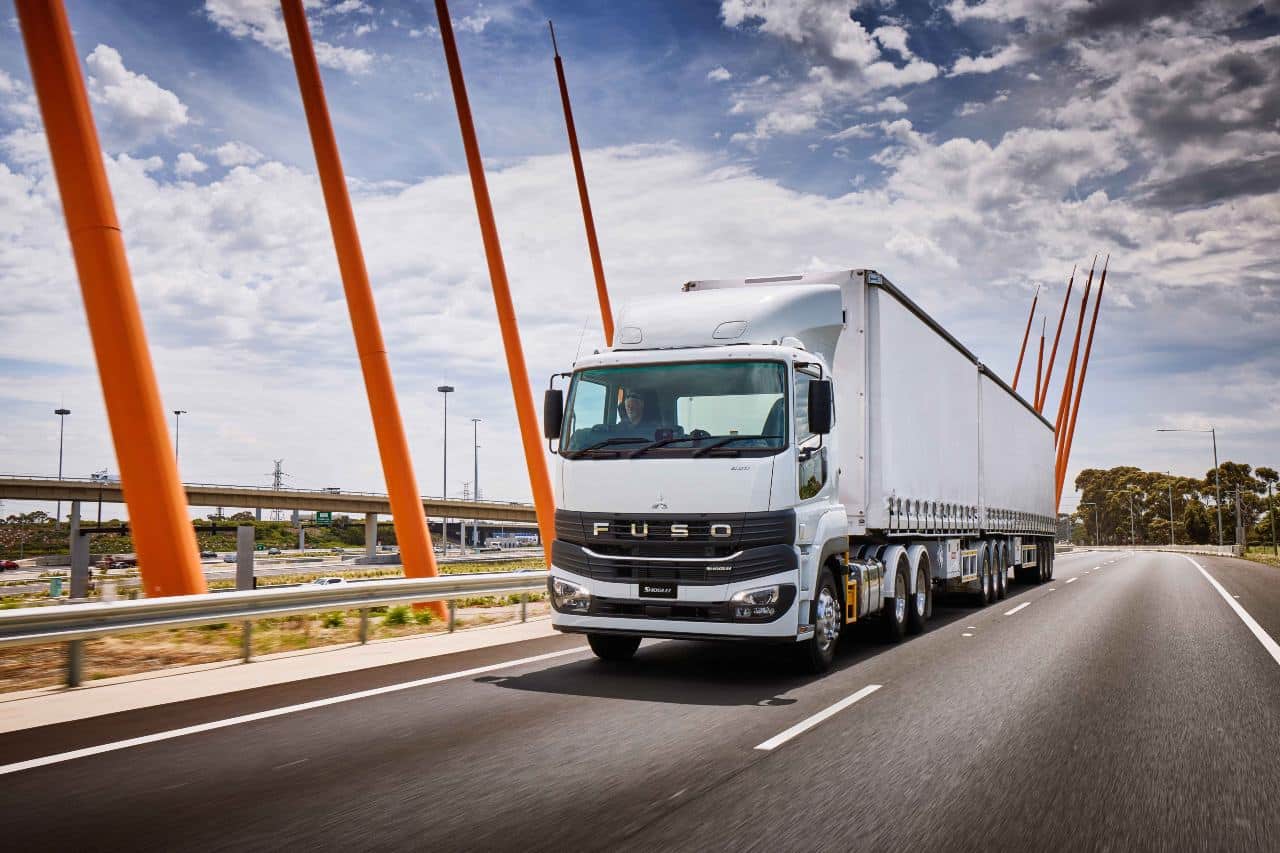
Hauling B-doubles around town, or further, now won’t be a problem. Images: Daimler Truck
Back in 2019 I was invited to test drive the prototype of a brand-new Fuso – so new that it still had the codename, ‘Panther’.
The truck was unveiled at the Brisbane Truck Show a couple of months later and turned out to be the all-new Shogun.
Re-reading the article I wrote at the time I enthused to the point of virtually dribbling over the new truck, from its quietness – I didn’t realise the engine had started when I turned the key – to its interior appointments and safety features. That truck came with a 455hp donk with 2200Nm on tap from 900rpm.
Move forward and the next generation saw the introduction of a 510hp version in the same body, making it the most powerful Japanese truck you could buy.
Now the company has kept that country’s opposition at bay by upping the ante to 530 prancing horses, coupled with 2600Nm. This in a new (and in some respects not so new) cab.
The cabin is in fact the same shell as that of the original, but the front is changed from the midriff down with the addition of a new, full width black grill with the Fuso name incorporated into it, instead of above.
Just above sits the three-diamond logo and to the top left, ‘530’ proclaiming the extra power. There’s plenty of real estate here to incorporate your company’s logo/name. LED headlights are now standard as are the LED taillights.
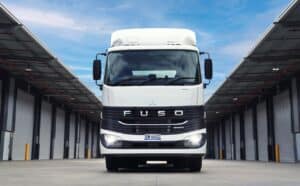 LED headlights are now standard.
There are also innocuous black bumps on the rear of the wheel arches which house the Active Sideguard Assist radar, previously only on the nearside of the truck. Overall it looks completely different and has removed what was to my mind a vague resemblance to the M-B Actros.
Inside, the truck is little changed from past versions with the same dash layout incorporating a new and updated multi-media unit. There are new trim panels and the new Isri seat – leather and heated on the 530 models, instead of fabric.
The stalks on the steering column are straight from its Mercedes cousin, but Fuso have turned them through 180 degrees so that the indicator is on the RHS. This means that you move the Jacobs Brake forward rather than back to activate its three stages.
Between the seats is a large hump – think KW 100s – but this engine cowl makes the most use of its presence by incorporating a cup holder and various storage compartments, one of which is lockable. And unlike those old KWs, there is no gearstick to contort yourself around and so climbing into the bunk is quite easy.
Thoughtfully, Fuso has incorporated not only a curtain track on the rear window but another in the roof lining on the front edge of the bunk as all the way along the sides, so you could easily block out light for undisturbed sleeping.
On the bunk itself; this is not meant to be a home-away-from-home affair but is more than adequate for overnighters – on a comfortable mattress – should your logbook max out, or you’re sent away on a longer trip.
The big change inside is the replacement of the old dual parking brakes with an electronic one that releases both cabin and trailer brakes. Whilst these changes are mild, this cabin has always been a nice place in which to spend one’s day, so there’s no need to reinvent the wheel just for the sake of it.
The biggest news is of course under the cab where now sits the twin turbo, 12.8 litre with those 530 horses and an increase in torque to 2600Nm.
Those horses are all galloping in sync at 1600rpm with 2000Nm available from just 600 revs through to full torque at 1100rpm and hanging around long enough for the power to do its job.
The result is a perfect blend throughout the rev range and it shows in the (laden) truck’s spirited performance out on the highway. The other result of this increase is an increase from 63-70 tonnes GCM so hauling B-doubles around town, intrastate or even interstate won’t be a problem.
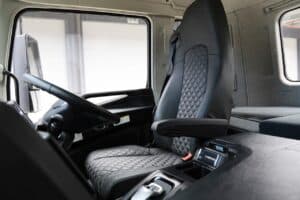 The plush leather ISRI seats are as good as it gets.
On the road the Shogun rides and steers as surely as its Mercedes-Benz cousins. If you don’t know what I mean by that, you’ve never driven an Actros and your life is not complete. It is simply a pleasure to drive with its 12-speed gearbox giving lightening changes and the Active Cruise Control doing its thing.
The front suspension is Long Taper Leaf with double acting shock absorbers and soaks up the worst our roads can throw at it. It’s not air, but it is close. Aim the truck and it simply goes there.
Jiggling of the steering wheel not required. Believe me, there are still trucks out there that require constant input of the steering wheel. The rear is two-bag air suspension and does all asked of it.
I get to drive the Shogun over a variety of roads and road surfaces which change as quickly and often as Melbourne’s weather on an autumn day. Good, indifferent and all too often shocking, the truck handles them all without complaint.
The fuel tank is 400 litres which reflects the uses for which this truck is intended such as short haul work. Travel interstate and you’ll have to refill, depending where you’re heading.
That said, these Mercedes-derived engines are renowned for their frugality so you’ll go further than you might expect.
Five radars and a camera, with up to five of the latter available as an option should ensure you don’t get into trouble no matter the situation. The Daimler group was the first to install Active Sideguard Assist on their trucks.
Originally just on the left hand side, this radar detected a person, bike and other obstacles in the truck’s blind spot and would warn the driver. Now they have added this feature to the driver’s side as well, under barely noticeable black cowlings, unlike the bulky original iteration.
Warning lights built into the A pillars glow orange when an object is beside the truck, changing to red and emitting an audible warning if collision is imminent.
Other radars take care of things like that Adaptive Cruise Control. These are just some of the full suite of safety features built into the truck.
As well as this prime mover the Shogun is available as 6×2 rigids as well as an 8×4 for applications like waste. Tipper applications are another area where the company hope to see sales. Engines range from 8 litre through 11 litre and top out with the 13-litre 530.
As with the original ‘Panther’, I’m still a great fan of the Shogun. Quiet, capable, surefooted, safe and now with even more guts.
After I climbed down from the Shogun I jumped into a little manual Fuso 515 wide cab truck with the company’s ‘Built Ready Tradie Tray on the back.
Talk about going from the sublime to the ridiculous. This truck is a hoot to drive, but that’s a story for another day.
Spec sheet
FUSO SHOGUN 530
ENGINE: 12.8-litre six-cylinder turbo diesel
POWER: 530hp at 1600rpm
TORQUE: 2600Nm at 1100rpm
TRANSMISSION: 12-speed Automated Manual Transmission (AMT), with crawler mode
ENGINE BRAKE: Three-speed (Jacobs brake) engine brake
RATINGS: 70-tonne Gross Combination Mass (GCM) and 26-tonne Gross Vehicle Mass (GVM)
TARE WEIGHT: 7985kg
SEAT: ISRI leather seat with heating function
AXLE RATIO: 4.222:1
SAFETY FEATURES: Driver airbag, AEBS Active Brake Assist 6, Active Sideguard Assist, Pedestrian Detection, Adaptive Cruise Control, Electronic Stability Control, LED headligts.
SERVICE INTERVALS: 50,000km or 12 months (whichever comes first)
WARRANTY: Five years or 500,000km (whichever comes first)