

TORONTO — Craig Berube stood in front of a group of reporters with plenty on his mind.
It was late November and Berube’s Toronto Maple Leafs had fallen from a team with Stanley Cup aspirations to the bottom of the NHL’s Eastern Conference.
“We all feel it,” the coach said after practice. “Everyone has to grind right now. It’s a grind.”
Two months later to the day, Berube’s team was again slipping. He saw only one path forward.
“We have to grind through it. We have to grind. It is a grinding time right now. We have to grind through it.”
Over those two media sessions alone, the beleaguered coach used one word six times. He used it as a verb, as an adjective, and as a noun.
Grind.
It might be hockey’s favorite word.
Grind is commonly used in daily life. According to the Oxford English Dictionary website, it has 31 meanings as a verb, and 11 more as a noun.
Usually, it’s used to describe a thankless or difficult task. A traffic-filled daily commute can be a grind. Working a 12-hour night shift? That’s a grind. Of course, one can also grind their teeth. Or their coffee beans. Other sports use the word too, often to describe a relentless schedule. MLB’s 162-game season, for example, might be called a grind.
But hockey is different in its embrace of the term. For starters, the sport has celebrated “grinders” — players who are defined by a specific, grinding style on the ice.
“It’s definitely one of the most popular words (in the NHL),” said veteran Leafs defenseman Morgan Rielly. “If someone says ‘You were grinding tonight,’ after a game, that’s a good thing. And yet, if someone comes up to you after a practice and says, ‘You were grinding out there,’ that could be bad. There’s some nuance to it.”
Some even believe hockey has a unique claim to the word.
“Maybe people in other sports can say, ‘It’s a grind,’” said Philadelphia Flyers winger Noah Cates. “But when you add up the physicality of the game and how relentless the schedule is, hockey truly becomes a grind to play. It’s the only sport (where) you can use the word grind.”
With the two-month grind toward the Stanley Cup under way for 16 teams, expect to hear the word again and again.
“The beauty of it,” Rielly said, “is that it means a number of different things.”
Hockey is full of sport-specific slang. You can “sauce” a pass to a teammate. The puck can be a “biscuit,” or lately, it can be a “pill.” When someone describes a teammate as a “beauty,” we know this is a popular player.
There’s a reason coaches might not use these words in their day-to-day vernacular. Like all slang, the popularity of usages can come and go between generations.
“Grind” might be the only hockey word so consistently used by young and old alike.
The hard-nosed Berube, 60, is as old-school a coach as there is.
He likes the word so much he had it plastered on the wall of the Leafs video room: “No grit. No grind. No greatness” — meant to imply that “grind” is a key ingredient in greatness.
“There’s shifts out there in a game where you get stuck in your zone and you’re tired, you’ve got to grind it and try to get the puck out somehow. And then throughout the year you have to grind,” Berube said.
“I use it multiple times a day, every day,” Cates, 27, said.
The reason the word resonates so much with hockey players might have something to do with its roots in hockey culture.
“The Great Philadelphia Fan Book” by former sports reporters Glen Macnow and Anthony Gargano describes how the Flyers of the 1970s became popular.
“… hockey denotes work, old-fashioned, hearty labor. After all, players play in shifts, and they dig in the corner and grind along the boards and muck like they do in the mine,” they wrote.
The pair described how Bobby Clarke, a Flyers star in the 1970s and later a longtime team executive, loved to have muckers and grinders on his team. The term stuck.
“If you weren’t very skilled but you were strong, you were a grinder,” Rielly said of growing up playing hockey.
A grinder, in the eyes of Seattle Kraken forward Bobby McMann, is “willing to do anything to get a win.” That may be true. But it’s still a vague definition, which McMann appreciates.
“Grinder” can be seen as pejorative in a league continually favoring speed and skill. Yet “grind” is still a universally used word in the NHL. Most players remember hearing the word for the first time well before playing pro. But “grind” was never clearly defined to them. Nor did any ask a coach or teammate what it meant, even as these same players would have learned other hockey-specific terms, such as “forecheck,” when coaches first started having whiteboards at practices.
“You just… organically learn the word,” Cates said.
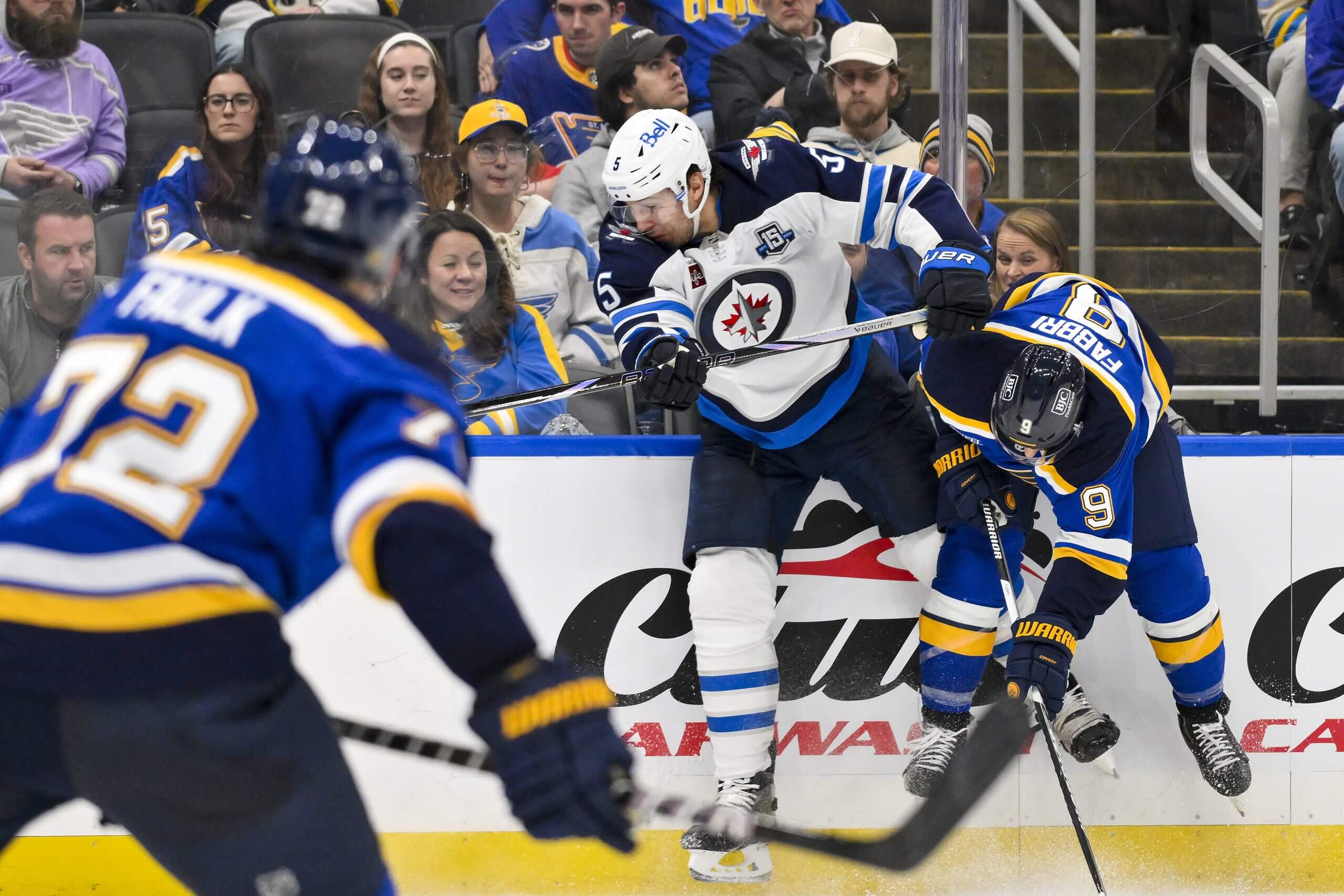
Luke Schenn has made a name for himself as a grinder while throwing plenty of hits. (Jeff Curry / Imagn Images)
Since he entered the NHL in 2008, only two NHL players have thrown more hits than Luke Schenn. The bruising Buffalo Sabres defenseman’s eyes light up when asked to define a word that, in a sense, defines him.
“You don’t even take a breath. You’re not even coming up for air,” Schenn said. “It’s mind over matter.”
Is the meaning of the word positive or negative?
“You could use it both ways, which is why it’s used so much,” Schenn said.
“I think it’s positive,” said Leafs defenseman Simon Benoit, himself a grinder. “But it’s not an easy word. When you’re f—ing grinding, you know it’s going to be tough.”
“It’s also good to use off the ice, if something is difficult,” Rielly said. “A travel day when you’re flying and you went out the night before as a team, that’s a grind.”
It’s a word that transcends language barriers.
Benoit, born in Laval, Que., said he’s used the term even when speaking French: “It’s not a French word, obviously. But we would just say, ‘grindé.’”
There is a different translation for the typical definition of grind in French (moudre). But Benoit does not use that word on the ice.
“Grind is universal,” he said.
Same in Swedish, according to Leafs defenseman Oliver Ekman-Larsson. When communicating in his native language to players around him, the English word “grind” will pop up in sentences instead of the Swedish translation, “slipa.”
How a word with multiple meanings stretched — and then stuck — throughout the sport is revealing, experts said.
“If a subculture adopts a word, it becomes a marker of their group identity,” said Sali Tagliamonte, a professor of linguistics at the University of Toronto. “The group assigns meaning and it resonates with the values of that group.”
Tagliamonte said she was only familiar with the word’s meaning in a hockey context because of time spent in northern Ontario.
“The use of these types of words in subcultures really shows how language can be used as a boundary,” Tagliamonte said. “Like, ‘Let’s use it because these are the types of people we are.’”
“Humans are wired that way: they love being part of a group of people who have a shared language,” added Sarah Adams, a PhD candidate in linguistics at the University of Colorado and an Avalanche fan. “And they love that they don’t have to share it with anybody else.”
Hockey has battled with a culture of exclusivity. It is an expensive sport and its dependence on cold-weather climates means it is not played everywhere. Perhaps the word “grind” is emblematic of hockey’s regionalism. The sport’s idiosyncrasies, like the sport’s multi-faceted favorite word, can keep it lower down the list of popular sports worldwide.
“(Grind) is a badge of authenticity to players,” Tagliamonte said. “It signals insider knowledge of hockey norms, and that enregisterment reinforces the identity of the subculture.”
Players are fine with that.
“It’s because of our mindset,” said Flyers defenseman Travis Sanheim. “Grind means something that’s going to be hard. (Hockey players) are more about a hardworking style.”
So, “grind” has become popular in hockey thanks to players’ desire to identify with those themes.
Leafs forward Steven Lorentz said he learned the meaning of “grind” because he “was living it.”
If someone asked him to describe being drafted low in both the OHL and NHL drafts, having to convince coaches with his play to give him a chance and working his way up from the ECHL, the third tier of professional hockey, he would say he “grinded” through it.
“That’s a compliment to me,” he said when asked how he would feel if someone called him a grinder. “It gets thrown around a little loosely, but most guys have gone through a grind in their careers.”
Ultimately, players appreciate they have a word of their own to, in their minds, better define what it takes to play hockey.
“When you look at four lines on a team, there’s always a working, grinding line,” Tampa Bay Lightning winger Nick Paul said. “They’re going to push through things and not stop working. In baseball, there’s no players who grind and position-wise, you’re not really grinding.”
Maybe it is when players feel what it is to “grind” in the NHL that they can also feel like they belong. The word encompasses almost everything about the league. The physical pain. The work. The travel. And the success you can attain if you come out the other end.
That’s why Lorentz believes living by the word grind in the NHL is “the best thing.” His life as a bottom-line NHL player has never been easy, but he wouldn’t have it any other way.
“You have to embrace the grind,” he said. “Anything that’s easy is not as fulfilling as grinding to get something done.”