
There is no time like the Stanley Cup playoffs to get dramatic.
While there is only so much to draw from the first few games of postseason action, this is the time of year to get reactionary and make grand statements. Here are eight way-too-early takes developing in each series.
Rick Tocchet’s defensive masterclass is elevating the Flyers
The Flyers’ elite defensive play has completely silenced Pittsburgh’s prolific offense. They’ve shockingly limited the high-flying Penguins, who scored the second-most five-on-five goals of all NHL teams during the regular season, to just one five-on-five goal through three games en route to a commanding 3-0 series lead.
Tocchet’s teams have always been structured and disciplined defensively, but they’ve hit a completely new level lately. Philadelphia made a couple of tactical tweaks coming out of the Olympic break, and it yielded strong gains, as the Flyers were the NHL’s best team at defending the rush down the stretch.
In the neutral zone, Philadelphia has run a 1-1-3 setup that has completely stifled Pittsburgh’s zone entries and rush attack. Here’s an example of what that looks like (the Flyers forced Malkin into a turnover on the entry in this play)

During in-zone offensive possessions, the Penguins like to have three players high in the zone. The Flyers have flooded that high ice with aggressive pressure, continually thwarting those plays and even generating high-danger chances off of those forced turnovers, especially early in the series.
In Game 1, the Penguins committed a maddening number of turnovers near the blue line, both on entries and failed sequences high in the offensive zone. Pittsburgh adopted a more dump-and-chase style for parts of Game 2, but the Flyers have done a terrific job of blocking shots and protecting the inner slot, even when the Penguins have recovered pucks and sustained offensive-zone possession.
Utah’s speed could be a problem for Vegas
The Mammoth have built an identity over the last couple of seasons. This is an up-and-coming team with a lot of skill and puck-moving ability, and a ton of speed. In the regular season, Utah ranked fourth in the league in 20-plus miles-per-hour speed bursts. The forward group fuels that; having defensemen who can turn on the jets adds another dimension.
As exciting as that style of hockey is, it’s easy to write it off, especially in a series against the battle-tested Golden Knights, who were expected to be in the contender’s circle this season. Utah’s inexperience is one knock. The team’s rush-based attack can be thought of as another because it’s not prototypical playoff hockey.
Vegas has some forwards who can skate, but the defense isn’t nearly as mobile — and the first period of Game 1 showed that gap in footspeed. But the Golden Knights settled in, upped the physicality and pressure to contain the Mammoth, and eventually took Game 1.
Utah responded by playing to its strengths in Game 2. The top line embodied that the most, with Dylan Guenther, Logan Cooley, and Kailer Yamamoto using their speed to their advantage. That trio went up 8-1 in shot attempts, drove right to the high-danger areas, and outscored Vegas 2-0.
That speed helped Guenther quickly create some separation from Jack Eichel in the neutral zone and get in behind Shea Theodore for a chance; Cooley’s second-effort on the play was the game-winner.
The Mammoth’s speed is the key to upsetting the Golden Knights. And with the series shifting back to Utah, the coaches can try to control the matchups even more to use it to their advantage.
Kucherov should play with Cirelli and Hagel full-time
Through five periods of Round 1, Nikita Kucherov was mostly invisible.
His first touch on the puck lacked smoothness and crispness; he bobbled and fumbled possessions, which is very unlike him. Every east-west pass he tried to make in the offensive zone was getting broken up. He had multiple turnovers that directly led to Grade-A scoring chances for the Canadiens on counterattack rushes in Game 2. Montreal’s penalty kill was cheating aggressively toward Kucherov’s right flank to limit his puck touches on the power-play; the Canadiens content to surrender extra time and space to Brandon Hagel, the less dangerous power-play weapon, on the left flank.
Kucherov’s frustration was close to a boiling point — he recklessly hit Josh Anderson away from the puck in the first period of Game 2 and wound up for a fake slapshot in a linesman’s direction after an offside call later in the game.
Jon Cooper finally made an adjustment in the third period. Cooper moved Kucherov to play on a line with Hagel and Anthony Cirelli (a combination that had success earlier in the season), and it instantly jump-started the Russian superstar.
Hagel and Cirelli’s speed carrying the puck up ice put Kucherov in more advantageous situations to make plays. Kucherov snapped his 16-game playoff goal drought to tie Game 2 late, and they were on the ice for JJ Moser’s overtime winner as well.
Cooper originally used Cirelli and Hagel in a checking role against the Nick Suzuki line, with the idea that Kucherov and Brayden Point’s line would be freed up to create offensive damage in more favorable situations. Unfortunately, Point’s game is strangely quiet right now, and his inability to lead fast rushes is limiting Kucherov’s impact. Kucherov and Point have played 17:25 together at five-on-five against the Canadiens, and haven’t recorded a single high-danger chance, while only driving 38 percent of expected goals.
It shouldn’t come as a surprise that Kucherov instantly gelled with Hagel and Cirelli because that trio outscored opponents by a whopping 28-8 margin in the regular season. Cooper needs to stick with this trio for the rest of the series.
Could disastrous special teams lead to another Wild first-round exit?
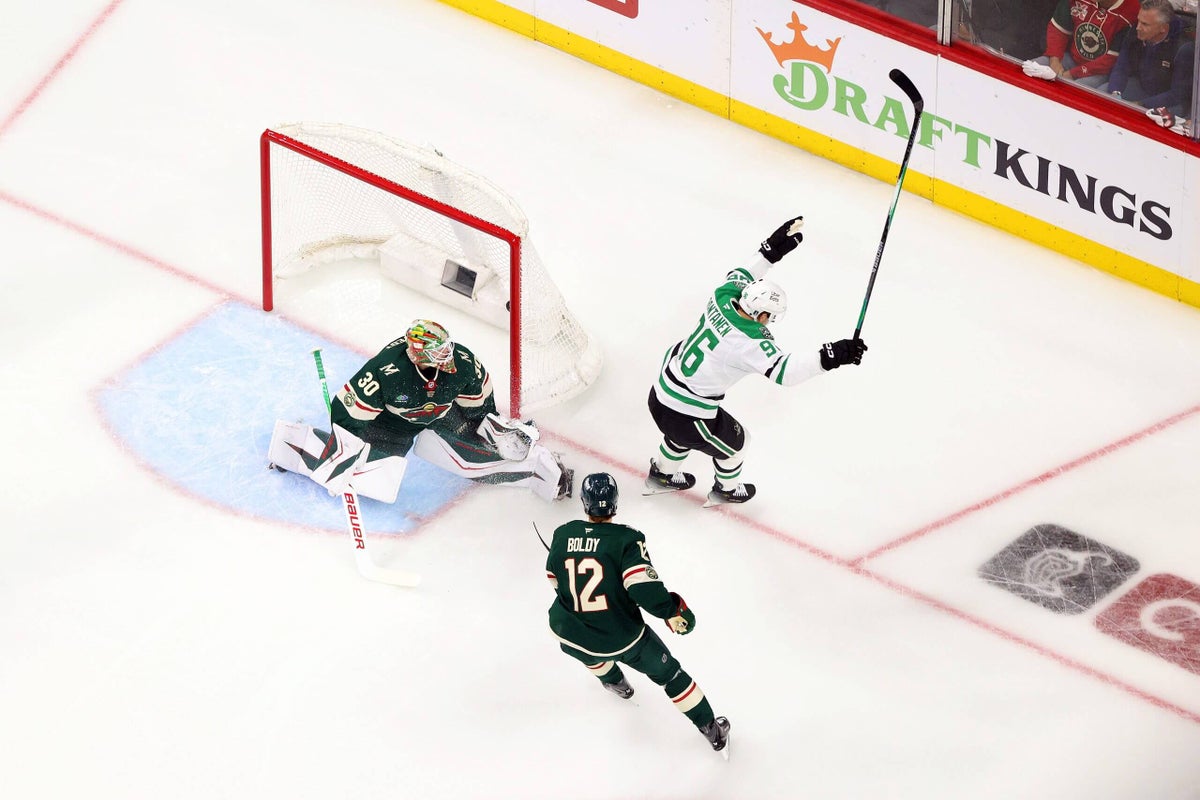
The Wild have outscored the Stars 7-3 at even-strength in Round 1 — Dallas hasn’t won the even-strength battle in a single game — yet they’re trailing the series 2-1. The problem is a familiar ghost that’s haunted Minnesota in previous first-round exits: Disastrous special teams.
In Game 1, Minnesota’s power-play was firing on all cylinders as it went 2-for-4 in a 6-1 victory. Unfortunately, Mats Zuccarello, who had three assists in Game 1, including two on the advantage, suffered an injury, and it’s all gone downhill since then.
Minnesota’s power play has gone a dreadful 1-for-11 in the past two games without Zuccarello. Zuccarello’s playmaking is an underrated driver for the top unit’s success, and the Stars deserve credit for making smart penalty kill adjustments after Game 1, but there should be no excuses for a power-play that still features elite weapons like Kirill Kaprizov, Matt Boldy, and Quinn Hughes.
During the 4-3 double overtime loss in Game 3, the Wild squandered three glorious third-period power plays to score the go-ahead goal. They wasted two more in the first overtime period. These big-moment struggles can’t happen to a Minnesota power play that ranked top-five in the NHL from the moment they acquired Hughes until the end of the regular season.
To make matters worse, they’ve gifted the Stars 13 power-play opportunities in the last two games, and their penalty kill is crumbling, as they’ve surrendered five man-advantage goals, including three in Game 3.
It has to be exceptionally frustrating for Wild fans to see their team trailing despite limiting the Stars to only three even-strength goals in the entire series.
Draisaitl’s welcome return
Without Leon Draisaitl’s timely return from injury, the Oilers could be staring at an early 2-0 series deficit against the Ducks.
Connor McDavid’s excellence down the stretch was the driving force behind Edmonton’s second-place finish in the Pacific. But Draisaitl’s return to action in Game 1 was a reminder of what was missing along the way: Another all-around force in the lineup.
Draisaitl hits another gear when it matters most, with 145 points (and counting) in 98 playoff games. That shakes out to 1.48 points per game, which is second in the salary cap era to McDavid’s 1.55. Expand out to the expansion era and it ranks fifth.
There was some rust to shake off after missing a month-plus of action, but Draisaitl was a difference-maker in Game 1, with his transition game, passing, and shot-making ability. He was the driver of an effective second line with Vasily Podkolzin and Kasperi Kapanen which went up 18-13 in shot attempts and earned a 71 percent xG rate.
And no play showed that better than the game-winner in the last couple minutes of regulation. Draisaitl powered into the zone, through Leo Carlsson and Jackson LaCombe, and created space for Podkolzin and Kapanen to set up the 4-3 goal.
While Edmonton fell short in Game 2 and the Ducks tied the series, it wasn’t for a lack of trying from Draisaitl. Take his assist on Connor Murphy’s goal — he maintained possession under pressure for Alex Killron and drew the attention of all five Anaheim skaters, which gave Murphy time and space to score.
Draisaitl’s availability was always going to be important for the Oilers; this team can’t do much playoff damage without him and McDavid firing on all cylinders. But his return has been even more clutch, considering how uncharacteristically ordinary McDavid has looked through two games.
Wedgewood is the real deal
The Avalanche’s goaltending has been very strong this season, with Scott Wedgewood and MacKenzie Blackwood winning the William M. Jennings Trophy for fewest goals against. But there was still a little bit of uncertainty about whether that netminding would hold up in the pressure cooker of the playoffs, considering how limited each one’s postseason track record is.
Before this series, Wedgewood, a 33-year-old career journeyman, had never made a start in the playoffs. And if he faltered, there’d be valid questions about whether Blackwood could capably take over because he struggled down the stretch with an .876 save percentage in his final 13 games.
Wedgewood is proving he’s the real deal — he’s recorded a .960 save percentage and saved 2.4 goals above expected through two games against the Kings. Yes, the Kings aren’t exactly an offensive powerhouse, but they’ve kept the series surprisingly close and have tested Wedgewood with legitimate scoring chances.
Wedgewood’s solidity between the pipes has helped the Avs grind out a pair of 2-1 wins. With this caliber of netminding, Colorado looks equally comfortable in low-scoring games as it does in high-scoring, back-and-forth affairs. That ability to play and succeed in any style of game is a critical ingredient to a long playoff run.
If Colorado advances to Round 2, it will play the winner of the Minnesota-Dallas series, both of whom have elite, high-pedigree goaltenders in Jesper Wallstedt and Jake Oettinger, respectively. With Wedgewood playing at this level, the Avs should have confidence that their goaltending can match, if not narrowly outplay, whatever opponent they face.
Sabres power play could be a back-breaker
What’s even more discouraging than going 0-for-4 in Game 1 on the power play? Going 0-for-5 in Game 2.
This is more than a playoff problem. The Sabres power play always had its faults; mainly, predictability because it overrelied on Tage Thompson’s bomb from the left circle and Rasmus Dahlin at the point. So the cold streak isn’t just two games — it’s the entire month of April. Buffalo hasn’t scored a single power-play goal in its last 31 opportunities, going back to March 31.
That cost the Sabres on Tuesday, when they went 0-for-5 on the advantage, and lost the game 4-2.
A few things have been going wrong. Even when the Sabres win the initial faceoff and start with control, they don’t maintain it; the team doesn’t have enough puck retrievers on that top unit to extend zone time. When the Bruins clear the puck, things get even more complicated, because Buffalo’s struggled to enter the zone often and efficiently.
Take this Game 2 sequence. The Bruins had already killed off 40 seconds of short-handed time with two clears. The Sabres pass the puck three times in the neutral zone, and on the fourth pass attempt, Mark Kastelic intercepts the puck, and rushes down the ice for a short-handed chance.
The Bruins’ penalty killers got sticks in the way to disrupt a couple of Jason Zucker’s entry attempts in that same spot. And when the team did finally set up and get shots, Jeremy Swayman shut the door.
So while the Sabres 1) can score at five-on-five to make up for it and 2) will likely get fewer opportunities as series, and rounds, roll on, that isn’t a solution to what’s become a real weakness.
The Senators’ forward depth is falling short
The Hurricanes are a tough team to keep up with offensively. They wear opponents down with their aggressive forecheck and pour on scoring chances. It’s even tougher for an opponent to contain that without one of its best shutdown defensemen.
So if the Senators can’t suppress the Hurricanes shots and chances, they have to up their offensive game.
That isn’t without its challenges, either; Carolina is stingy on the backend. Plus, Ottawa’s depth and overall forward strength don’t match up to the Canes, either. That was always a potential shortfall for the Senators in this series, whose Offensive Rating is 27 goals behind their Round 1 opponents’.
It proved to be the difference in Game 1; Carolina had the edge in shot volume (66-48 in shot attempts in all situations) and quality (4.94 xG to 2.83).
To the Senators’ credit, Game 2 was a lot closer — a double-overtime thriller, where these two teams were only separated by 10 shot attempts and 0.07 expected goals.
But as much as Ottawa closed the gap below the surface, that game still put a spotlight on some of the Senators’ missed opportunities and chances — like a missed shot from Tim Stützle on an open net in the first minute of action, or one that rang off the post later in the third. Stützle attempted seven shots in total on Monday night, but only two actually reached Frederik Andersen.
Thanks to Linus Ullmark, the Senators don’t necessarily need to explode on the scoresheet to win games; the Hurricanes’ 1.95 goals per 60 pace sits 12th in the playoff field. Still, the Senators’ 0.78 goals per 60, that sit at the bottom of the playoff field, aren’t enough to get this team to Round 2.