
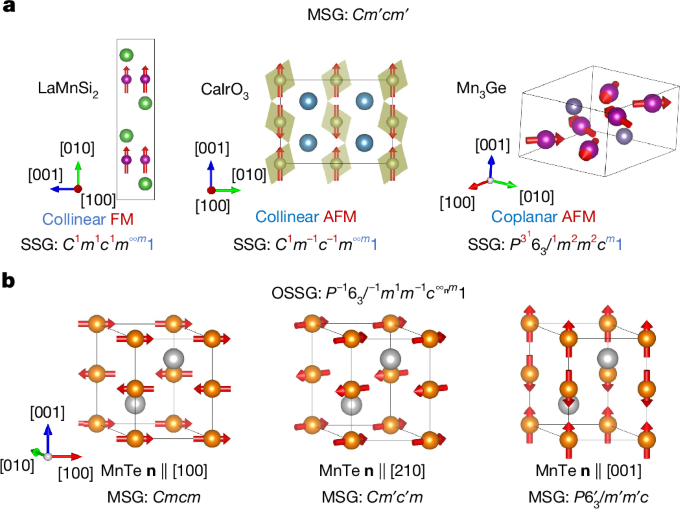
Further classification of magnetic geometries based on the FM/AFM dichotomy
On the basis of the FM/AFM dichotomy, the SSG framework enables further classification of magnetic geometry. Here we focus on the SSG-based classification of various antiferromagnetic geometries, especially for noncollinear magnets, which were also phenomenologically described previously such as Néel-type, spiral and multi-q AFM. Experimentally, the spin distribution across crystallographic primitive cells is typically described by the propagation vector q. However, q alone cannot capture the complexity of the magnetic geometry within a single primitive cell. Moreover, when the lattice periodicity and the propagation vector period are mismatched, q fails to reflect the modulation of the crystal field on the magnetic configuration. Furthermore, even the propagation of spiral magnetic order is hardly captured by MSGs, necessitating the application of SSGs.
As mentioned in the main text, we introduce spin translational group Tspin, which consists of the combination of pure spin-space operation and fractional translation {gs||1|τ}. Because the components of Tspin, gs and τ act in different spaces and their multiplicative actions commute, the group Tspin follows the group structure of its τ component and is, thus, Abelian.
The classification constitutes four distinct categories, as shown in Extended Data Fig. 1. For ik = 1, Tspin only consists of the identity operation and the complexity of magnetic geometry is only included in the magnetic primary cell. A typical example is CuMnAs with antiparallel spin arrangement for the two Mn atoms within a primary cell. Therefore, such a type of AFM is classified as primary AFM. In the case of ik = 2, Tspin has an order 2 spin translational operation, whose spin-space part can be −1, 2 or m. Examples include the intrinsic magnetic topological insulator MnBi2Te4 (refs. 42,43), which has two magnetic atoms with antiparallel spin connected by {U2||1|τ1/2} (\({\tau }_{1/2}=0,0,\frac{1}{2}\)). Owing to the correspondence between the collinear SSG and MSG in the group structure, its group symbol can be simplified as RI1−31m∞m1. Such a category aligns with the pedagogical one-dimensional AFM chain, referred to as bicolour AFM.
The case of ik > 2 could be further divided into two categories based on whether Tspin is cyclic. If Tspin is a cyclic group, such as n, −n (n > 2), the magnetic geometry aligns with a high-order spin rotation associated with translation. We select EuIn2As2 as an example in which the magnetic moments are connected by {U3||1|τ1/3}, forming a so-called spiral AFM8,44. Finally, if Tspin is a non-cyclic Abelian group, the spin rotations with different axes must be mapped to translations in different directions. Such mappings result in a more intricate multi-q magnetic geometry, as observed in antiferromagnetic [111]-strained cubic γ-FeMn (ref. 26) and CoNb3S6 (ref. 27), referred to as multiaxial AFM. Apparently, both spiral and multiaxial AFM cannot be described by MSGs, in which the corresponding Tspin only allows {−1||1|τ} operation. Furthermore, FM can also be classified into the four categories in the same way. For example, a helimagnet with AFM geometries and a FM magnetic canting can be directly described by combining a Tspin with ik > 2 and a polar Pspin.
Extended Data Fig. 2 summarizes the quantities and proportions of materials exhibiting each type of AFM geometry in the MAGNDATA database obtained by our online program FINDSPINGROUP. On the basis of Tspin, AFM geometries are further classified into primary (660, 32.0%), bicolour (857, 41.5%), spiral (24, 1.2%) and multiaxial (45, 2.2%) categories. In Supplementary Information sections 2.1 and 2.2, we provide an exhaustive list of all materials and their oriented SSG including the dichotomy of FM/AFM and further geometries classification based on Tspin.
SOC tensor
To describe the transformation of SOC under SSG operations, we reformulate it in a form that explicitly allows for independent coordinate systems in real space and spin space:
$$\begin{array}{c}\begin{array}{c}\begin{array}{c}{\hat{H}}_{{\rm{SOC}}}={\lambda }{\hat{{\bf{L}}}}^{{\rm{T}}}{\boldsymbol{\chi }}\hat{{\boldsymbol{\sigma }}}=\lambda \sum _{i,j}{\chi }_{{ij}}{\hat{L}}_{i}{\hat{\sigma }}_{j}\\ =\,\lambda ({\hat{L}}_{1}\,{\hat{L}}_{2}\,{\hat{L}}_{3})\left(\begin{array}{ccc}{{\bf{r}}}_{1}\cdot {{\bf{s}}}_{1} & {{\bf{r}}}_{1}\cdot {{\bf{s}}}_{2} & {{\bf{r}}}_{1}\cdot {{\bf{s}}}_{3}\\ {{\bf{r}}}_{2}\cdot {{\bf{s}}}_{1} & {{\bf{r}}}_{2}\cdot {{\bf{s}}}_{2} & {{\bf{r}}}_{2}\cdot {{\bf{s}}}_{3}\\ {{\bf{r}}}_{3}\cdot {{\bf{s}}}_{1} & {{\bf{r}}}_{3}\cdot {{\bf{s}}}_{2} & {{\bf{r}}}_{3}\cdot {{\bf{s}}}_{3}\end{array}\right)\,\left(\begin{array}{c}{\hat{\sigma }}_{1}\\ {\hat{\sigma }}_{2}\\ {\hat{\sigma }}_{3}\end{array}\right),\end{array}\end{array}\end{array}$$
(1)
in which λ, \(\hat{{\bf{L}}}\) and \(\hat{{\boldsymbol{\sigma }}}\) represent the SOC coefficient, effective orbital angular momentum operator and spin operator, respectively; ri and sj are the unit base vectors with i = 1, 2, 3 and j = 1, 2, 3 for real space and spin space, respectively; χ represents a 3 × 3 SOC tensor matrix, defined as χ = {χij = ri · sj|i = 1, 2, 3; j = 1, 2, 3}. For a general SSG operation {gs||gl}, the transformation of χ can be expressed as:
$$\begin{array}{l}{\hat{\rho }}_{\{{g}_{{\rm{s}}}||{g}_{{\rm{l}}}\}}^{-1}\lambda {\hat{{\bf{L}}}}^{{\rm{T}}}{\boldsymbol{\chi }}\hat{{\boldsymbol{\sigma }}}{\hat{\rho }}_{\{{g}_{{\rm{s}}}||{g}_{{\rm{l}}}\}}\,=\,\lambda det({R}_{{\rm{s}}})det({R}_{{\rm{l}}})[{\hat{{\bf{L}}}}^{{\rm{T}}}{R}_{{\rm{l}}}^{-1}]{\boldsymbol{\chi }}[{R}_{{\rm{s}}}\hat{{\boldsymbol{\sigma }}}]\\ \,\,\,\,\,\,\,\,\,=\,\lambda {\hat{{\bf{L}}}}^{{\rm{T}}}det({R}_{{\rm{s}}})det({R}_{{\rm{l}}})[{R}_{{\rm{l}}}^{-1}{\boldsymbol{\chi }}{R}_{{\rm{s}}}]\hat{{\boldsymbol{\sigma }}}\end{array}$$
(2)
in which \({\hat{\rho }}_{\{{g}_{{\rm{s}}}||{g}_{{\rm{l}}}\}}\) is the representation operator of {gs||gl} in Hilbert space; Rl and Rs are three-dimensional Euclidean transformations corresponding to gl and gs in three-dimensional real space and spin space, respectively. det(Rl) and det(Rs) are the determinants of Rl and Rs, respectively; their values, either −1 or 1, depend on whether Rl includes the space-inversion operation and whether Rs includes the time-reversal operation, respectively. Therefore, the transformation of the SOC term under a SSG operation can be described using the SOC tensor χ, based on its defined transformation rule:
$${\boldsymbol{\chi }}\mathop{\longrightarrow }\limits^{\{{g}_{{\rm{s}}}||{g}_{{\rm{l}}}\}}{{\boldsymbol{\chi }}}^{{\prime} }=det({R}_{{\rm{s}}})det({R}_{{\rm{l}}}){R}_{{\rm{l}}}^{-1}{\boldsymbol{\chi }}{R}_{{\rm{s}}}$$
(3)
A similar method has also been applied to investigate the AHE in ferromagnetic systems45.
Material example for orbital and spin magnetization: Mn3Sn
In the following, we use the orbital magnetization Mo, the spin magnetization Ms and noncollinear antiferromagnetic Mn3Sn (Fig. 3b) as examples to demonstrate how to analyse the SOC-induced physical properties by SOC tensor χ. By definition, Mo and Ms are the sums of the expectation values of orbital angular momentum operator \(\hat{{\mathcal{L}}}\) and spin operator \(\hat{{\boldsymbol{\sigma }}}\) over the entire Brillouin zone, respectively, expressed as:
$${{\bf{M}}}_{{\rm{o}}}=-\frac{{\mu }_{{\rm{B}}}{{\mathcal{g}}}_{{\rm{o}}}}{2{\rm{\pi }}}{\int }_{{\rm{B}}{\rm{Z}}}\sum _{n}{f}_{n{\bf{k}}}\langle {{\varphi }}_{n}({\bf{k}})|\hat{{\mathcal{L}}}|{{\varphi }}_{n}({\bf{k}})\rangle {\rm{d}}{\bf{k}}$$
(4)
$${{\bf{M}}}_{{\rm{s}}}=-\frac{{\mu }_{{\rm{B}}}{{\mathcal{g}}}_{{\rm{s}}}}{2{\rm{\pi }}}{\int }_{{\rm{B}}{\rm{Z}}}\sum _{n}{f}_{n{\bf{k}}}\langle {{\varphi }}_{n}({\bf{k}})|\hat{{\sigma }}|{{\varphi }}_{n}({\bf{k}})\rangle {\rm{d}}{\bf{k}}$$
(5)
in which fnk is the Fermi distribution at wavevector k; μB represents the Bohr magneton; and \({{\mathcal{g}}}_{{\rm{o}}}\) and \({{\mathcal{g}}}_{{\rm{s}}}\) denote the Landé \({\mathcal{g}}\)-factors for orbital and spin, respectively. Consequently, the transformations of Mo and Ms are equivalent to time-reversal-odd axial vectors and follow the corresponding proper rotation operations in real space and spin space, respectively, expressed as:
$${{\bf{M}}}_{{\rm{o}}}\mathop{\longrightarrow }\limits^{\{{g}_{{\rm{s}}}||{g}_{{\rm{l}}}\}}det({R}_{{\rm{s}}})det({R}_{{\rm{l}}}){R}_{{\rm{l}}}{{\bf{M}}}_{{\rm{o}}}$$
(6)
$${{\bf{M}}}_{{\rm{s}}}\mathop{\longrightarrow }\limits^{\{{g}_{{\rm{s}}}||{g}_{{\rm{l}}}\}}{R}_{{\rm{s}}}{{\bf{M}}}_{{\rm{s}}}$$
(7)
To analyse the coupling relationship between Mo, Ms and λχ, we express both Mo and Ms as a series expansion in terms of λχ:
$${M}_{a}[{\boldsymbol{\chi }}]={\omega }_{a}^{(0)}+\lambda \sum _{{ij}}{\omega }_{a,{ij}}^{(1)}{\chi }_{{ij}}+{\lambda }^{2}\sum _{{ijkl}}{\omega }_{a,{ij},{kl}}^{(2)}{\chi }_{{ij}}{\chi }_{{kl}}+\ldots $$
(8)
in which ω(n) is a (2n + 1)th-order undetermined tensor. Equation (8) is constrained by the OSSG symmetry and is valid both for Mo and Ms, but in each case, different transformation properties have to be considered for the tensors ω(n) owing to the restriction:
$$det({R}_{{\rm{s}}})det({R}_{{\rm{l}}}){R}_{{\rm{l}}}{{\bf{M}}}_{{\rm{o}}}[\,{\boldsymbol{\chi }}]={{\bf{M}}}_{{\rm{o}}}[det({R}_{{\rm{s}}})det({R}_{{\rm{l}}}){R}_{{\rm{l}}}\,{\boldsymbol{\chi }}{R}_{{\rm{s}}}^{-1}]$$
(9)
$${R}_{{\rm{s}}}{{\bf{M}}}_{{\rm{s}}}[\,{\boldsymbol{\chi }}]={{\bf{M}}}_{{\rm{s}}}[det({R}_{{\rm{s}}})det({R}_{{\rm{l}}}){R}_{{\rm{l}}}\,{\boldsymbol{\chi }}{R}_{{\rm{s}}}^{-1}]$$
(10)
Once the properties of ω(n) have been established, the same basis in real space and spin space can be chosen (that is, χij = δij), fixing the spin orientation to that defined by the OSSG. Equation (8) then strongly simplifies and only very specific components of the OSSG symmetry-adapted tensors ω(n) become relevant.
The SOM material Mn3Sn has the OSSG \({P}^{{3}_{001}^{1}}{6}_{3}{/}^{1}{m}^{{2}_{110}}{m}^{{2}_{010}}{c}^{{m}_{001}}1\). The point operation parts of the OSSG generators include {1||−1}, \(\{-{6}_{001}^{5}||{6}_{001}^{1}\}\), {2100||21-10} and {m001||1}. By applying the symmetry constraints of all of the OSSG generators and choosing χij = δij, we can analyse the relationship between Mo, Ms and χ order by order. For the zeroth-order SOC tensor term, the coefficient ω(0) remains invariant under all OSSG operations. However, both Mo and Ms transform non-identity under this OSSG. Therefore, the zeroth-order ω(0) must vanish for all three components of Mo and Ms. For the first-order SOC tensor term, by requiring that each component of the tensor ω(1) remains invariant under the OSSG generators, the OSSG restriction on the first-order coefficient tensor \({{\boldsymbol{\omega }}}_{{\rm{o}}}^{(1)}\) for Mo can be obtained by combining equations (8) and (9). Applying the same method to the symmetry constraints of Ms, we find that all first-order SOC tensor terms of Ms are forbidden by the SSG symmetry. Expressed in an orthonormal basis parallel to the directions (a, 2b + a, c), the expansion of the spin magnetization Ms and the orbital magnetization Mo (to the lowest non-zero order terms) can be written as:
$${M}_{{\rm{s}},1}=2({\omega }_{{\rm{s}},1,1111}^{(2)}+{\omega }_{{\rm{s}},1,2222}^{(2)}){\lambda }^{2},{M}_{{\rm{s}},2}=-2\sqrt{3}({\omega }_{{\rm{s}},1,1111}^{(2)}+{\omega }_{{\rm{s}},1,2222}^{(2)}){\lambda }^{2}$$
(11)
$${M}_{{\rm{o}},1}=2{\omega }_{{\rm{o}},1,11}^{(1)}\lambda ,{M}_{{\rm{o}},2}=-2\sqrt{3}{\omega }_{{\rm{o}},1,11}^{(1)}\lambda $$
(12)
in which Ms,i and Mo,i represent the ith components of Ms and Mo in the mentioned basis, respectively. Both Ms and Mo vectors therefore lie along the OSSG [010] direction, as expected from the corresponding MSG. Note, however, that equations (11) and (12) have been obtained by applying the symmetry conditions of the OSSG, with no explicit use of the MSG.
Next we discuss the advantages of the SOC tensor framework in identifying promising AFM candidates for the AHE. According to the Kubo formula, the intrinsic anomalous Hall conductivity can be expressed as:
$${\sigma }_{z}^{{\rm{AHE}}}=\frac{{e}^{2}}{\hbar }\sum _{{n}^{{\prime} }\ne n}{\int }_{{\rm{BZ}}}\frac{{{\rm{d}}}^{3}k}{{(2{\rm{\pi }})}^{3}}{f}_{{\bf{k}}n}\frac{2{\rm{Im}}[\langle {\bf{k}}n|{\partial }_{{k}_{x}}\hat{H}({\bf{k}})|{\bf{k}}{n}^{{\prime} }\rangle \langle {\bf{k}}{n}^{{\prime} }|{\partial }_{{k}_{y}}\hat{H}({\bf{k}})|{\bf{k}}n\rangle ]}{{({{\epsilon }}_{{\bf{k}}n}-{{\epsilon }}_{{\bf{k}}{n}^{{\prime} }})}^{2}},$$
(13)
in which fkn is the Fermi–Dirac distribution, \(\hat{H}({\bf{k}})\) is the system Hamiltonian and |kn⟩ and |kn′⟩ are the eigenstates of the system. From symmetry considerations, the anomalous Hall conductivity vector \({{\boldsymbol{\sigma }}}^{{\rm{AHE}}}=({\sigma }_{x}^{{\rm{AHE}}},{\sigma }_{y}^{{\rm{AHE}}},{\sigma }_{z}^{{\rm{AHE}}})\) transforms as an axial vector in real space and is odd under time-reversal symmetry in spin space. Therefore, it shares the same symmetry transformation properties as the orbital magnetic moment Mo and, consequently, follows the same expansion form in terms of the SOC tensor. Within the MSG framework that includes SOC, AHE and magnetization are subject to the same symmetry constraints—meaning that symmetry either permits both or forbids both simultaneously. On the other hand, our SOC tensor framework enables a systematic comparison of the magnitudes of the AHE (transformed as Mo) and the spin magnetization Ms, providing insights for realizing a large AHE response in systems with minimal net magnetization.
Identification of SOM materials
According to the symmetry classification in our paper, spin–orbit magnets exhibit SSG-enforced Ms = 0 but not MSG-enforced M = 0, indicating that the net magnetization originates from SOC. To identify the SOM materials in the MAGNDATA database24, we use the FINDSPINGROUP program (https://findspingroup.com) to identify the SSG and MSG of all of the materials with tolerance ∆ = 0.02 μB and find 207 SOM materials (left workflow in Extended Data Fig. 4). Here the tolerance ∆ is defined as the allowable magnitude of the vector difference |Mi − RsMj|, in which Mi and Mj are the magnetic moments at atomic sites i and j, respectively, satisfying the mappings \(j\mathop{\to }\limits^{{g}_{{\rm{l}}}}i\) and \({{\bf{M}}}_{j}\mathop{\to }\limits^{{g}_{{\rm{s}}}}{R}_{{\rm{s}}}{{\bf{M}}}_{j}\) under the symmetry operation {gs||gl} and Rs is a three-dimensional orthogonal transformation in spin space corresponding to gs.
Next, to distinguish materials in which the net magnetization is generated by SOC but SSG has been identified as ferromagnetic, we increase the tolerance to 1.50 μB, resulting in the symmetry identification of 61 more possible SOM materials. After excluding materials with strong disorder, using SOC-free DFT calculations, we compare for each material the energy of the magnetic arrangement provided by MAGNDATA with arrangements having a higher SSG. The results indicate that the SOC-free ground states of 17 materials have a SSG of higher symmetry, which does not allow Ms, and are reidentified as SOM materials, with their Ms being characterized as a SOC-driven effect (right workflow in Extended Data Fig. 4). The remaining 44 materials are mainly ferromagnetic systems with tiny magnetizations and disordered systems that are beyond the scope of this symmetry identification. The list of spin–orbit magnets is provided in Supplementary Information section 2.1 and the DFT-reidentified SOM materials are provided in Supplementary Information section 2.2.
In the following, we present material examples to demonstrate the identification of SOM materials. For direct symmetry identification, we use LaMnO3 as an example, in which the three components of the local magnetic moments are (3.87 μB, 0, 0). Although the symmetry constraint of its net magnetic moment is (0, My, 0), the local magnetic moment does not have a y-direction component within the accuracy (0.02 μB) allowed by the database. As a result, the FINDSPINGROUP program can directly identify its magnetic geometry of collinear AFM and classify it as SOM. The SOM materials with experimental negligible net magnetic moment account for 10.0% of the entire material database, which is the most common situation in SOM.
On the other hand, some materials with SOC-induced net magnetic moments are sufficiently large, requiring auxiliary evaluation by means of DFT calculations. We use NiF2 as an example, in which the three components of the local magnetic moments are (2 μB, 0.03 μB, 0). As a result, its net magnetic moment in a unit cell is 0.06 μB, which requires evaluation to determine whether it originates from SOC. We perform SOC-free DFT calculations to compare the total energy of this magnetic configuration with that of the configuration without canting. The results show that the magnetic configuration without canting has lower energy, indicating that the net magnetic moment is induced by SOC. Furthermore, we reidentify the symmetry of the magnetic configuration without canting to confirm the OSSG of the ground-state magnetic configuration without SOC. The revised OSSG of NiF2 is \({P}^{-1}{4}_{2}{/}^{1}{m}^{-1}{n}^{1}{m}^{{\infty }_{100}m}1\), confirming SOM.
DFT calculations
Our DFT calculations are conducted using the Vienna Ab initio Simulation Package (VASP)46, which used the projector augmented wave47 method. The exchange-correlation functional was described through the generalized gradient approximation of the Perdew–Burke–Ernzerhof formalism48,49 with on-site Coulomb interaction Hubbard U, which are provided in Supplementary Information section 2.2 for each material. The plane-wave cut-off energy was set to 500 eV and the total energy convergence criteria was set to 1.0 × 10⁻⁶ eV for all candidate materials. Sampling of the entire Brillouin zone was performed by a Γ-centred Monkhorst–Pack grid50, with the standard requiring that the product of the number of k-points and the lattice constant exceeds 45 Å for each direction.