
From both sides of the causeway, friends and community are celebrating the larger-than-life story of undergraduate Lincoln Sabini, who was hit and killed by a car while riding his orange cargo bike on the way home from work on campus.
They describe him as “(their) first friend in Davis”, “the first kid who talked to me in a lecture,” a “bike-saint,” “the most beautiful soul,” “extremely energetic,” “gentle and kind,” a “bouncing off the walls kind of person” whose “silly food” would get everywhere in his bag, that he was “gone too soon,” or as his mom, Rucha Powers says, “a sunflower at the end that just spits out all those seeds.”
He did some gardening at his house with roommate Logan Leys, who shared a love for plants.
Sabini was a sustainable ag major who worked with sheep on the student farm, conducted research on Diamondback Moths, and worked in a Chia root lab under the principal investigator, Dr. Jennifer Funk.
Sabini was a member of the UC Davis Triathlon Club, the cycling club, and his favorite place was the Davis Bicycle Collective, where he built a bicycle from the bottom up that he called Red Rocket. He was a top swimmer at CK McClatchy High School with a box full of awards.
“He was just such a driven, excited person, and he did all that just because he wanted to, not because we were leaning on him to be perfect. He just wanted always to do the best,” Powers said.
He leaves behind Powers, his father, Keith Sabini, and his brothers’ Royal Sabini, and Maceo Powers.
In honor of his memory, the UC Davis Triathlon Club held Lincoln-themed workouts, like 100, 100-yard swim sets, in his name. He apparently liked middle- to long-distance sets; he had amazing endurance on land and in the water, as teammates attested.
UCD referenced a statement they released last week honoring Sabini, and Chancellor Gary May held a moment of silence, going “off script” during the Picnic Day Parade opening ceremony.
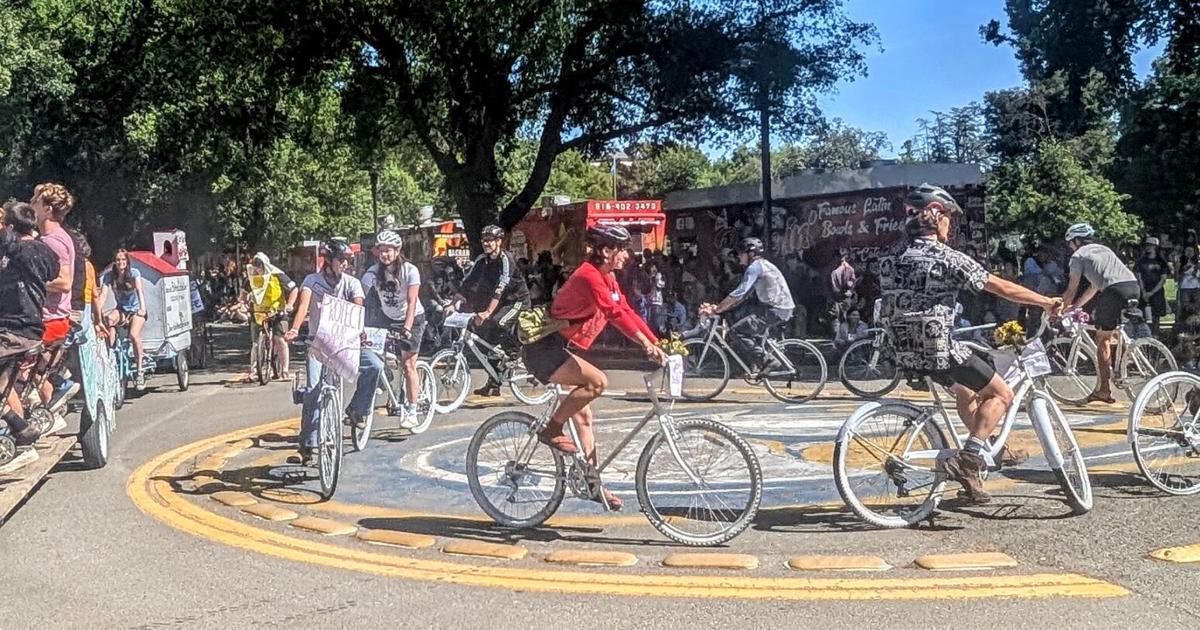
The parade lineup included nine ghost bikes and a large beer bike with a banner draped over the front, “In honor of Lincoln Sabini: We <3 You!” They wore patches pinned to their clothes and represented some of the bicycle and triathlon communities to which Sabini belonged.
KDVS’s Underground Threads held an hourlong show dedicated to Sabini’s memory, playing some of his favorite songs, including Songs ranged from Alison Krauss’ “Down To The River To Pray” and Gillian Welch’s “I’ll Fly Away” (From the “O Brother, Where Art Thou?” Soundtrack) to Justin Bieber’s “YUKON” and Death Grips’ “Bubbles Buried In This Jungle.”
One of their friends, now studying abroad in New Zealand, carried a rock for him.
Sabini told his longtime girlfriend, Leah Ozgun, that he would move to New Zealand to become a farmer after graduating. Powers is from New Zealand.
Families created a meal train that has been shared by members of the Sacramento Waldorf community, where his parents have professional and personal connections, Powers, an administrative assistant at A.M. Winn, Waldorf-inspired ek-8, and Keith Sabini, a former math teacher at Washington Carver Public Waldorf High School, both in the Lincoln Village area of Rancho Cordova.
Sabini cultivated his own community through a “20-year experiment” that ended way too soon, as Powers shared. “What we know for sure is community, and that love is everything.”
A ghost bike ceremony was held on Monday on Hutchinson Drive.
A petition with 3,634 signers as of Thursday morning has called to build “Lincoln’s Loop,” a protected bike and pedestrian corridor on Hutchinson Drive, and they started an online form letter to UC leadership.
“Our vision for Lincoln’s Loop is the solution to UC Davis’s West Campus transportation infrastructure and liability issues,” the form reads. “The construction of Lincoln’s Loop will prevent future deaths and injuries in West Campus and improve the quality of life for everyone in Davis while elevating the bike-friendly status of the school and the city.
“His closest people say no words will do him justice, but they do implore the university to do more for bike safety.”
Sabini commuted to UC Davis from Sacramento by bus and bike, or, if he was up for it, just by bike.
He was the student-athlete biking around with quite the load — swim gear, schoolwork, snacks of sardines, beans, fruit — even though he was known for forgetting his towel.
“All my memories of Lincoln are filled with laughter and silliness,” says Tomas Herrero, who joined the triathlon club around the same time and became fast friends with Sabini.
Friends like Tomas and Logan shared many “you-had-to-be-there” moments.
·Like the car trip to Sabini’s first triathlon in San Diego, where he carbo-loaded in the most eccentric, silly, inefficient way, pounding celery, strawberries, and bananas and needing lots of bathroom breaks along the way—as Tomas shared.
·Tritonman was his first triathlon race. He did draft legal and wasn’t supposed to do classic the next day. “However, when he finished he decided it was so much fun that he immediately signed up for classic as well. I respect him so much for that! I remember standing with some of my teammates cheering for him during the classic, and watching him come out of transition with a banana to eat on the run. One of my teammates yelled, ‘Lincoln no more bananas.’ He ate a lot of bananas that weekend.” – Teammate Tatiana Dorrestein
·Or that he wore wool socks and wool underwear, influences from his Waldorf upbringing— as Logan shared.
·That he wore the goofiest, “the funniest outfits and the coolest outfits” like skinny jeans with Birkenstocks, and an MTV shirt or an all-jean outfit of baggy jeans and jorts on top, paired with Birkenstocks that he had then glued denim on to, with a simple t-shirt on top. “He had the goofiest smile on his face, like this guy was always wearing goofy stuff.”- As Logan shared.
-Worked previously at Freestyle Thrift Store, where he dabbled in modeling— Logan added.
·That he lived in a yurt in his parents’ backyard his first year of college. —Logan
-That he slept only about 5-6 hours because he was always doing something – Logan
-Showing up for a ride to Winters with his red commuter bike, jeans and a bag of Swedish fish. – Tatiana Dorrestein, teammate
-He’d run his fingers through a small patch of grass and flowers along the bike path. “They were just the little plants you’d see everyday, but he wanted to appreciate them, an embodiment of stop and smell the flowers,” Tatiana said.
-Multi-lane drafting sets to simulate the chaos of an open water start, where you’re swimming over people until the race can settle. “Lincoln made it feel like a high stakes race every time. Twice my size and a bullet in the water we were interlocked in a match, fighting for who would reach the wall first. This was one of my favorite swims, a sort of fire and intense competition, mixed with smiles and laughs in the brief minute between sets.” – Tatiana
Sabini’s bits and jokes underlie the joy they experienced together -Tomas
Ozgun loved practicing with him, even though she says she “wasn’t very good,” he would make her “feel like a prodigy.” Biking the Winters loop, she drafted off of him, going about 16 miles per hour, which she says “is not very good,” especially with the draft, but that she didn’t because he kept hyping her up and saying “wow, that is so fast, you went so fast!”
“He always saw my potential in every aspect of life and fostered curiosity. He was so passionate about being alive, enjoying life, and stopping to smell the roses. Every morning, he’d make up and, half asleep, he’d start singing (though he wasn’t very good and would never get the lyrics right). Waking up to the sound of his voice singing Justin Bieber or whatever other 2016 song he was stuck on that week was my absolute favorite sound in the world.”
Growing up, Powers said that Sabini’s father, Keith, biked 15 miles to and from work every day, rain or shine, from Sacramento to Washington Carver High School, where he taught math for many years.
This is the role model her son saw, and it inspired his passion for bikes, Powers said. “I love the fact that Lincoln became an amazing bike mechanic, because that is just straight from my husband.”
A Waldorf family “through and through,” not for any allegiance to the pedagogy, as Powers adds, but the community they’ve seen in the last week is like the harvest of all those years of community. “We just had people coming from every walk of life, people who remembered Lincoln.” She said that, in his first year at UCD, when he lived at home, their place became “where the parties were” as he became “fast friends with these boys.”
“It was so wholesome, honestly. I’m just so proud of the community he built.”
Because Sabini was an avid cyclist and bike mechanic riding on a clear section of campus land where Hutchinson leaves town — past the roundabouts, street lights, and hustle and bustle — the collision raises additional concerns about bike infrastructure and car culture.
As floats readied for the Picnic Day Parade in Lot 15, the ghost bike coalition included members of the Davis Bicycle Collective and Sabini’s teammates.
Aaron Shaw, DBC bike minister, shared that Sabini frequented the collective more “out of passion than necessity” and customized everything on his bike. “It’s really sad to hear that someone loses their life, and so young,” Shaw said. “That’s my first reaction. My second reaction is, how did it happen? Why did it happen? Where did it happen?”
Gina Queck, an undergrad who knew Sabini as a Bike Collective volunteer and UCD triathlete who helped organize the ghost bike participation in the parade, said the pre-parade gathering was “not just a vigil,” but “a call for accountability and urgent action.” She said Sabini gave countless hours to both the Triathlon Team and the Bike Collective, and his loss is “devastating, but it is also infuriating, because it was preventable.”
Shaw said some from the collective went to Hutchinson to check out the scene. “There are many things wrong with that road that make it unsafe for cyclists. We already lost someone.”
He’s referring to the deadly collision in 2022 also on Hutchinson Drive when a garbage truck hit and killed Trisha “Tris” Nicole Sabay Yasay, a third-year plant sciences major and Student Farm volunteer.
At least one Picnic Day parade sign in the ghost bike ride also included the message: “Two deaths, one road, four years. WTF, UCD? RIP Lincoln Sabini, 2026; RIP Trisha Yasay, 2022.”
Queck says that if anything, this death is evidence enough for the university to make infrastructural adjustments to the road.
She says the shoulder should be wider and include a clear bike lane, “at minimum,” preferring a protected lane and a walking path.
The triathlon team bikes on the side of this road every Sunday. Davis residents bike, walk, and run this road to Putah Creek, then to Olive Tree Lane, and then to West Davis and Winters.
If anything, this death is evidence enough for the university to make infrastructural adjustments to the road, she said. “I hope they do, but it likely requires our voice for change to take place.”
Since the parade, family and friends held services, including a ghost bike ceremony at the scene of the collision.
Powers said that when she went to the site, she thought she would see something “totally different.”
“I could not, for the life of me, understand how my son, in broad daylight on a wide open, straight shot of road, riding a 100-pound bright orange cargo bike, could not be avoided by the vehicle that passed by him. There’s no reason; it makes no sense. It was not a blind corner. There are no potholes. There’s nothing; it just means that the driver was not paying attention or modifying their driving for passing a cyclist.”
Learning about Yasay’s tragedy after her son’s, Powers noted that many ag students are committed environmentalists who ride along Hutchinson to their labs and homes.
She said she’d been seeing on social media people wrongly describe the spot as an “intersection”; however, she points out, “It was a straightaway, full visibility piece of road that a driver could easily make a modification to their driving.”
During the ghost bike installation ceremony for Sabini, Powers said she listened to cars “whiz by” without slowing down and that a driver revved the engine, even with a group of mourners in the rain.
After they left that site that day, they headed to Sabini’s East Davis apartment because his younger brother, Royal, who’s 17, wanted some T-shirts. Sitting in the back seat of her sister’s car, Powers closed her eyes, and when she opened them, she saw a ghost bike. “I just thought, what the f— Davis? You want parents to have this tour of dead kids all over this town. We weren’t even anywhere near where my son crashed.”
She said that her son’s death certificate says, “motor vehicle versus bicycle.”
“The bike’s never going to win that.” She said she learned everything she needed to when she went to the site: “People did not slow down. People sped up. People do not care.”
While the parents don’t yet have a police report, the hospital told them that the car stopped and there were witnesses. People tried to render aid, and the EMTs came, but Sabini never had a pulse— a point she’d like to see corrected from news reports that stated he was transported to Kaiser in Vacaville, where he later died. “That was just when they pronounced him dead. We want it to be known that he was killed on impact when the car hit his bike, because that’s the reality of what’s happening, and I don’t want it to be whitewashed.”
Of all the things she ever imagined, she never thought she would lose him like this.
Parenting a boy like Sabini, “a wild child, a risk taker, and lover of life,” Powers said, isn’t easy.
“You just always feel like you’re about to lose him at any minute, but my son was riding home at 3 p.m. from his job, working with sheep. He was not doing anything reckless.”
She asks why there isn’t a protected pathway down that area and why the whole area isn’t paved for cyclists, especially following Yasay’s tragedy.
The bike lane is only about 3.5 feet of asphalt, with no separation from vehicles. The edge curves off to gravel, offering no safety from cars.
There’s a ditch on one side, and it’s dark at night. Powers said they walked past the student housing and saw solar panels, but no solar lights for the road. Again, nothing they could see that would make it safe for cyclists. She said it’s frustrating that no real changes have been made since Yasay’s accident.
Asked to comment on what had been done since Yasay’s death, UCD spokesperson James Nash pointed to a university article from last year titled,“7 Ways UC Davis Is Improving Traffic Safety on Campus.” It includes enhanced safety training for university drivers and student riders, added traffic amfbassadors, 360-degree cameras to large campus vehicles, a reduction of hazardous turns and heavy vehicle presence, improved sight lines, restriped bike lanes on campus roadways and added stop signs. According to the article, Transportation Services’ maintenance team updated green bike lanes along La Rue Road, repainted crosswalks, and bike lane markings “throughout the campus core. “The team is responsible for replacing damaged or fading regulatory road signs throughout the year.”
As the community continues to celebrate and honor Sabini’s life, it also advocates for better bicycling conditions in town and on and off-campus property.
City of Davis Transportation Commissioner and bicycle advocate Mark Huising said the City is moving forward with the Richard’s Boulevard infrastructure improvement— “but just for cars, as we no longer have the money for the bike infrastructure part of it.”
He also added that the city is about to approve the Willow Grove Development for the ballot, “the second planned neighborhood we allow to move forward without assurances for a grade-separated crossing of East Covell.”
“We want more DJUSD enrollment, but this just sets up a future council to have to express thoughts and prayers the next time we lose someone to traffic violence that can be prevented by better design.”
Catherine Brinkley, an associate professor in Human Ecology, Community and Regional Development, announced during public comment at Tuesday’s city council meeting a petition to commemorate Eighth Street as America’s first bike lane for Bike Month in May to celebrate the hard work that went into making Eighth Street a bike lane in the 60s.
Brinkley taught Sabini last year. “He was amazing,” she said. “He was a triathlete, just a really fun, wonderful person, and it is easy to project out the bright future he would have and how many people he would have impacted with it. It’s on us now to carry that weight.”
“I’m going to think of him every time I bike, every time I see a car.”