
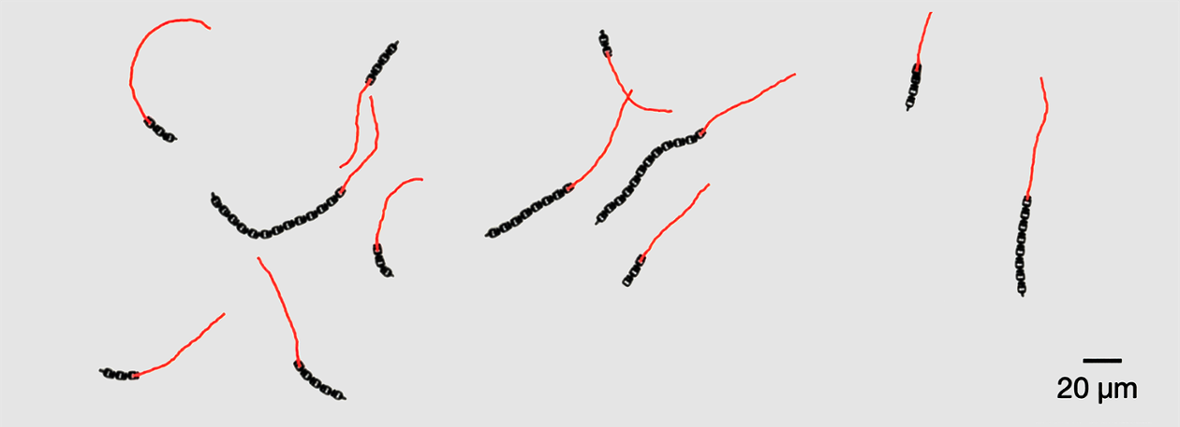
At Leiden University, Professor Daniela Kraft and researcher Mengshi Wei have built microscopic robots that move, navigate obstacles, and adapt to their surroundings, without sensors, software, or external control. This research opens up entirely new possibilities for biomedical applications.
The concept didn’t come from engineering theory, it came from watching animals move. Worms and snakes continuously reshape their bodies as they travel, allowing them to slip through complex terrain without conscious planning. Macroscopic robots have long borrowed this principle, but shrinking it down to the microscale had always hit a wall: small robots were rigid, and flexible robots were large. Kraft and Wei set out to close that gap.
Their solution was a soft, chain-like structure made of flexibly connected segments, fabricated on a Nanoscribe 3D microprinter. Each element measures just 5 µm, with bar-joints of 0.5 µm connecting them. To put that in perspective, a human hair runs between 70 and 100 µm thick.
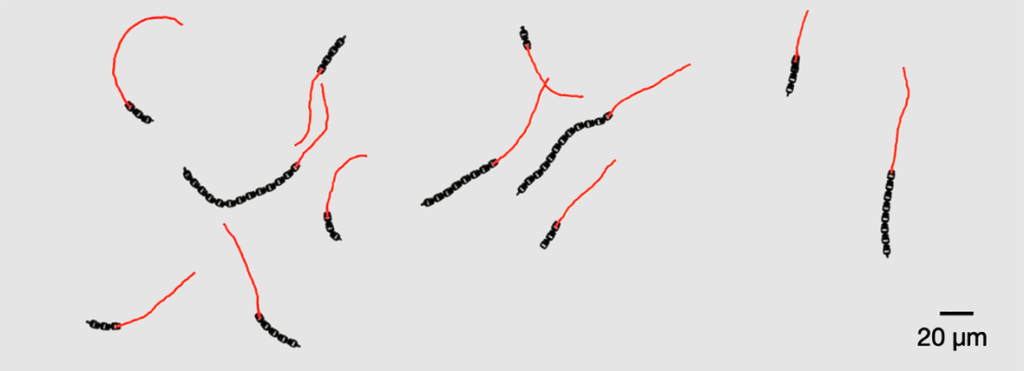 3D printed robots that swim and navigate. Image via Universiteit Leiden.
Shape as the Only Engine
When an electric field is switched on, the chains begin to swim. What the researchers didn’t anticipate was what came next: a continuous loop of feedback between the robot’s form and its motion. The shape dictates how it moves; the movement reshapes the structure. In effect, the robot senses its environment through its own body, no electronics required.
“When the robot is slowed down or even stopped, it starts to wave its tail as if it wants to break free,’ Wei says. ‘This happens, because the elements in the back still want to move, and they can do so because of their flexibility.”
The practical consequences are striking. When the microrobot encounters an obstacle, it automatically searches for an alternate route. When two robots cross paths, they steer away from each other without any external instruction. They can push objects out of their way and maintain movement through dense, crowded environments, behaviors that typically require onboard computation to achieve.
What Comes Next
The implications for medicine are far-reaching. Robots capable of autonomous navigation through biological environments, bloodstreams, tissue, narrow cavities, could open new frontiers in targeted drug delivery, minimally invasive diagnostics, and surgical procedures too delicate for conventional tools.
For Kraft, the immediate priority is understanding the underlying physics before scaling up the ambition. “We now need to fully understand how such dynamic and functional behavior emerge. This knowledge will help us develop more advanced microrobots and devices, but also to better understand the physics of biological microswimmers and organisms.”
3D Printing and the Rise of Smart Microrobotics
Kraft and Wei’s Leiden robots are part of a broader strategic wave in which 3D printing is becoming the primary tool for building intelligence directly into a robot’s physical form, rather than relying on onboard electronics, software, or external control systems. The underlying logic is the same across research groups worldwide: at the microscale, traditional components simply cannot shrink far enough to be useful, so structure itself must do the work.
Several research groups are already advancing this strategy in distinct directions. Scientists from ETH Zurich developed multi-material 3D printed microbots using a Nanoscribe two-photon polymerization system, combining metallic cage and helix geometries that generate a tumbling motion through blood vessels for targeted drug delivery.
At UCLA, researchers developed active metamaterials that serve simultaneously as the mechanical and electronic systems of a robot, 3D printed in a single pass into tiny “meta-bots” capable of pathfinding around obstacles and navigating rough terrain, with biomedical applications ranging from self-steering endoscopes to swimmer bots for drug delivery.
What sets Leiden’s contribution apart is the removal of even magnetic actuation from the equation, replacing external control entirely with the geometry of the structure itself.
3D Printing Industry is inviting speakers for its 2026 Additive Manufacturing Applications (AMA) series, covering Energy, Healthcare, Automotive and Mobility, Aerospace, Space and Defense, and Software. Each online event focuses on real production deployments, qualification, and supply chain integration. Practitioners interested in contributing can complete the call for speakers form here.
To stay up to date with the latest 3D printing news, don’t forget to subscribe to the 3D Printing Industry newsletter or follow us on LinkedIn.
Explore the full Future of 3D Printing and Executive Survey series from 3D Printing Industry, featuring perspectives from CEOs, engineers, and industry leaders on the industrialization of additive manufacturing, 3D printing industry trends 2026, qualification, supply chains, and additive manufacturing industry analysis.
Featured image shows 3D printed robots that swim and navigate. Image via Universiteit Leiden.