
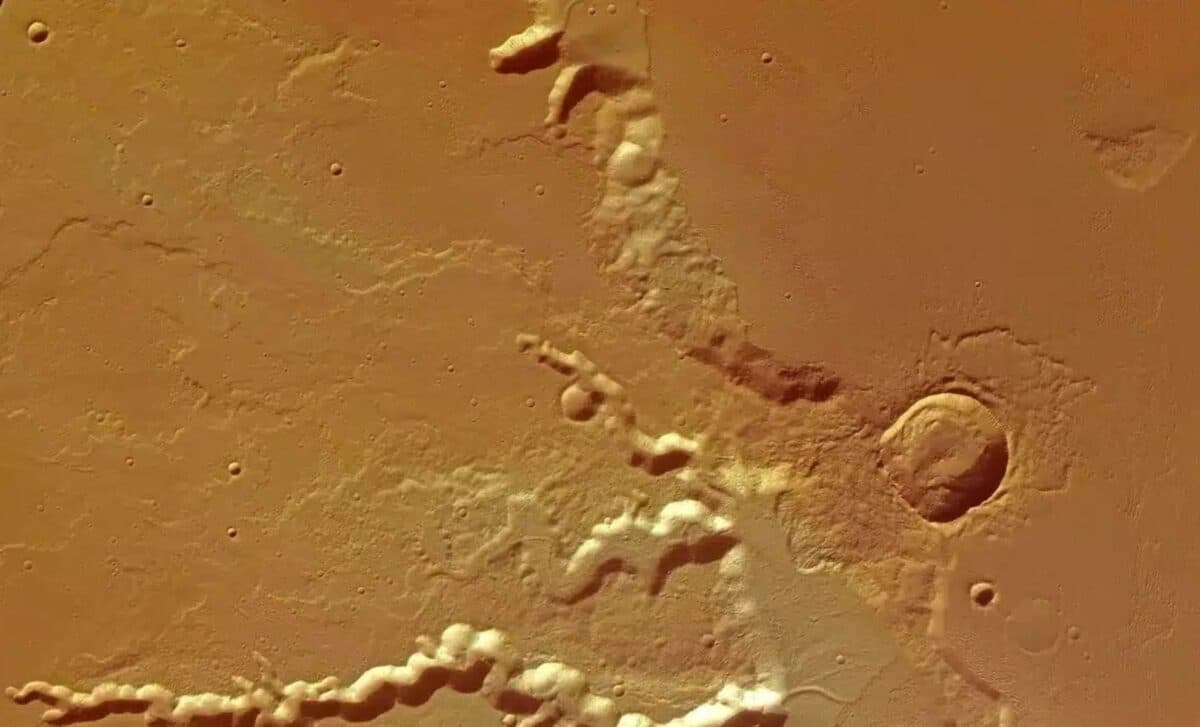
A vast stretch of Mars near the equator, long written off as windblown dust, holds one of the largest water deposits ever found on the planet. Data from the European Space Agency’s Mars Express orbiter shows that the Medusae Fossae Formation, a sprawling geological structure straddling the Martian equator, contains layers of frozen water buried under hundreds of meters of volcanic ash and dry sediment, reaching depths of up to 3.7 kilometers.
Melted, that ice would cover all of Mars in a layer of water between 1.5 and 2.7 meters deep, the most water ever identified in the planet’s equatorial band, and in a zone where stable surface ice has no business existing under current conditions.
Mars surface height map showing the location of the Medusae Fossae Formation (MFF). Image Credit: ESA
The timing matters. Scientists are actively planning crewed missions to Mars, and those missions will need to land near the equator, far from the polar ice caps that dominate most water-ice maps of the planet. Water is not a nice-to-have; it is fuel, oxygen, and drinking water. Finding it this close to an ideal landing zone changes the math.
A Formation Nobody Could Quite Explain
The Medusae Fossae Formation runs roughly 5,000 kilometers along the boundary between Mars’s highland and lowland terrain. It is thought to be the single largest source of dust on the planet, feeding the seasonal storms that can swallow Mars whole. Up close, it looks like a series of wind-carved mounds, some hundreds of kilometers wide and several kilometers tall, scoured over billions of years. Where it came from has never been settled, hypotheses range from ancient lava flows buried in volcanic ash to ice-rich sediment deposited during a wetter era.
Map of potential ice thickness in the MFF. Image Credit: ESA
Mars Express first turned its MARSIS radar toward the Medusae Fossae Formation in 2007 and picked up massive buried deposits reaching 2.5 kilometers deep. The readings were strange: the material was low in density and nearly transparent to radar. That profile fit either fine dust or ice. Without more data, neither could be ruled out, and the question sat open for fifteen years.
Why the New Data Rules Out Dust
“We’ve explored the MFF again using newer data from Mars Express’s MARSIS radar, and found the deposits to be even thicker than we thought: up to 3.7 km thick,” said Thomas Watters of the Smithsonian Institution, who led both the new study and the original 2007 investigation. “Excitingly, the radar signals match what we’d expect to see from layered ice, and are similar to the signals we see from Mars’s polar caps, which we know to be very ice rich.”
The argument against dust is physical. Co-author Andrea Cicchetti of Italy’s National Institute for Astrophysics explained that a pure dust pile several kilometers deep would compress under its own weight into something far denser than what MARSIS actually detects.
Mars Express radar image (black and white) showing layers of dry material and possible ice in the MFF below the surface. Image Credit: ESA
The team ran models of every plausible ice-free material and found none that matched the radar readings. Ice was the only thing that fit. The picture that emerges is a structure of interlayered dust and ice, sealed beneath a dry cap of ash and sediment several hundred meters thick, which is also why it has survived this long without evaporating into the thin Martian atmosphere.
The internal layering adds further weight. As described in the study published in Geophysical Research Letters, the stratified structure of the deposit closely resembles the polar layered deposits that form Mars’s north and south ice caps, formations that are well established as ice-rich. The same radar signature appearing at the equator is not a coincidence the data can easily explain away.
How Water Ice Ended up at the Equator
This is the part that has no clean answer yet. Under today’s thin Martian atmosphere, water ice at the equator is unstable, it would evaporate directly into gas within geologically short timescales. For it to accumulate there at all, Mars must have been operating under very different conditions.
The strongest candidate explanation involves Mars’s axial tilt. Unlike Earth, which tilts within a narrow range, Mars swings through far larger variations over long cycles. During periods of high tilt, the poles would have faced the Sun more directly, warming and releasing water vapor, while the equatorial zone cooled enough for ice to settle out and build up.
View of the MFF from Mars Express’s High-Resolution Stereo Camera. Image Credit: ESA
Layer by layer, those deposits were then buried under ash and dust, which insulated them well enough to survive to the present. The Medusae Fossae Formation may be a climate record, a snapshot of an ancient Mars that no longer exists, preserved underground.
What It Means for Exploration
ESA’s project scientist for Mars Express, Colin Wilson, put it plainly in the agency’s announcement: “How long ago did these ice deposits form, and what was Mars like at that time? If confirmed to be water ice, these massive deposits would change our understanding of Mars climate history. Any reservoir of ancient water would be a fascinating target for human or robotic exploration.”
The Medusae Fossae Formation sits in a near-ideal location for future Mars missions. The equatorial band offers more stable temperatures than the high latitudes and is easier to reach from a trajectory standpoint. Most known Martian ice sits at high latitudes, where missions are harder to design and execute. A water source at the equator removes one of the central logistical problems any long-duration surface mission would face.
The deposit has not been confirmed by direct sampling, and MARSIS alone cannot eliminate every alternative interpretation of the radar data, though the team found no ice-free material that fits. The next step is cross-referencing these results with data from NASA’s SHARAD radar aboard the Mars Reconnaissance Orbiter, which has already contributed to subsurface mapping of the same region and could help tighten the case.