
It’s harder than ever to be a young starting pitcher in Major League Baseball. The evidence for that? Last year, we had the fewest starters aged 25 and under to reach 80 innings since MLB’s free-agency era began.
That continues a downward trend.
The reasons for this are varied. There could be an issue with using Stuff+ grades to develop pitchers who have optimized each pitch but don’t have a great sense of how to put them all together into a working arsenal. Injuries could also have something to do with this, because innings volume is down everywhere. The biggest reason is that teams just don’t push their minor leaguers to throw deep into games (perhaps because of a fear of injury), so they don’t arrive with the ability to pitch into those later innings.
All of this is to say that it’s hard for a young pitcher to come into the league with all the weapons and the bulk to become a dominant force right away. And yet, over the past week-plus, we’ve had six young starters join the fray, all of whom have tantalizing upside. We want them to be ready to stay in the big leagues for the long haul. Are they?
Let’s take a look at their arsenals.
Payton Tolle, LHP, Boston Red Sox
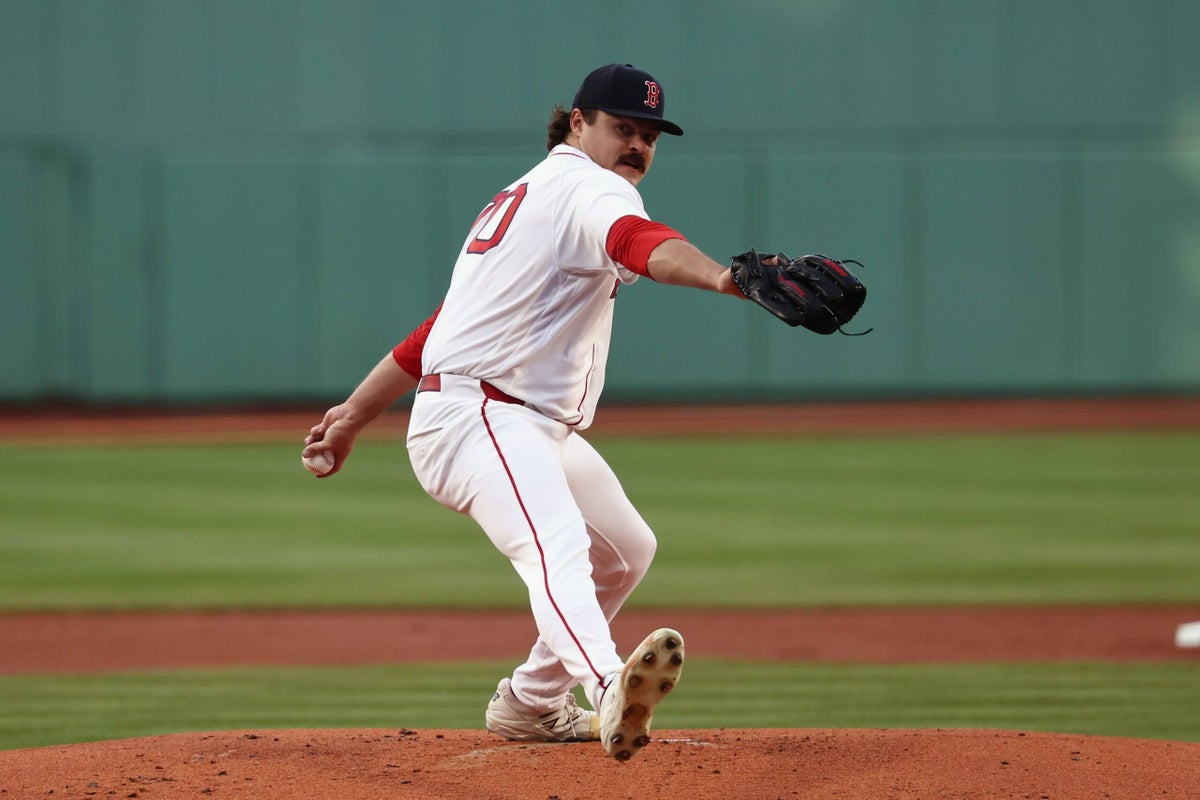
What a great re-debut for Tolle. Eleven strikeouts, one walk and one earned run over six innings against the Yankees, who have been a top-five offense so far. He showed some of the same aspects that were so exciting in his MLB debut late last year, with a few wrinkles that bode well for the future.
The main reason he’s probably going to be great is that none of his pitches move like they are “supposed to.” (Chart courtesy of Statcast.)
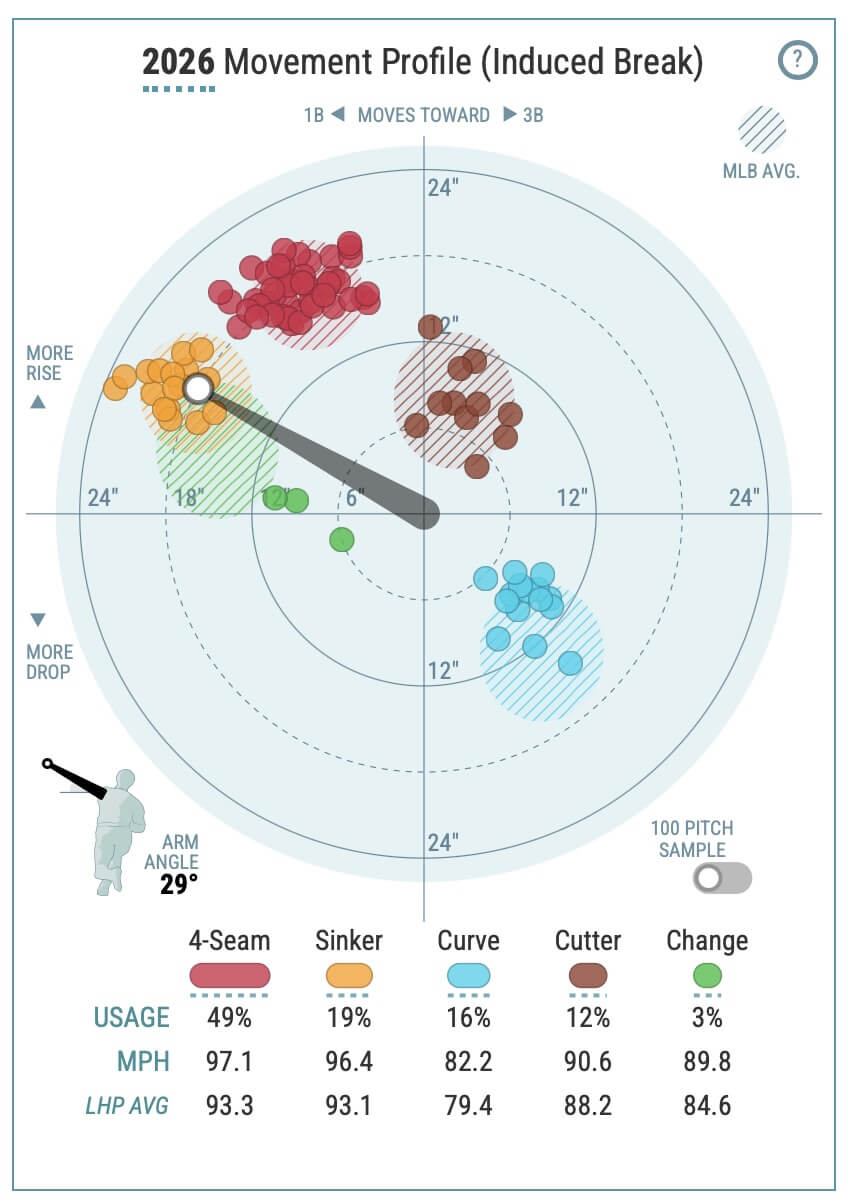
His arm angle is in the bottom 20 percent of the league, and yet he gets above-average ride on the fastball. Curveballs from his arm slot, at that velocity, should have three inches more drop and four inches more horizontal movement. His cutter gets two inches more horizontal movement than those thrown from similar arm slots. That changeup gets four inches more drop than the average changeup, and six inches less sideways movement, from a slot that normally augments sideways movement.
Tolle is basically a vertical pitcher coming from a low slot. There aren’t great comps for him.
The new wrinkle this year is a sinker. It’s not a standout by shape, just velocity. But, for a player who had some troubles with command last season, and had varying command grades as a prospect, the most important thing is that he can command it well. Look how he sprayed the four-seamer but kept the sinker in the zone against the Yankees.
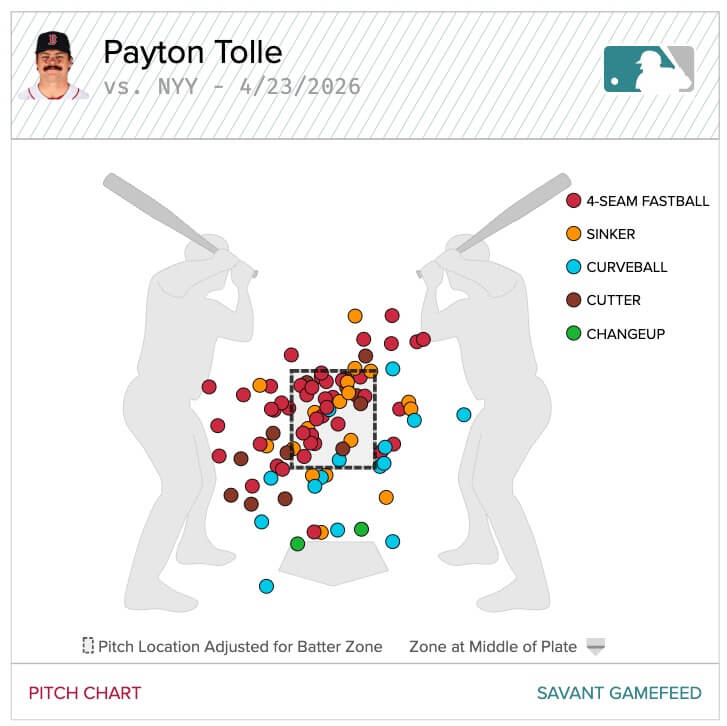
There’s still some risk in how much the cutter and four-seamer were scattered. If he gets pigeonholed to the sinker and curveball in certain counts, batters will have an easier time. But a Tolle with even average command will be an absolute beast, with the upside to be a top-10 pitcher in this league. Even a conservative projection for the rest of the season includes a sub-four ERA and a strong strikeout rate. A star in the making.
Noah Schultz, LHP, Chicago White Sox
In his first start, Schultz looked pretty hyped up. He had some trouble corralling his fastball, which was up a tick-plus over where it had been in the minors. He threw a seed right at the toenails of his catcher on a bunt. It’s tough heading straight from high school into the professional ranks and being the face of the future for a struggling franchise.
In his second start, he settled down. He was more 96 than 97, and he located his four-seamer well. Take a look at where he put his pitches to right-handers in his starts, and you can see the difference that being a little more relaxed can make. His third start was a mix of the first two: good cutter command, bad four-seam command.
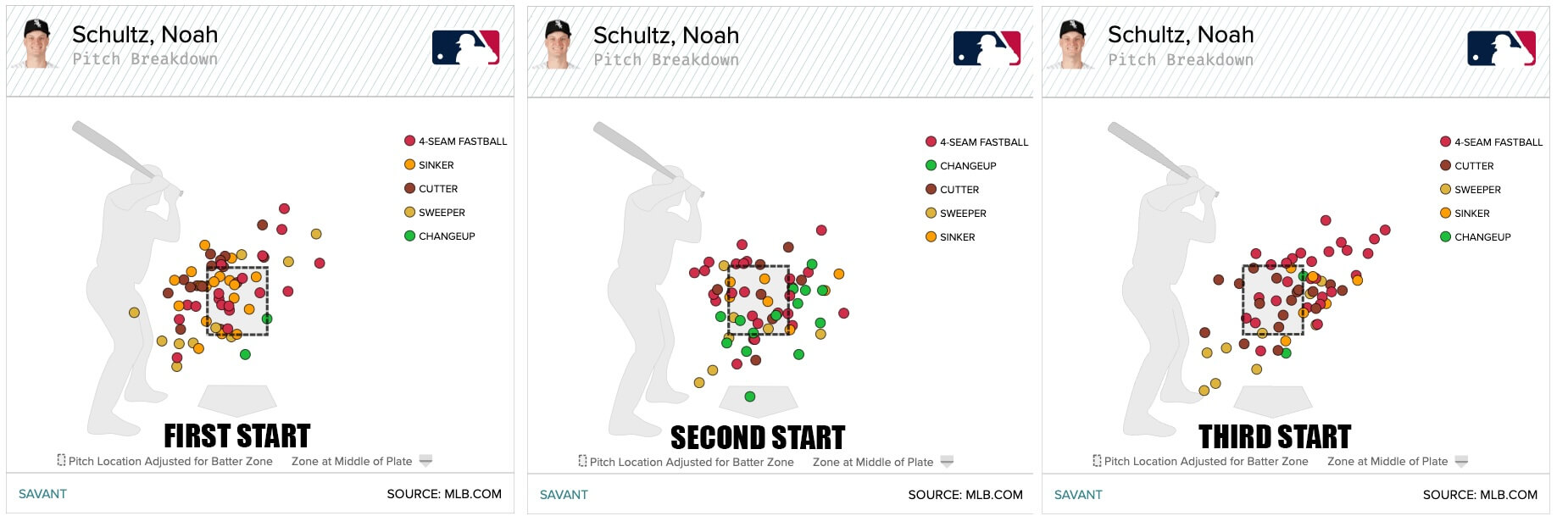
His command remains an open question, but there are some good signs in the heat maps. When he can command the four-seamer decently inside to righties, he’s dominant. Using the cutter on the outside to play off the changeup — as he did in his second start — looks like a winning combo. The changeup comes and goes.
The fact that he has three fastballs that are all high-velocity is good news. His cutter is his best pitch by the model; his changeup gets the most whiffs. The pieces are there, but it might be too soon to see if the secondaries match the fastball quality. There isn’t really a great comp for a low-slot lefty with this arsenal, but if he could back-foot the sweeper like Chris Sale and figure out the cutter like Garrett Crochet, he still has a couple of pathways in front of him to join the greats atop the league. Someone like Connolly Early has a better changeup, but Schultz has more velocity and a better cutter. The market favors Early now, but that may not hold forever.
In the short term, hopefully the White Sox let him throw more than 80-ish pitches going forward. He has a decent schedule going into San Diego and Anaheim before coming home to face the Royals, and that (along with his potential) is enough for him to be rostered in most leagues.
Didier Fuentes, RHP, Atlanta Braves
There’s young, and then there’s Didier Fuentes young. The 20-year-old tore through the minors so quickly with stuff so big it’s easy to forget he’s still a kid. But he’s still enjoying himself out there like one.
Braves P Didier Fuentes says that his pizza patch on his glove is there because he likes pizza
— Barrett Sallee 🇺🇸 (@BarrettSallee) April 23, 2026
Fuentes’ best pitch is his fastball. Despite an arm angle in the bottom 15 percent of the league, he gets average ride on the pitch (see how his fastball in red dots sits near the average fastball denoted by red shading). That surprising movement comes with 96-97 mph velocity. (Chart courtesy of Statcast.)
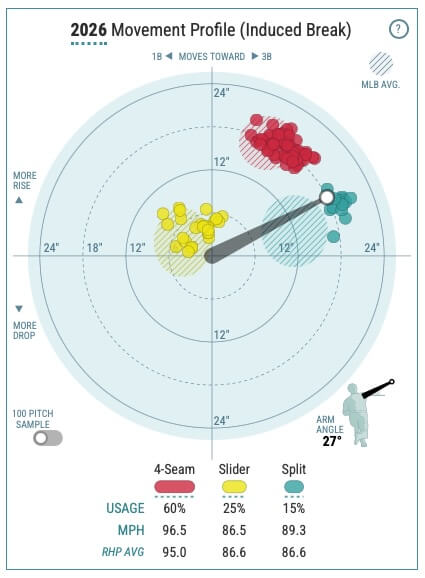
The 87-mph gyro slider without much movement isn’t as special. It’s not bad velocity, but the best gyro sliders sit north of 87 and 88 mph. The split-finger has less drop than you’d expect, and the Stuff+ model doesn’t love it, but he’s shown decent feel for it and it might be good enough.
The Braves optioned Fuentes late last week, but we are likely to see him again in the big leagues this season. As exciting as the fastball is, he is an unfinished product. If the splitter is his best secondary, maybe he could be like Joe Ryan and find a couple of breaking balls that are good enough to keep hitters off-balance. A bigger, slower breaking ball would add a couple of dimensions to this arsenal that aren’t there now. With a dominant fastball, his ceiling is as good as anyone else on this list. With a smaller arsenal and some flaws in the secondaries, his immediate future might be shorter outings that start very well and end with some traffic on the bases.
Connor Prielipp, LHP, Minnesota Twins
A 2022 second-rounder out of Alabama, Prielipp sits nearly 96 from the left side, but might not pitch how you’d expect. Because his four-seam movement matches his arm angle and is nearly league average, it’s not a great offering by modern pitch modeling standards. Not surprisingly then, he threw his slider twice as often as his fastball in his debut. Because it’s an 88 mph “gyro” slider with very little movement, it theoretically has less of a platoon split than a bigger slider, and Prielipp was able to bury it inside very effectively in his first start.
In the minors, he threw the four-seamer a little more and the slider a little less, so this may have been a scouting-report-driven anomaly, but he’ll throw the slider a lot nonetheless. It’s good to see that the Stuff+ model says that it’s a strong pitch against righties, and he locates his changeup really well and has a curveball to boot, so it’s a legitimate four-pitch mix even if it’s light on four-seamers.
The closest comp in terms of pitch usage and quality might be Yusei Kikuchi or Reid Detmers, two over-the-top lefties with better sliders than fastballs. If Prielipp can dial in the command of the four-seamer (he sprayed the pitch above the zone in his first start), he could separate himself from the comps somewhat. But it’s worth noticing the ups and downs in those two lefty arms with similar reliance on sliders. Without a dominant fastball, Prielipp may find himself oscillating a little start to start and year to year as he figures out the right mix of effort and velocity and command on the four-seamer.
In the immediate future, he’s got Seattle at home, and his team gave him 83 pitches in his first start, so that seems like a decent situation in fantasy leagues. Will he get to the next start against Toronto? Watch Simeon Woods Richardson, who isn’t striking anyone out and doesn’t have any options left. How long will the Twins stick with the low-stuff righty if Prielipp is dealing?
JR Ritchie, RHP, Atlanta Braves
Despite being greeted rudely — his first pitch was deposited in the seats by James Wood — Ritchie’s MLB debut was a great success. Seven innings, seven strikeouts, two walks and two solo homers allowed against a Washington Nationals team that has been decent offensively. But the fact that he gave up homers to two lefties may not be an accident. Here are Ritchie’s Stuff+ numbers against lefties, which mirror almost exactly the numbers he was showing in the minors.
JR Ritchie’s Stuff+ versus lefties
TypenS+L+P+
Four-seamer
23
82
117
105
Curve
18
87
103
97
Change
17
89
85
79
Slider
8
84
134
136
Cutter
7
87
87
84
He doesn’t have great weapons against lefties. He still has that nice, wider pitch mix with good command, but it could be that he’s lacking the stuff that would give him great upside. It’s still a small sample, even for a stat designed to work in small samples, so where could the model be wrong? It could just misunderstand how good his changeup is, though it’s worth pointing out that the pitch got below-average grades from most prospect evaluators, and it got below-average whiffs against the Nationals and in the minors. Stuff+ usually nails four-seamers, even in tiny samples, and that’s the pitch Wood hit out.
It’s pretty wild, but 94.4 mph on the four-seamer is below-average velocity these days. None of his pitches are a lock to produce whiffs based on their action — as Keith Law put it, he has a “big arsenal of mostly average to above-average pitches, without a clear out-pitch to get him past No. 4 starter upside,” and the Stuff+ model agrees. Ritchie’s excellence may depend more on his command than it first appears.
Walbert Urena, RHP, Los Angeles Angels
The changeup looks impossible.
That’s a 92-mph changeup buckling Manny Machado’s knees. Pretty nasty.
As impressive as that pitch and Urena’s 98-mph sinker are on paper and even to the eye so far in the big leagues, his minor-league numbers were not great. He threw 141 innings last year, which is great bulk, but the top-line numbers (4.34 ERA, 1.36 WHIP) were supported by mediocre walk and strikeout numbers. His near-60 percent ground-ball rate helped him keep the ball in the park, and gives him great floor, but is there anything to suggest he can keep up the above-average strikeout rate he’s shown so far in the big leagues (and never before)?
Maybe not. The Stuff+ model says to expect around 35 percent whiff rates from the slider and the changeup, given their movement and velocity profiles, and as much as the José Soriano comps are right there for the making, his teammate has run 40-plus percent whiff rates on multiple pitches even before his big breakout this year. There is a decent comp of a pitcher with lower whiff rates, good ground-ball rates, good velocity and a similar arm angle: Brayan Bello. Urena has a better four-seamer, and that might make all the difference in terms of ceiling. But in terms of understanding what it might look like as Urena tries to get there, Bello seems like a decent place to start.