
Tales of the unexpected played out across the weekend’s URC matches, as lower-placed teams rattled the cages of those in contention for the playoffs.
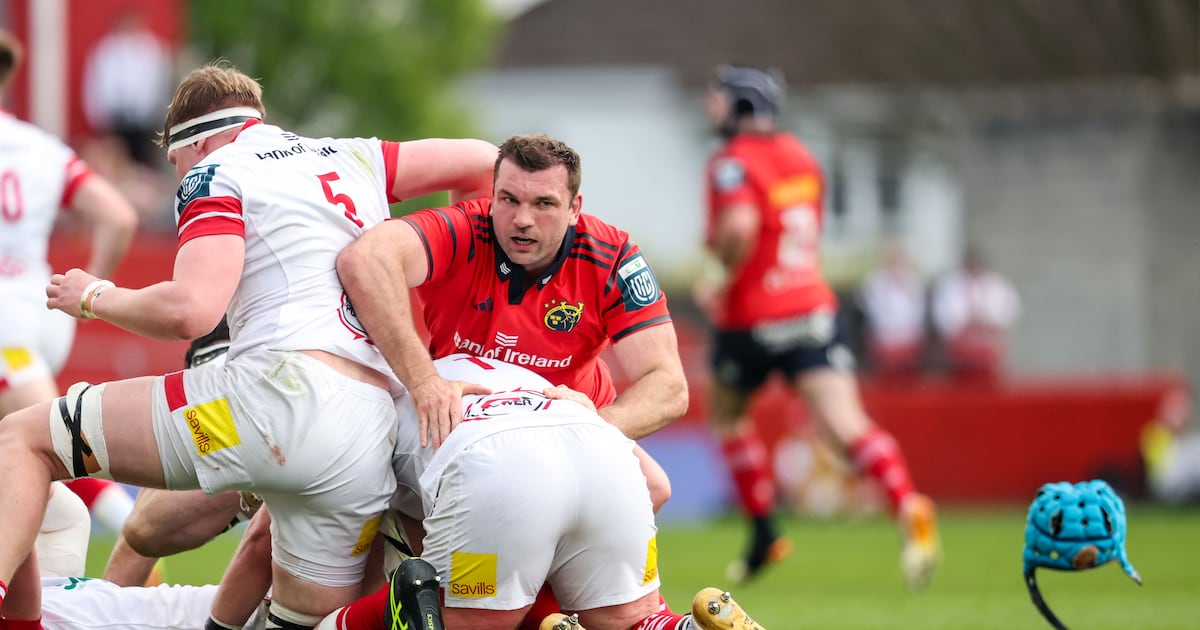
Let’s look at the goings-on at Thomond Park. This match will have done precisely nothing for parents struggling with the idea of their young kids playing the game. It was carnage, a war of attrition. More like Russell Crowe’s Gladiator than sport. Nasty injury followed nasty injury, players were clearly badly hurt, with some uncertain to play again this season.
Richie Murphy’s young Ulster team again showed the merit of how they go about their business, putting in a serious challenge to the hot favourites. Referee Sam Grove-White was in charge and he entered the arena smiling and looking relaxed. That would be shortlived. Within minutes, Tadhg Beirne had a very serious point to make to the referee. It’s impossible not to agree with the Munster captain on this one.
Beirne, no doubt, was referring to several early side-entries into the breakdown which weren’t picked up by the referee. He had a valid point because these can be very dangerous. Some of the looks he threw in the direction of Grove-White as the game went on spoke volumes.
The post-tackle breakdown was like something from days of long ago. Players from both teams were coming in the side or diving in off their feet, sealing off the ball at will. The referee was apparently happy to adopt a laissez-faire policy. He was fortunate that by the time he called proceedings to a halt, Munster had pulled away on the scoreboard. But the idea that a convincing win can hide a below-par refereeing performance is misplaced.
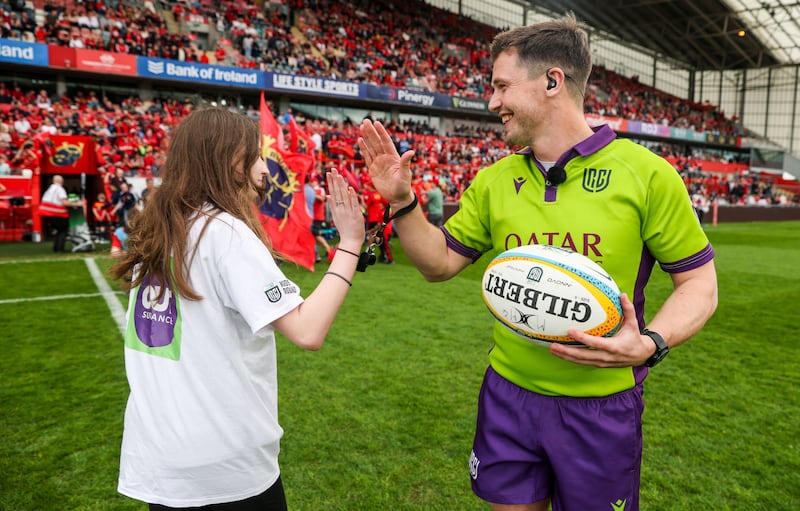 Saoirse Prenderville with referee Sam Grove-White before Saturday’s URC match between Munster and Ulster at Thomond Park. Photograph: Nick Elliott/Inpho
The scoreboard had moved along nicely for Munster, who notched up a couple of tries while Ulster’s Tom Brigg was in the bin for deliberately knocking the ball forward. Murphy would be right to look askance at that call – it was unnecessarily severe. The referee failed to take the same action for something similar by Calvin Nash.
The URC do have a problem with referee appointments, caused by their insistence on neutrality. Bit by bit, it has led to mediocrity and, well, just more mediocrity – at best. Both Grove-White and his compatriot Mike Adamson have proved to be in the high-risk category in recent times. Despite this, they keep getting assigned to matches of great significance. Based on their overall performances in the last season or two, it is difficult to see how they are considered up to the task.
As recently as the previous week, questions were asked of Adamson and his TMO, Andrew McMenemy. They didn’t notice any foul play when Ospreys’ Luke Morgan threw himself dangerously on top of Sharks’ try scorer Ethan Hooker. While most players do their best to avoid such dangerous collisions, we are still seeing too much of it. It needs to be high on any referee’s check list when tries have been scored.
The URC send neutral referees and TMOs to each match. The officiating team is then completed by the appointment of “home” assistants who are put in the invidious position of making calls for or against “their” team. No wonder they don’t seem to want to get involved. This may well be a money-saving exercise but, as we are now at the sharp end of the competition, if they want a neutral team of officials, then that’s what it should be. The coffers must be opened so that the entire team of officials is neutral.
There was a sting in the tale of the weekend at the Stadio Comunale Monigo, where Leinster played Benetton. What seemed a needless infringement in the dying embers cost Leinster the match. While there are always issues to discuss, there is little point in trying to blame South African referee Morné Ferreira. I’d be surprised if Leo Cullen took issue with him.
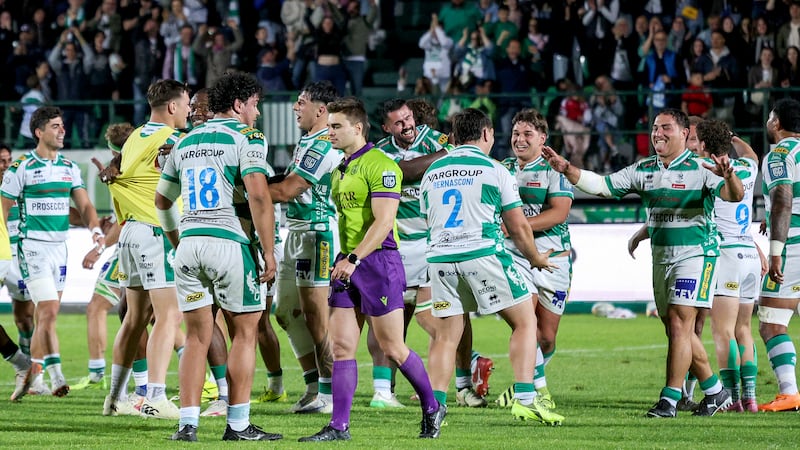 Benetton players celebrate with Jacob Umaga after he kicked a penalty to win Saturday’s URC match against Leinster at Stadio Comunale Monigo in Treviso, Italy. Photograph: Roberto Bregani/Inpho
However, like so many, Ferreira looked to be very dependent on his TMO. I’d hazard a guess that the anticipated new protocols will reduce the reasons a TMO can instigate a conversation with the man in the middle.
If that comes to pass, which it should, it will be a huge wake-up call for quite a few match officials. I wonder if they all will manage to adapt.
Now, let’s go back in time for a moment, to Twickenham in 1982. When Ollie Campbell was the victim of a late, high, cheap shot by England’s Peter Winterbottom as ‘Ginger’ McLoughlin stormed to his never-to-be-forgotten try. The outhalf retaliated in the only way he knew. He got up, dusted himself down and kicked the touchline conversion, which was vital to Ireland’s 16-15 winning score.
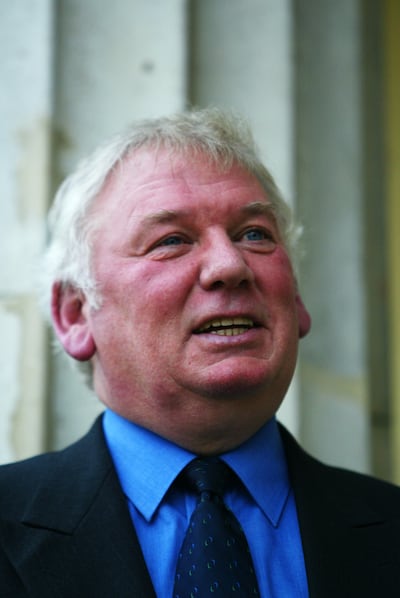 Former referee Allan Hosie died last week. photograph: Clive Mason/Getty Images
Campbell had “cleverly” started the move leading to the try by having an attempted dropgoal charged down. Ireland quickly regained possession and a magical swift-passing interchange then followed. It involved five or six players, with Campbell and Willie Duggan both handling twice. Unsurprisingly, the great Fergus Slattery was also involved. It sent McLoughlin rampaging towards the goalline, with team-mates binding on to him, joining the charge. Even winger Trevor Ringland was seen in the middle of the driving maul.
It was a slice of good Irish luck that the referee was the outstanding Scot, Allan Hosie. He had a truly uncanny sense of anticipation. This was key to being perfectly positioned to award the try – touched down somewhere amid a pile-up of Irish bodies.
Allan Hosie passed away last week. He was not just a very fine rugby referee, but a true gentlemen in every way. He will be remembered with great respect and affection throughout the world of rugby. Requiescat in Pace.