
An ignorant comment from federal opposition energy spokesman Dan Tehan last week has solar recyclers bristling, and one company founder is now on a media tour to prove that, actually, his tech does exist and he’s making good money off of it.
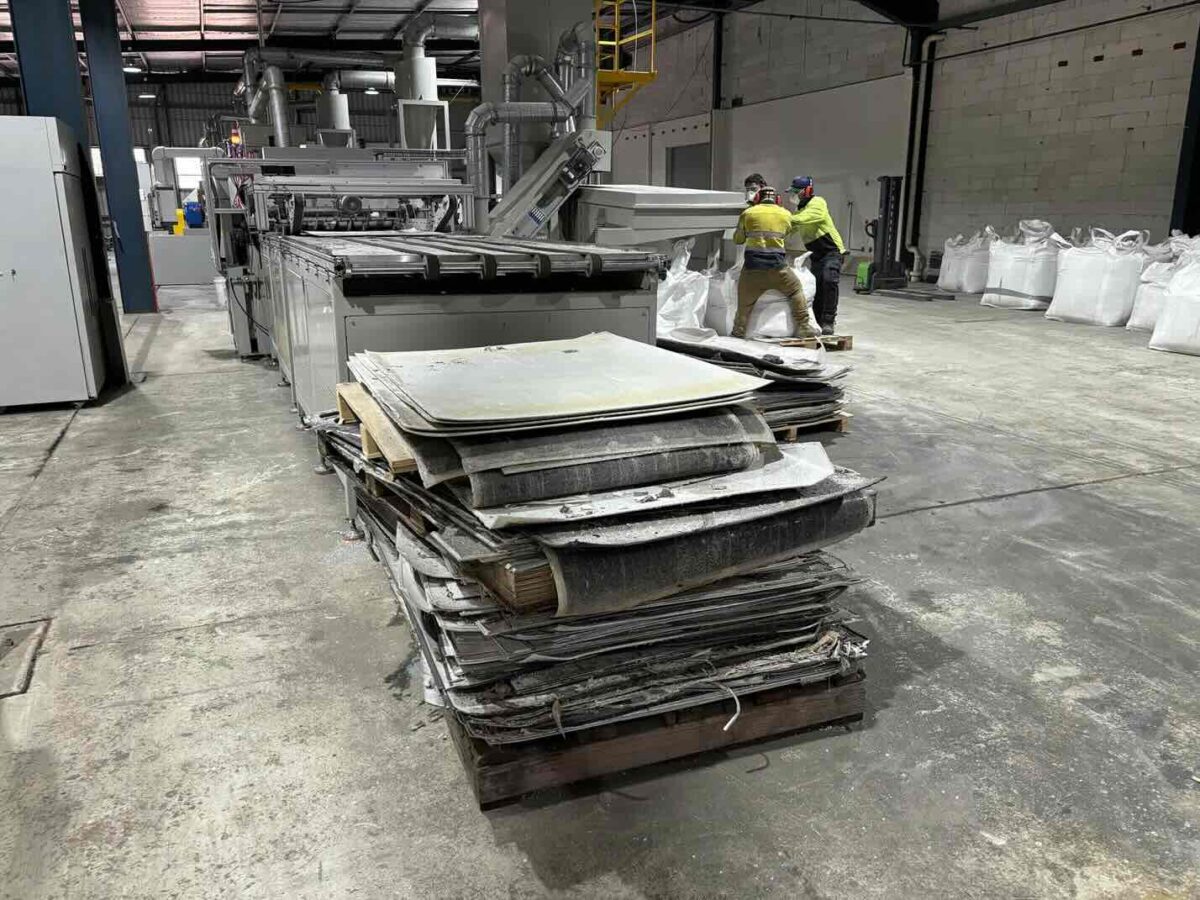
John Hill is the cofounder of Pan Pacific Recycling, a Brisbane-based company that has a machine that can strip a solar panel of its valuable parts in 45 seconds.
“We’re able to remove all the products from the panel,” Hill tells Renew Economy. “It enables us to do broken panels, whole panels, misshapen panels, to a degree, without flattening them back out.”
Pan Pacific has been doing this commercially since 2023 – hence the irritation with the likes of Tehan saying they don’t exist – and is projecting revenue of $5 million from solar recycling alone this financial year against $3 million in costs, including the R&D and machinery spend.
That’s on a “gateway” of $10 per panel, and making a 50c margin from material sales. That margin is not quite good enough, but it’s early days yet, Hill says.
Buyers include a manufacturer that was turning the glass into benchtops and floor tiles and engraving each tile saying as much, and jewellers who bought the silver.
But the big sellers are copper and aluminium, which Pan Pacific projects to bring in $1.1 million and $1.9 million alone this financial year as they’re able to sell it at the very top end of what recycled metals get in Australia.
The company is not even the only very-high-recovery solar panel recycler in Australia – although given the challenges of competing with cheaper landfill or crushers, its company is slim.
Victoria-based Elecsome is one competitor still in the industry, and Sircel is still advertising its solar recycling services despite administrators being called in last year over what it called a business dispute in the e-waste division.
We exist
The industry has been pushing for years for policies around recycling and stewardship, and frustration boiled over last week when a story in The Australia suggested even the federal environment and energy department doesn’t think solar recycling is possible.
The newspaper quotes Tehan saying this proves “solar panels are not renewable” and that the issue of solar panel disposal threatened to “become a huge problem for Australia into the future.”
“All these panels are made overseas using materials which will not recycle,” Tehan said.
“So the government has to front up and tell Australians what they’re going to do with the huge waste that we’re going to be left with from these overseas-produced and manufactured solar panels.”
And yet last year the federal government started work on a stewardship campaign which seeks to mandate this process and last month put $24.7 million into a 100-site recycling pilot. Queensland backed a recycling pilot in 2024.
Hill invited Tehan, and other politicians, to visit and see what people “are doing in the real world.”
“Australia invented the solar panel, and we’ve invented the technology to recycle,” he says.
Secret tech
The machine scans a panel in – provided it’s flat; if not, human-power gives it a helping hand – and logs every detail from brand through to wattage and chemistry and provides a traceability “passport” for the final materials.
The machine then strips the panel of the junction box, aluminium frame and glass, and sends the remaining silicon and plastic back sheet with all of the valuable metals such as copper, silver and antimony into a grinder.
It’s at this point where Hill becomes a bit cagey, because this bit of process comes with a cloak of secrecy.
The overview is that the ground-up pieces of silicon and backsheet go into an electrostatic separator that divides each material by its individual electrostatic charge. These are further cleaned in a vibrating device that sorts each piece by gravity.
“Most people think heavy things come out the bottom when you talk about gravity, but our copper comes out the middle, our silicon goes out the top, and plastics go out the bottom,” Hill says.
“The way the machine essentially works is it vibrates and so the heavy material will actually climb.
“It’s [about] getting those angles and getting those air flows and vibrations just right so it climbs out clean.”
Then it’s into a chemical bath – another trade secret because they can reuse almost all of the chemical – to do a final clean and separation of the metals and materials in the plastic backing.
The machine needs about 300,000 panels each year to make it worthwhile to run.
Moving offshore
Expansion plans are afoot, according to Hill.
He says they’re signing a memorandum of understanding with a company in Belgium to licence the tech, and talking to a company in the UAE – negotiations currently held up by a lack of flights out of the Middle East right now.
Pan Pacific already has five plants licensed and operational in New Zealand which are handling electric vehicle (EV) recycling – tweaks to the tech means it can test and repackage lithium batteries so it only recycles the parts that need to be.
In Australia, the company wants to have a plant in Western Australia possibly by the end of 2026, and there are looser plans for one in South Australia, two in New South Wales and another one in Queensland.
Victoria’s no-landfill rule is working against Pan Pacific right now, Hill says, because companies that just crush up panels rather than actually separate and recover the different materials can do this rough-and-ready work much more cheaply.
Each machine needs a minimum of 300,000 panels a year, which rules out Tasmania for now as it doesn’t have the supply.
That supply rate also means the upcoming $25 million national stewardship pilot, which will collect and recycle up to 250,000 panels over a 12-to-18-month period starting mid-way through this year, vastly underestimates the volume of supply Hill is expecting with his expansion plans.
“We welcome the stewardship pilot, but I think they have underestimated the numbers that are there…. Considerably,” Hill says.
If you would like to join more than 29,000 others and get the latest clean energy news delivered straight to your inbox, for free, please click here to subscribe to our free daily newsletter.

Rachel Williamson is a science and business journalist, who focuses on climate change-related health and environmental issues.