
The NHL Draft Lottery has always been cruel to the Vancouver Canucks.
Next week, however, perhaps things will be different. There’s at least a chance, and a good one.
By virtue of their 32nd-place finish, the Canucks will be allocated 185 of the 1,000 possible combinations of draft lottery balls when the NHL holds the annual draw in New Jersey on May 5. It will be a critical night for Canucks fans, and for a franchise that has never once benefited from the good fortune of a random draw at any point in its history.
Given the importance of the lottery, let’s preview the top of the 2026 class by sharing a few thoughts on some recent developments that could shake up the top of the draft order.
1. One final front in the battle for No. 1
It’s been an interesting race at the top of the 2026 class throughout this season between a pair of potentially transcendent scoring wingers in Gavin McKenna and Ivar Stenberg.
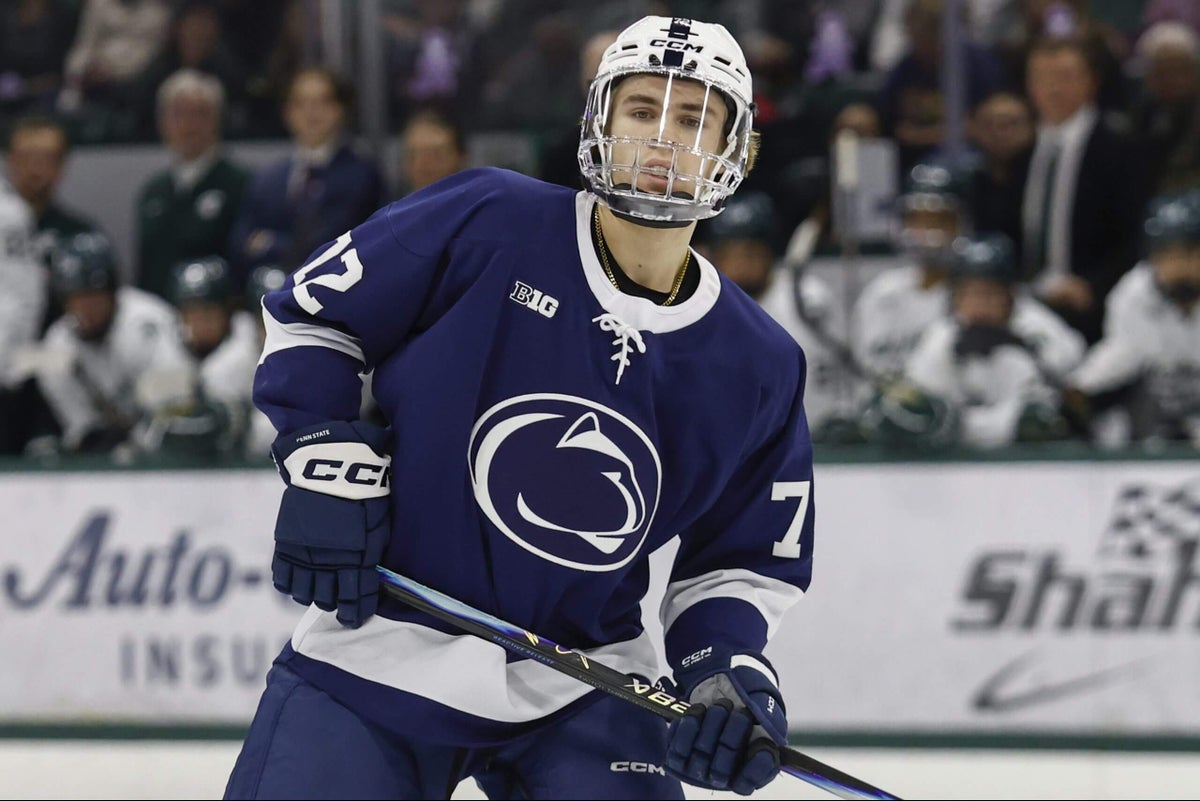
McKenna, coming off a historic WHL scoring season as a 16-year-old, took the NIL route and joined Penn State last summer. He didn’t choose a loaded program or a traditional NCAA hockey power. He picked a leaner team that was then battered by some early-season injuries, and leaned heavily on McKenna to produce offence.
Stenberg, meanwhile, was part of a high-flying Frölunda offensive machine that ran extremely hot in the first few months of the season.
As McKenna was plodding along at a point-per-game clip, which is excellent production generally, but was seen as disappointing for a prospect of McKenna’s supposed calibre, Stenberg was lighting up the SHL and threatening to make history with his scoring profile in his first draft-eligible campaign.
Stenberg then looked like the most complete, most NHL-ready prospect at the World Juniors, winning gold with Sweden, while McKenna and Canada fell short against Czechia in a frustrating semifinal game punctuated by a McKenna penalty in the closing minutes.
McKenna, however, put his slow start behind him. Despite some legal troubles connected to a misdemeanour assault charge, McKenna dominated the back half of the college season, putting up 33 points in 19 games in the 2026 portion of Penn State’s regular season. Stenberg and Frölunda, meanwhile, faded substantially. The crooked goals totals that the team put up in the first half became a more pedestrian trickle, as Stenberg managed 14 points in his final 29 games between SHL and Champions League play from Jan. 1 onward.
What’s happened over the past few months has re-established McKenna as the consensus top prospect going into lottery night, but there’s still a lot of road to run before the draft in late June. And Stenberg and McKenna may have an opportunity to face off directly, or in any event, be evaluated on the same difficult stage at the upcoming World Championships.
Both players appear to be pacing to make their respective senior men’s national teams, and while minutes tend to be in short supply for teenage players at the worlds, this year’s tournament is a little bit different than what we’ve come to expect. The tournament is taking place later — it doesn’t even begin until May 15 — which has made it more difficult for even the top hockey federations to recruit top NHL players on teams that missed the playoffs than it normally is.
The opportunity is there for Stenberg and McKenna to play larger roles than draft-eligible players usually do, and to perhaps make one closing argument for the benefit of whichever team wins next week’s draft lottery.
2. Caleb Malhotra rising
With an empty-net assist on Sunday, Caleb Malhotra has points in all three games of the OHL’s Eastern Conference final. His Brantford Bulldogs have a 2-1 series lead over the Barrie Colts and have only lost one playoff game so far.
As Brantford has stormed through the playoffs, Malhotra’s draft stock is rising considerably. The 17-year-old centre, who won’t turn 18 until June, has taken his production up a notch, recording 10 goals and 19 points in 11 games on this Bulldogs run.
There’s increasing chatter among NHL scouts that he’s been Brantford’s most impressive player, and that’s high praise given that Malhotra is teammates with Jett Luchanko and Jake O’Brien, both of whom are older and were taken in the top half of the first round.
Malhotra is 6-foot-2 and has the sort of NHL tools that get scouts excited. He’s conscientious defensively, giving him a very high floor as a prospect. He’s a plus skater. He’s got prototypical NHL size. And there’s really no question that he’s a centre who will stick in the middle as he moves to the professional ranks.
This draft class is relatively flat beyond McKenna and Stenberg, who are clearly head and shoulders above the rest of the prospects in terms of their scoring profiles, NHL-readiness and tool kits. There are a half dozen impressive blue liners that are worthy of top 10, and maybe even top-five selections, and at least a few additional forwards who have turned heads with their performance in very difficult professional leagues this season, like Swedish centre Viggo Björck.
But Malhotra has squarely put himself on the radar to go as soon as No. 3. And that’s a possibility that the Canucks are considering strongly, to the point that it’s impacting the organization’s thinking on Caleb’s father Manny Malhotra’s future as a potential head-coach-in-waiting, as The Athletic first reported when the season ended.
There are a few things about considering Malhotra at No. 3 that are worth dwelling on, however, even beyond the angle of his father being currently employed within the organization.
The first is that his scoring profile — 84 points in 67 regular-season games — isn’t at the level of most 17-year-old OHL players who go on to be selected at the apex of the draft. While 1.25 points per game is nothing to sniff at for a defensive-minded centre, it’s worth noting that recent top-five picks out of the OHL like Quinton Byfield (1.8 points per game) and Michael Misa (2.0 points per game) were in a totally different stratosphere — and that was before the NIL era sapped the CHL of top players the way it did this season.
Even if we just look at similarly gifted, two-way centres who went in the top five — players like Shane Wright and Sam Bennett — we’ll see age-17 scoring profiles that outpaced Malhotra’s this season comfortably.
Malhotra is clearly worthy of consideration with a top-five pick, but his age-17 scoring profile is far more similar to previous top-10 picks — like Sean Monahan, or his teammate O’Brien — than it is the sort of profile that is usually attached to a player picked third.
So, while Malhotra is deservedly generating buzz, and the Canucks seem relatively set on the back end as opposed to their desperate need for centres, there are a handful of defence prospects in this draft class that Vancouver can’t afford to overlook based on the position they play.
In the past few drafts, the Canucks have seemed to be in the habit of coincidentally selecting the best player on their board who also happened to play the position of greatest need for the franchise: Tom Willander, a right-handed defender, in 2023 and Braeden Cootes, a centre, in 2025.
Vancouver simply cannot allow positional need to in any way influence its decision at the top of the draft. This asset is too important, and the Canucks’ need for star-level contributors is far too significant.
3. The flat tier of elite blue-line profiles
Superficially, it seems as if the Canucks are set on the back end, given the ages of Willander, Zeev Buium, Elias Pettersson and even Kirill Kudryavtsev, and the progress they’ve made at the professional level over the past 12 months.
However, the jury is still very much out as to whether or not the Canucks have even a single player who will be an elite NHL blueliner in the future. Buium and Willander have some traits and aspects of their game that are worth betting on, but they’ve also got a lot of road to run yet to cement themselves as top-of-the-lineup fixtures, much less star-level defenders.
Behind the two wingers, and along with Malhotra’s late entry to the top tier, sits a bevy of defenders with significant potential and the scoring profiles to suggest that they may be future NHL superstars.
Keaton Verhoeff, for example, just completed his age-17 campaign while logging major minutes for one of the best teams in the NCAA. He’s 6-foot-4, right-handed and is the third NCAA defender to put up more than 20 points before his 18th birthday in the past 20 years. The other two are Zach Werenski and Noah Hanifin, a pair of long-tenured NHLers, Olympic gold medallists and players who were selected in the top 10.
Chase Reid, meanwhile, just put together a better-than-point-per-game season in the OHL and has the loud tools — the escapability and skating speed in particular — that have NHL scouts positively drooling. Reid’s production profile isn’t quite at the level of what recent top-10 picks out of the OHL have managed in their first draft-eligible campaigns, though; on a per-game basis, Reid was less productive, for example, than Calgary Flames defender Zayne Parekh or San Jose Sharks first-rounder Sam Dickinson, but he’s an enormously impressive prospect.
Finally, Carson Carels is both a beast physically and the most productive 17-year-old WHL defender since Scott Niedermayer on a point-per-game basis, while Daxon Rudolph trails only very narrowly behind him, as a 6-foot-2, right-handed defender and plus skater.
There’s also Latvian blueliner Alberts Šmits, who was a standout at the Olympics. Šmits may not have the offensive upside of the other four blueliners, but he’s probably the most likely among them to play in the NHL next season, and given his physical maturity — he’s 6-foot-2 and 205 pounds — and two-way IQ, could legitimately be that rare prospect who is an NHL-ready out-of-the-box top-four level defender as soon as his draft plus-one season.
The Canucks simply aren’t so loaded or set on the blue line to ignore the profiles of these defenders if the statistically most likely outcome occurs, and Vancouver doesn’t end up with one of the top two picks.