
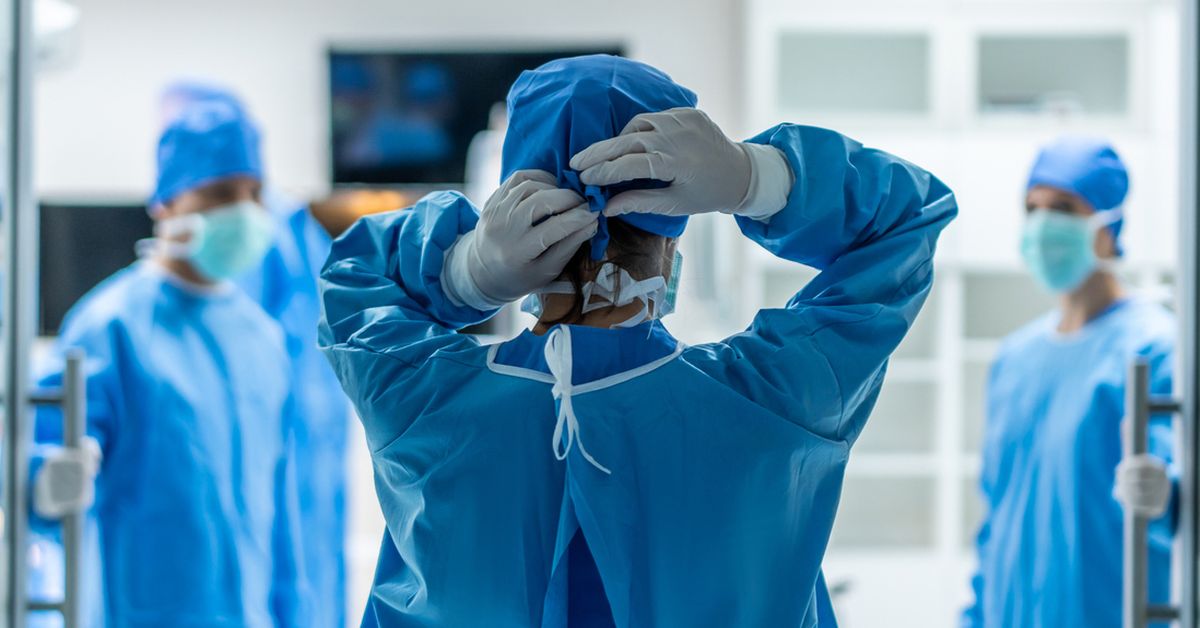
Australia’s regional and rural healthcare system is facing a critical shortage of GPs.
Regional and remote communities consistently face healthcare shortages, including an incredibly high demand for GPs and other medical professionals, according to Healthcare Australia.
However, the Australian Medical Student Association says the solution to the problem starts well before medical school – it starts with the cost of taking the exam to get in.
 Australia’s regional and rural healthcare system is facing a critical shortage of GPs. (Getty)
The GAMSAT exam is the test that post-graduate students take to get them into medical school.
On Average, aspiring medical students take the test three times before they pass, setting them back $568 every time they take it.
It totals $1700 in exam fees for the average student, assuming they pass on their third attempt.
According to the Australian Medical Students Association, the exam costs present a massive barrier for entry for anyone wanting to become a doctor from rural, regional and low socio-economic backgrounds.
 The GAMSAT exam is the test that post-graduate students take to get them into medical school. (iStock)
“The prohibitive costs of the medicine admissions process, including tests such as the GAMSAT, disproportionately impact those from rural, regional, remote and low socioeconomic backgrounds,” AMSA President Seniru Mudannayake told Nine.com.au.
“We know that doctors from these backgrounds are four times more likely to return to serve their communities, where the largest medical workforce gaps exist, but they are massively underrepresented in the medical cohort.”
The solution so far has been to rely on immigrant workers, according to Federal Health Minister Mark Butler.
 Mudannayake says the focus should be on helping aspiring doctors in those local communities. (Getty)
“In health, we’ve always relied on overseas-trained doctors, particularly in rural communities,” he said while addressing the media on April 22.
“We’re certainly working very hard to expand the number of Australian-trained doctors.”
However, Mudannayake says the focus should be on helping aspiring doctors in those local communities, with the issue coming down to one factor – accessibility.
“GAMSAT costs are not limited to the test itself; practice tests, tutoring and other resources can amount to thousands of dollars per attempt, widening the gap between the affluent applicants with family support and those without,” he added.
 Minister for Health and Ageing Mark Butler says the solution to the regional health crisis has been to rely on immigrant workers to fill the gaps. (Alex Ellinghausen)
“Our ability to provide care starts with admitting students who can serve their local communities.
“Your ability to become a doctor should not be dependent on your postcode.”
They also added that there’s “very little evidence” to suggest that the GAMSAT exam is able to “indicate” which applicants would make good doctors.
‘It’s not meant to be this hard’
Aspiring medical student Sabrina lives in one of Sydney’s lowest socio-economic areas.
She has taken the GAMSAT four times, and will most likely need to take it again to get a competitive mark.
On top of paying for the exam, students need to purchase the study materials from the Australian Council for Educational Research (ACER), which also writes and facilitates the exam.
“The test is hard enough as it is, which is totally understandable; they’re trying to weed out students who will be resilient in medical school,” she explained.
“The problem is, ACER basically makes us buy the practice papers; there’s no other verified practice materials and the questions in the practice paper this year didn’t align with the exam.
“They’re making it difficult for students who want to pursue medicine when we have a shortage of nurses, a shortage of healthcare workers and a shortage of doctors.
“Add that to the fact that is $600 per exam. I understand it’s not meant to be easy, but it’s not meant to be this hard.”

Highest-paying jobs in Australia that don’t need a degree
Lisa Norris, Head of Division, Tertiary and Industry Tools at ACER said the exam fees “reflect the real costs of developing and delivering a globally recognised, high-stakes exam.
“It covers test design, secure administration, and rigorous scoring, including human triple marking and statistical analysis.
“It also covers venue hire, in-person supervision, remote proctoring, security measures, and ongoing improvements to keep the exam fair, equitable, and fit for purpose.”
She added that the Council “regularly reviews” its procedures to “promote accessibility while “maintaining the rigorous standards required for medical school admission.”
A spokesperson for NSW Health said they are “thankful for the outstanding commitment and the tireless efforts of our
healthcare workers.”
“Our staff are our most valuable resource and NSW Health has the largest
health system in the country with a workforce of around 180,000.”
“Despite the strength of our workforce, attracting and retaining the required healthcare staff,
particularly to regional, rural and remote areas, remains a long-standing challenge for NSW
and every other state and territory across Australia.”
They added that the state government offers scholarships to help people in regional areas get into medicine.