
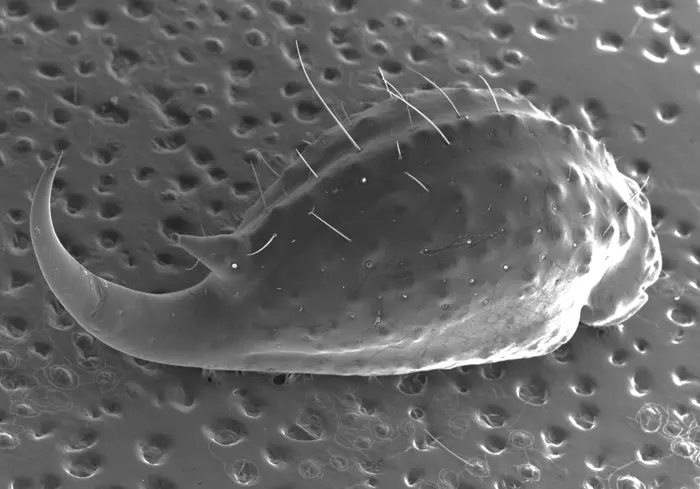
 SE micrograph of the entire telson (stinger) of the Tanzanian red bark scorpion (Babycurus Jacksoni). Image includes the telson vesicle, in which the two venom producing glands can be found. Muscles surrounding the glands will contract internally, pushing venom up through conduits to the tip of the telson (termed the aculeus). This species also features a subaculear tubercle (small protrusion above the stinger) with an unknown function.
Credit©
Sam Campbell/University of Queensland
Smithsonian researchers have found that scorpions use a “skillfully engineered” layout of zinc, manganese, and iron to reinforce their stingers and pincers
The study proves that these metals are precisely placed to boost durability and hardness, with different “metal recipes” evolving based on whether a scorpion prefers to crush its prey or sting it.
By analysing 18 different species, researchers found that the distribution of these metals—specifically zinc, manganese, and iron—is highly strategic and evolved to match how each species hunts.
The blueprint of a stinger
Using high-resolution electron microscopy, scientists discovered that a scorpion’s stinger is a masterpiece of material science. The metals aren’t just scattered; they are layered to handle different types of stress.
Zinc is concentrated at the very tip of the needle-like aculeus, providing extreme hardness for the initial puncture.
A langanese layer: Just below the tip, manganese becomes the dominant metal. There is a “sharp and visually distinct boundary” between these two layers, suggesting that different metals are used to transition between hardness and structural support.
Reinforcing the grip
A similar pattern of localised enrichment was found in scorpion pincers. In the movable outer segment (the tarsus), researchers detected zinc or a mix of zinc and iron. These metals appeared exclusively along the cutting edge of the pincer—the specific area that endures the most stress when a scorpion is crushing or holding onto struggling prey.
Durability over strength
One of the most counterintuitive discoveries was that species with the most powerful “crushing” pincers actually had less zinc than species with long, slender pincers.
Traditionally, scientists associated zinc with hardness, but this study suggests it might play a bigger role in durability. Slender claws are prone to snapping; by infusing them with zinc, the scorpion ensures its weapon can bend and grasp without breaking while it waits to deliver a venomous sting. This indicates a direct evolutionary link between a scorpion’s hunting behavior and the specific “metal recipe” found in its exoskeleton.
Expanding the “tree of life”
This research doesn’t just explain scorpion biology; it provides a new standardised method for measuring metal enrichment across the animal kingdom. The Smithsonian team believes this approach can now be used to study other “metal-headed” arthropods like spiders, wasps, and ants, helping us understand how nature uses the periodic table to create the ultimate biological tools.