
“We’ve relied on the All Blacks to push us through – expecting viewership, or kids nowadays to play rugby, because of the All Blacks.
“I just think it was a bad strategy to rely on that for so long.”
In the era of social media, he says, rugby seems to have missed “that boat, big time”.
Other sports – such as football, league or basketball, through the NBA – have been more appealing, especially as rugby contends with the added complication of concussions and worried parents.
He cites the Warriors, selling out grounds whether they win, draw, or lose. “They must be doing something right.”
“I definitely think there should have been things in place to make rugby more appealing to the younger generation.”
Is it salvageable? “I don’t know, to be honest.”
In his prime as an All Blacks wing (54 tests with 46 tries), Savea was a crowd-favourite – one of the most watchable and devastating players on the planet, sometimes compared to Jonah Lomu.
The Bus is coming through! Julian Savea fends of a Frenchman on his way to three tries in the 2015 World Cup quarter-final. Photo / Inpho
Like Lomu, Savea scored eight tries at a World Cup tournament – during the All Blacks’ victorious 2015 campaign in the United Kingdom.
That was the last time the All Blacks savoured the title of World Cup champions; they now have a massive job to turn their patchy form around as they eye the 2027 competition. This year, they’ll be coming together under a new coach, Dave Rennie, and possibly a new captain.
That new captain might well be Ardie Savea, Julian’s younger brother.
The pair are extremely close. Julian, 35, describes Ardie, 32, as a “big rock” in his life.
“I think Ards would be an awesome captain for the All Blacks – he leads from the front anyway, so I think for him personally he understands that if someone else gets [to be captain] there’s a greater good kind of thing happening.”
Niceties over, Julian slips into archetypal big-brother form.
“It’s hard,” he says of the All Blacks’ performances in recent years, before cracking a smile.
“I always give Ardie shit about it. I’m like, ‘I’ve never lost this much!’
“And he’s always giving it back to me as well – he says, ‘I never had Richie [McCaw], Ma’a [Nonu], Conrad [Smith] and DC [Dan Carter]’.”
At 35, and with ‘The Bus’ not quite hitting the top gear of a decade ago, Julian Savea – All Black number 1111 – is contemplating a new career.
Over the next few weeks, the curtain will close on his Moana Pasifika club and with it – quite possibly – Savea’s storied Super Rugby playing days.
There’s still the possibility of NPC rugby, though nothing is confirmed right now – Savea himself says he’s still feeling great about rugby and would like to think he has two to three years left on the field.
Julian Savea is playing a key role as a senior member of the Moana Pasifika squad. Photo / Getty
Regardless, he is setting his sights on setting up a new business venture – a “scary” step for a man whose school days and later professional life have been dedicated to rugby.
But he also wants to stay close to the sport: he’s keen to expand his coaching skills and give back to the game that has kept him on track, even as his life sometimes threatened to burst through the guardrails.
‘We almost lost him’
Julian Savea was born and grew up in Wellington, a product of Evans Bay Intermediate and then Rongotai College. He had some good and great mates, but there was, he says, “a lot of chaos growing up”.
“I remember some rough guys – they were part of gangs as well. I could have gone either way. I had close mates in those areas, where it could have influenced me. Obviously, I had mum back here going, ‘You better not!’,” he once told Coconet TV.
At school, he was scared of failing in the classroom, and so essentially didn’t strive as much as he says he could and should have. His focus was literally on the field outside.
Teacher, coach and mentor Justin Gray told Coconet TV: “I was outside taking a PE class and the science teacher dragged [Julian] out and brought him over to me. I was told he was just gazing out the window, watching what I was doing with my class and not doing the science.
“The teacher said to me, ‘Julian is polite, but he’s not doing the work that he should be doing. He would rather be outside … so please take him … this is where he wants to be’.
“And her parting message to him as she walked back into the classroom was that, ‘sport won’t take you places’”.
To places, Savea has been – physically and mentally – before and since those school days.
At age 4, he almost died. An asthmatic since birth, he suffered a horrendous attack while at home in Newtown. The family had neither a phone nor a car. His dad, Masina, carried Julian in his arms the kilometre or two to Wellington Hospital.
“We almost lost him,” Savea’s mum, Lina, told Coconet TV.
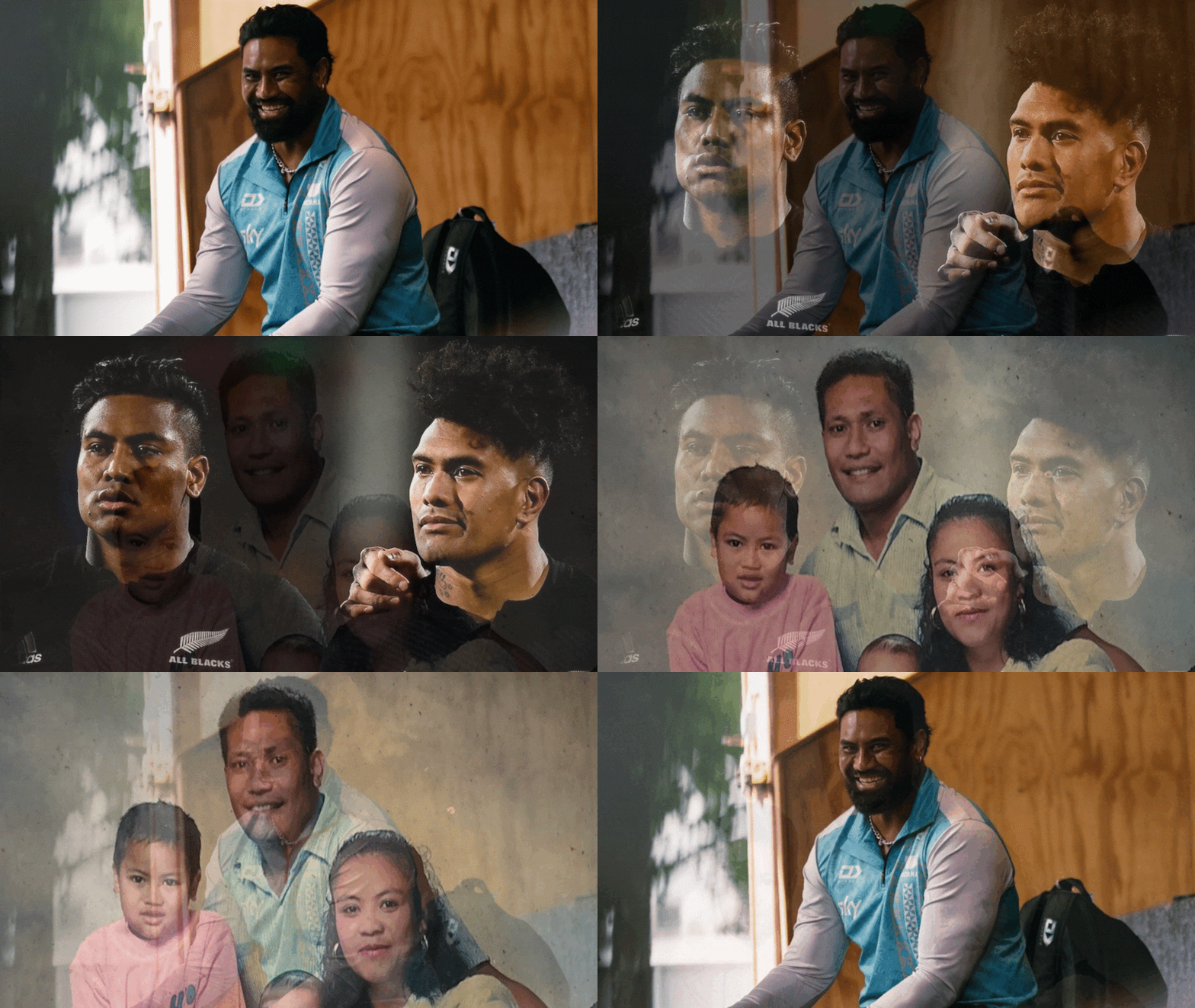
The Savea family – dad Masina, mum Lina, and boys Julian, left, and Ardie. Photo / supplied
Savea is an ambassador for Asthma Awareness Week next week. Over the years, he’s been hospitalised a couple of other times, while on rugby tours, as asthma-related conditions exacerbated a flu.
His message is a simple one. He makes sure he uses his asthma preventer in a daily routine – “it’s like brushing your teeth” – but will also plan ahead to recognise any triggers.
For instance, he’ll make sure he has an inhaler on hand if he’s on an evening out, or it’s a cold morning or night.
By managing it carefully, Savea’s asthma has certainly not curtailed his rugby skills – or physical and athletic prowess.
He was so big at school that Lina used to have to carry a birth certificate to matches, just to show other parents and officials that her son was a legitimate age-group player.
Life in Newtown, and then Berhampore, was sometimes hard. His parents were “very strict” – “especially with me” – but he and his brother Ardie were surrounded by love.
Without a car or transport, Julian and Ardie walked everywhere, even at a young age.
They’d visit dad at work – Trisha’s Pies in Island Bay – or walk to school and rugby training. A house at the end of one local street had a lot of people coming and going – only later would Julian realise it was a drug den.
His parents would work night shifts, leaving the house in the early hours. Mum would be home in time to get the boys ready for school.
Savea reflects on growing up and starting to earn money.
“My biggest motivation was just about making money so that I could help mum and dad or our family at the time.”
With his rugby earnings, he bought his mum her first car. She got her licence. Later, Lina and Masina moved to a new home in Strathmore thanks, she says, to Julian.
“As much as my parents were strict, it was all loving – they saw the potential and made sure I was always sticking to what I needed to do to succeed in rugby,” Savea says.
Life revolved around club rugby at Oriental Rongotai, before representative matches for Wellington, the Hurricanes and then the biggest team of all.
‘I definitely got lost in it for a bit’
Savea forged the path as the family’s first All Black, and Ardie eventually followed.
The announcement that Julian had made the squad in 2012 came after a rather ordinary 2011, and a stern message from his coaches that he was lucky to have a “plus one” extra year in his professional contract in Wellington.
That message was enough for Julian to reset himself and inspired him to a breakthrough year for the Hurricanes in 2012. “I just remember putting my head down and training my arse off.”
By the time Julian made his debut for the All Blacks in June 2012, against Ireland at the age of just 21, he was already labelled ‘The Bus’. Rennie came up with the nickname when he coached Savea in the New Zealand Under-20s team.
“It’s kind of stuck with me now, so I have to like it, don’t I?” he laughs.
Savea scored three tries on his All Blacks debut.
Julian Savea scores one of his three tries during his All Blacks debut against Ireland at Eden Park in 2012. Photo / Greg Bowker
For Savea, rugby has come naturally over almost three decades. But in New Zealand, where All Blacks are treated like gods, it did take some adjusting to wearing the silver fern and handling the associated fame.
“I definitely got lost in it for a bit,” he says.
“As a young Islander kid, I didn’t really know how to deal with it. You almost feel untouchable, but luckily, I had good boys around me – Ma’a [fellow All Black and Hurricane Ma’a Nonu] was a good mentor – and my family. They were able to keep my feet on the ground.”
Making the All Blacks was the relatively easy part, he says. Staying there was a lot harder.
He credits coaches Steve Hansen and Ian Foster for his success in the black jersey, particularly with the way they identified an individual game plan for him.
For instance, Hansen, unusually, wanted Savea to play almost every pool game at the 2015 World Cup. Normally, players get more rest. “With me, he said, I get better the more I play.”
Savea is incredibly loyal to both coaches. He said the way Foster was treated by NZ Rugby in 2023 was unfathomable. “Exited out and left dry – all of that stuff for me was very foreign. I couldn’t process why it was happening.”
But despite all the hiccups in recent years, Savea believes the All Blacks have the core players to build a new leadership group similar to what we saw in that golden period of 2011 and 2015.
“I remember every time I came to the All Blacks, it was easy because everyone just had to do their job.
“When you’ve got everyone else doing their own job, it’s easy to trust – it just makes me worry about what I have to do, which makes it easy.
“I just remember feeling, ‘man, this is awesome’ – being able to just focus on what I need to do for the team.”
Brothers Julian and Ardie Savea line up for the All Blacks for a test match against South Africa in 2016. Photo / Photosport
More recently, he says the players have felt pressure because of peripheral factors.
“The scrutiny that we were dealing with when I was there was that you didn’t play well enough. We’d beat a team 24-16, and that wasn’t good – ‘you guys should have smashed them’.
“Those players shouldn’t be in the team or this player shouldn’t be in the team. Those were the scrutinies we were dealing with, right?
“Not who’s the best coach or issues over who’s going to bring us the best opportunity. Seeing Ardie go through all of that, it’s tough.
“But I believe Rens and their coaching group will bring it back.”
A new home
Today, Savea and his wife Fatima live in a beautiful, modern home on a lifestyle block in Coatesville with their three kids – two daughters, 14 and 8, and a younger son, 3, who’s in day care. “It took a lot of time and bloody money!”
Julian and Fatima Savea. Photo / Getty Images
Auckland is home now- he loves the climate, and he’s just spent an entertaining weekend with the kids, including taking them go-karting.
Fatherhood has made him.
“It’s slowed my life down a little bit – I went from texting the boys on the weekend and saying ‘let’s get on the piss’, to now ‘sorry boys, I’m changing nappies’ and stuff like that.
“It’s definitely changed me for the better.”
He then adds with a grin: “Don’t get me wrong – I still know how to party!”
But there is also the serious side of a new career. Savea wants to expand his coaching skills and a few days before our lunch, over the weekend, he was researching his planned new business: a recovery centre for athletes and everyday people.
He admits that the work and research are “pretty overwhelming”, but he plans to target the business beyond just rugby players. “Everyone, really.”
He’s gaining inspiration from the likes of two AFL brothers who have established a wellness and recovery centre in Melbourne. Saunas and cold baths have become a key recovery component for many people, including members of running clubs.
“As a young fellow growing up, I never really took recovery seriously,” he says.
“I turned up to this gym and just started lifting – no rehab. I guess it wasn’t until the latter years that I realised, ‘hang on, if I want to extend my career, feel good every day, this is what I’ve got to do.”
Right now, he’s contemplating the business plan, including target markets, location, equipment, and finances.
“For a kid that didn’t do well at school, I’m just trying to understand and work my way through.”
All Blacks wing Julian Savea in 2015. Photo / Photosport
He says he’s receiving plenty of support.
“I’ve always been scared to jump into something new – it’s always hindered me in that aspect because I kind of just like to stay away from it. So now, getting to the back end of my career, I really have to think about this stuff.
“It’s definitely stepping out of my comfort zone.”
Moana Pasifika’s final fling
The eatery that we’re at today – Fields Cafe – overlooks North Harbour Stadium, where Moana Pasifika will tonight host the Blues. It is only the third time this year that Moana Pasifika will have played on their home ground.
“Can you believe we’ve only played two games here? It’s like we were sort of set up to fail, really just ticking boxes. We understand that – we’re always going to get the short end of the stick.”
As much as Moana Pasifika’s pending closure hurts the players and the club is languishing at the bottom of the Super Rugby table, morale is still high, Savea says. The boys, though gutted, want to put on strong performances in their final games.
Savea himself is not playing; he’s still recovering from a dislocated shoulder from a month ago.
After tonight, there will be just three games left for Moana Pasifika – Savea is hoping he’ll be back in time to don the jersey.
The club, he says, is so much more than rugby. “The morale is always high, especially with everyone’s faith. That’s what leads the boys.
“Obviously, we want them to play for Samoa and Tonga but at the end of the day, a lot of these boys are playing to support their families. It might take them to another Super team, which is fair … but a lot of it is bigger than just rugby.”
Savea is determined to keep helping the younger players.
“A lot of the time, it’s just making sure the boys know I’m available or approachable. Back in the day, a lot of the senior boys were pretty hard to talk to.
“Today, the environment’s changing and everyone has a voice. You want to be available so that these young boys learn off you pretty quickly.”
So, back to the state of the game.
Savea says that as players, there’s not a lot they can do when it comes to making the game a more entertaining spectacle.
He believes there are too many rules, open to different interpretations from referees. It can be a stop-start affair, although innovations such as ’50-22′ kick advantages have helped attacking strategies.
Savea thinks players should also be given the freedom to break away from structures.
“There are times when you’ve just got to let some individual players just do their thing. Sometimes we lose that sight. For someone like me, I don’t want to be just stuck on the wing.”
The Bus wants to make sure he and others can still run over a few more people yet.
ASTHMA IN NEW ZEALAND
Julian Savea says he has had asthma “for as long as I can remember”.
He is one of about 615,000 New Zealanders who are prescribed medication for asthma – roughly one in eight people;Asthma is estimated to cost the economy about $1.2 billion per year;Almost two asthma deaths per week are reported – these deaths are preventable. Older adults (those aged over 65) are dying from asthma more than any other age group;Across all age groups, children under-15 have the highest hospitalisation rate;Around 3500 children are admitted to hospitals across New Zealand each year due to asthma;Pacific peoples are reported as having more recorded asthma attacks, while Māori are reported as being hospitalised more often;Māori, Pasifika, and more deprived communities are about two to three times more likely to present to emergency departments;Only about 15% of healthcare professionals and about 20% of patients are reported to know the correct inhaler technique;Poor inhaler technique remains a major issue, which suggests that education and follow-up are critical;Because exacerbations can increase the risk of future exacerbations, early treatment and prevention matter;An up-to-date action plan is associated with a 70% reduction in mortality risk.Source (and for more information): https://asthma.org.nz/
Editor-at-Large Shayne Currie is one of New Zealand’s most experienced senior journalists and media leaders. He has held executive and senior editorial roles at NZME, including Managing Editor, NZ Herald Editor and Herald on Sunday Editor. As well as a weekly media column, he has a regular interview series featuring noteworthy and leading New Zealanders including Wayne Brown, Ruby Tui, Paddy Gower, Dame Kiri Te Kanawa, Scotty Stevenson, Chlöe Swarbrick, Simon Power, Josh and Helen Emett, Sir Ian Taylor, David Kirk, Sir Ashley Bloomfield, Paul Henry, Simon Barnett, Sophie Moloney, Brian and Hannah Tamaki, Sir Grahame Sydney, David Lomas, Carrie Hurihanganui, Sir Russell Coutts, Steven O’Meagher, Juliet Peterson, Brendan Lindsay, Tony Astle, Anna Mowbray David Higgins and Ian Jones.