
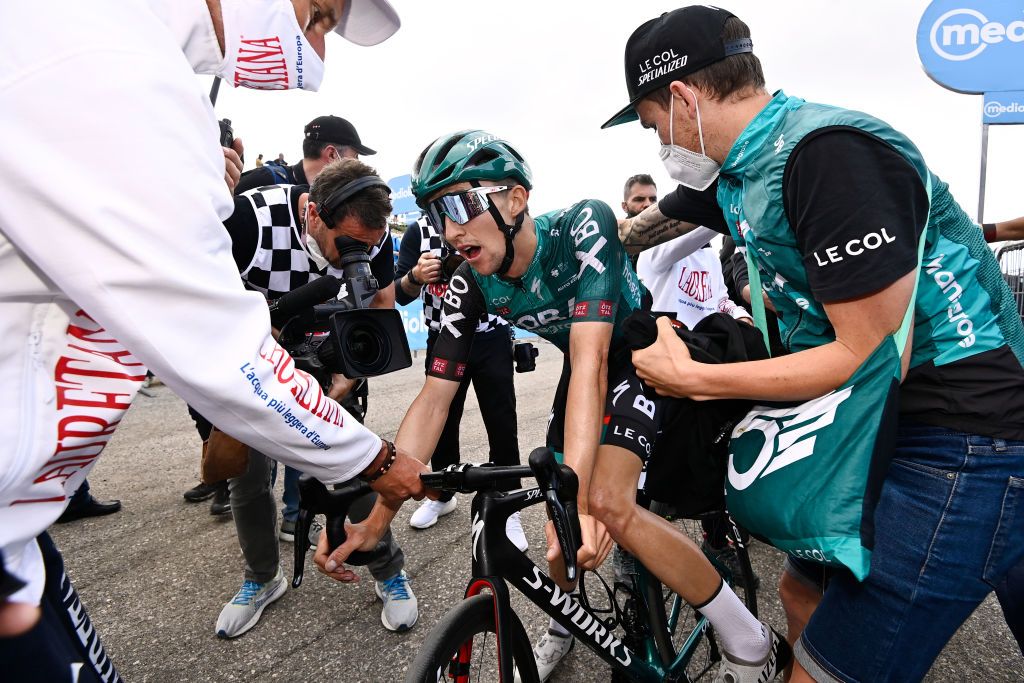
Such is the status of the Blockhaus in Giro d’Italia climbing mythology that no matter what other legendary ascents – Etna, the Stelvio, the Zoncolan – precede or follow it, whenever the peloton begins to tackle the Blockhaus’ 13.8 kilometre slopes deep in the Apennine mountains of central Italy, it’s invariably a red-letter race day.
No other climb, after all, has the honour of being the finish of the first-ever Grand Tour stage won by all-time great Eddy Merckx back in 1967. Or of being one of the handful of scenarios where Merckx was truly put up against the ropes when in his prime, on that occasion in 1972 on the Blockhaus by Spanish climbing genius Jose Manuel Fuente.
Article continues below
You may like
Roll forward 30 years and in 2017 the Blockhaus was where Nairo Quintana, Colombia’s controversial but hugely talented 21st century mountain pioneer, took one of his greatest ever summit triumphs – even while three of his rivals, Adam Yates, Mikel Landa and Geraint Thomas were fighting back from a collision caused by a police motorbike. For Neve Bradbury in 2024, the Blockhaus was the Australian’s biggest victory of her career to date as she soloed away in the Giro d’Italia Women and Elisa Longo Borghini confirmed her first of two overall triumphs on local soil.
But what perhaps gives the Blockhaus its true greatness whenever the Giro visits is not the racing: it’s the mountain itself. Alpe d’Huez or Sestriere, for example, are ski stations which now have their own firmly etched places in the history of the sport thanks to their summit finishes. Yet they remain temporal, man-made affairs all the same.
In contrast the Blockhaus has its own history and heritage and and just like the Mont Ventoux in the Tour de France or the lakes of Covadonga in the Vuelta a España (the latter, like the Blockhaus, also happens to be home to some of the last wolves in western Europe), the Blockhaus is equally if not more famous outside the sport as within it. The cycling connection is just a transient part of its much vaster, enduring story.
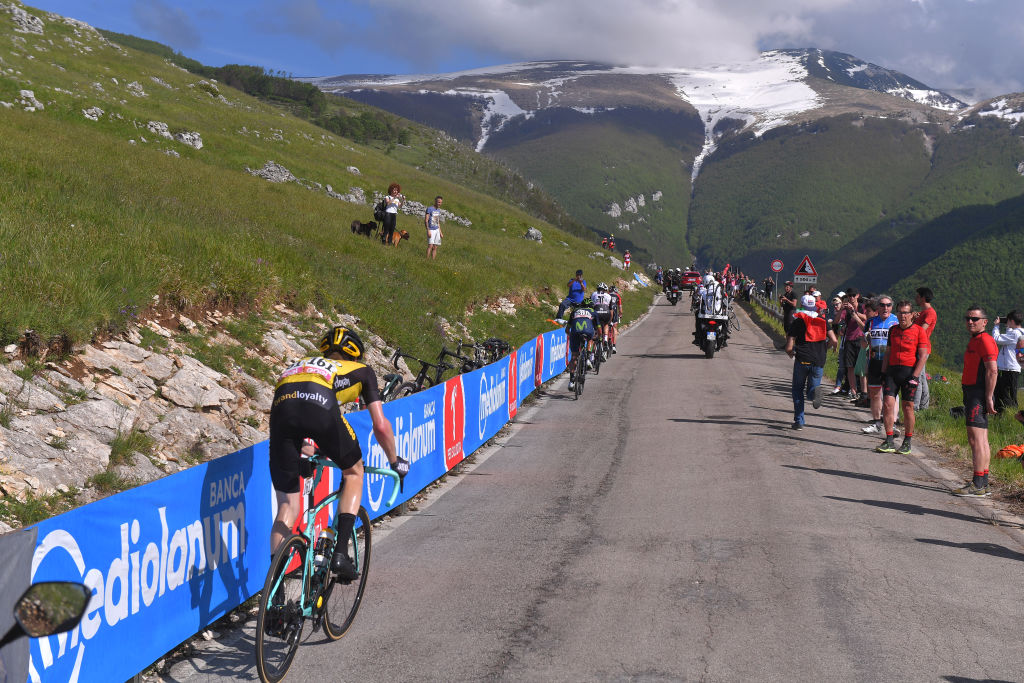
A previous edition of the Giro d’Italia ascends the Blockhaus (Image credit: Getty Images)
Even something as simple as the human descriptions and names for the mountain recognise that nearly timeless legacy. As writer Daniel Friebe points out in his landmark book on cycling’s different major ascents, Mountain High: Europe’s Greatest Climbs, the Majella massif in the Abruzzo region – which houses the Blockhaus climb – “has inspired many a nickname in the estimated 800,000 years since man first settled there, including Mother Mountain or Father of the Mountains as Pliny The Elder dubbed it. “
The mountain could create some deep borne fears, too, as well as awe and respect. In 1908 in her book In the Abruzzi, Friebe recounts, “Anne MacDonell depicted its backdrop as a poor, primitive region obsessed by religion and mythology. On the Majella, she reported, the locals were sure that devils still lurked. According to one legend, they would shovel lingering snows and pelt the surrounding villages with what fell as hail until someone down below rang a church bell and the devils would retreat to hell.” (In comparison, and memorable as Alpe d’Huez is, perhaps the only infernal thing there when the Tour arrives are the chaotic, enormous traffic jams that clog the ascent for hours after the stage.)
In any case, as Friebe points out in Mountain High, the Majella has changed enormously in its more recent history, becoming a National Park in 1991, one of 24 in Italy and three in the Abruzzo region – one of which, the Parco Nazionale Gran Sasso-Monti della Laga, also features heavily in Giro d’Italia lore. These days the Majella and the Blockhaus within it are visited regularly and faithfully by local tourists and cyclists. Gaia Realini, who hails from nearby Pescara, recently described it in an interview with Cyclingnews as an ascent she goes up 30 times or more a year.
The one thing that remains constant about the Blockhaus is the name, which is due to a nineteenth stone garrison christened by a commander of German origin, and that the toughest part of the ascent begins at 1,648 metres above sea level at the Hotel Mamma Rosa.
What to read next
“There, the third and hardest access route, from Roccamorice in the north, joins the road arriving from the pass and the final push to the top proceeds for six and a half kilometres along a single, narrow road,” Friebe writes. And it is along this road that the Giro will proceed, for just the third time in its history, on May 15, 2026.
An Italian Mont Ventoux
The grinding relentlessness of the climb itself is also an exceptional factor in why it’s so intimidating. After a few kilometres to Roccamorice, the ascent begins in earnest, but a quick glance at the Giro’s mountain profiles on the race website shows, for the best part of 10 kilometres, there’s almost no change from the marked gradient of 9.4%. Incredibly for such a long climb, only once does it alter, briefly rearing up to 14% some 5.5 kilometres from the top – a change will hardly be welcome except by the very strongest riders, and perhaps not even them.
The road does lessen in steepness just before the finish next to a small shrine, with the stone walls of the original Blockhaus just visible after the end of the road, but by that point it will barely matter. What makes this ascent so tough will have taken its toll, long, long before.
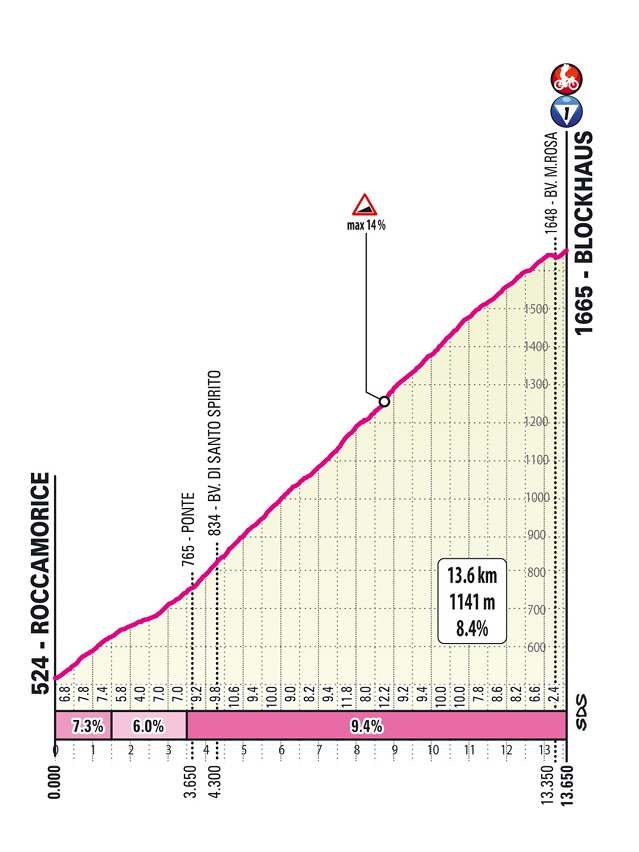
The profile of the 2026 Blockhaus ascent (Image credit: RCS Giro d’Italia)
Friebe compares the Blockhaus to Ventoux not just in terms of legend and reputation, nor yet its relentlessly rising, ‘suffocating nature’, but also because there are two markedly different parts, with a hostelry acting as the unofficial line between the two. Just as on the Ventoux and the rise up to the Chalet Reynard hotel, the lower part of the Blockhaus is wooded – with a huge beech forest preceding the road reaching the Hotel Mamma Rosa. After that, we’re into open, exposed terrain, and “as the beeches recede, the wind, sun and slope often form an unholy trinity which is real essence of the Blockhaus.”
The difference is that Ventoux is a moonscape of scree slopes and broken rocks, whereas thanks to the heavy rain that predominates the weather cycle in the winter in the Dolomites, the steady, remorseless rise in the Blockhaus is a brilliant green, verdant pasture. For miles, though, if you were looking at the race on the horizon as they rode up the Blockhaus, the highest objects on this landscape would be the profiles of the bike riders themselves – a testimony to just how exposed and unchanging this steadily rising slope is.
To describe it as suffocating seems like an understatement, in fact, and with over 4,400 metres of climbing, even if there is only one ascent beforehand, the cat.2 Roccaraso – scene of stage finishes in 2016 and 2020 – the peloton is hardly likely to still be in a single unit when it hits the foot of the climb.
While there’s no questioning the steadiness of the gradient, arguably the greatest uncertainty lies in the skies above the Blockhaus. Unlike so many Giro climbs further north in the Dolomites, the ascent to the Blockhaus has only once been cancelled or shortened because of poor weather, back in 2009, when the stage ended at the Mamma Rosa. But whilst it’s unclear if the demons will be out throwing hailstones like the villagers’ winter tales of long ago come Friday, May 15, should there be any strong winds or heavy rain, as well as potentially very low temperatures on the upper slopes, after the sunshine that oversaw the last two ascent of 2022 and 2017, the Blockhaus could abruptly turn into a few hours of real cycling hell.
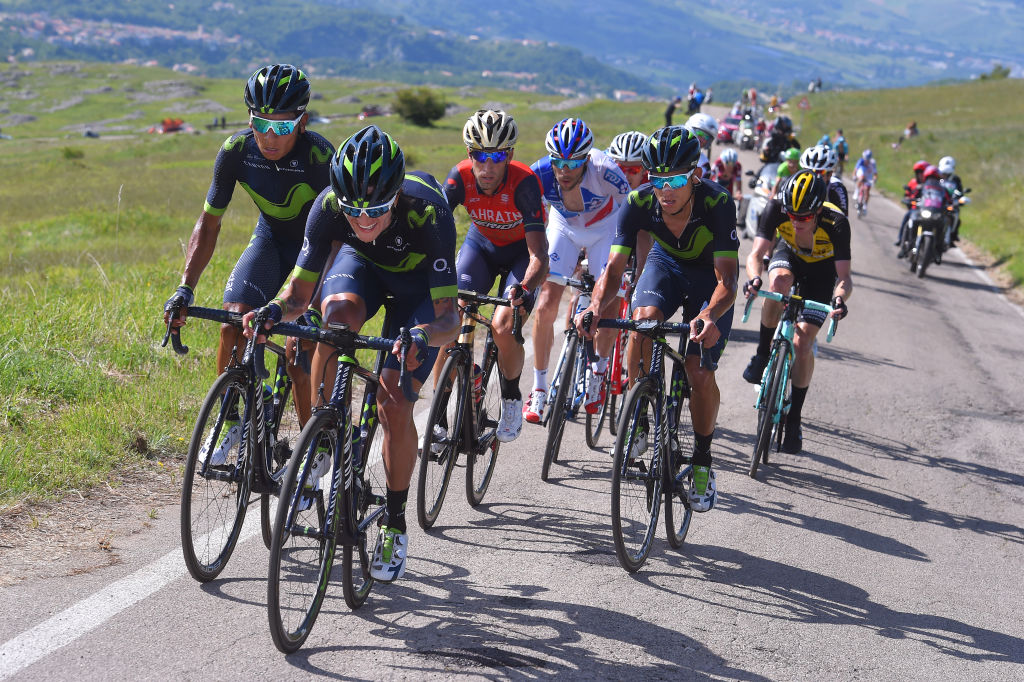
2017 Giro d’Italia: Movistar lay down a strong pace in the main pack on the Blockhaus before leader Nairo Quintana goes solo to win (Image credit: Getty Images)
But if all of the legends and history swirling around the climb are what make it so special, the Blockhaus’ ability to stand out from the rest of the Giro’s mountain ascents is arguably even greater than usual this May.
Part of the reason is its placing in the route, as the Blockhaus is often used as a mid-race climbing challenge after a southern or foreign start prior to the Giro heading further north to the crunch stages in the Dolomites and Alps. And though that’s true in 2026, there’s also a crucial difference.
In both 2022 and again in 2017, the last two times the Blockhaus was tackled in the Giro, it was preceded a few days before by a summit finish at Mount Etna. This time, after the three opening stages in Bulgaria and a brief run through the southern half of Italy, the Blockhaus on stage 7 is the first summit finish of the 2026 Giro and the first full day of mountain climbing, too. As such, this is the moment when for the first time in the 2026 Giro, the cards are truly on the table for all the GC riders.
The switch of terrain from phony war and skirmishing to an all-out setpiece battle in any Grand Tour is always a crucial one, but what will make is so pivotal this time round is that by a considerable margin, stage 7 is also the longest of the entire race: 246 kilometres. Only stage 17 to Andalo comes anywhere near that distance of the hilly stages, at 202 kilometres but it ends with a cat.3 climb. As such, the Blockhaus can hardly fail to set a clear direction of travel.
Just how unchangeable that direction of travel will be remains to be seen, of course. Stage 14’s little-known summit finish to Pila comes at the end of a deceptively hard day through the Alps, stage 19’s cat.3 finale is preceded by the dreaded Giau ascent (the only HC-rated climb of the race) and stage 20’s double showdown on the Piancavallo is where riders like Marco Pantani have dealt knockout blows in the past. But given its past history, its almost excessive standout qualities in this year’s race and the fact that the Blockhaus is the only major legendary final ascent in this year’s Giro, could stage 7 be where Jonas Vingegaard, say, begins and ends the Giro d’Italia?
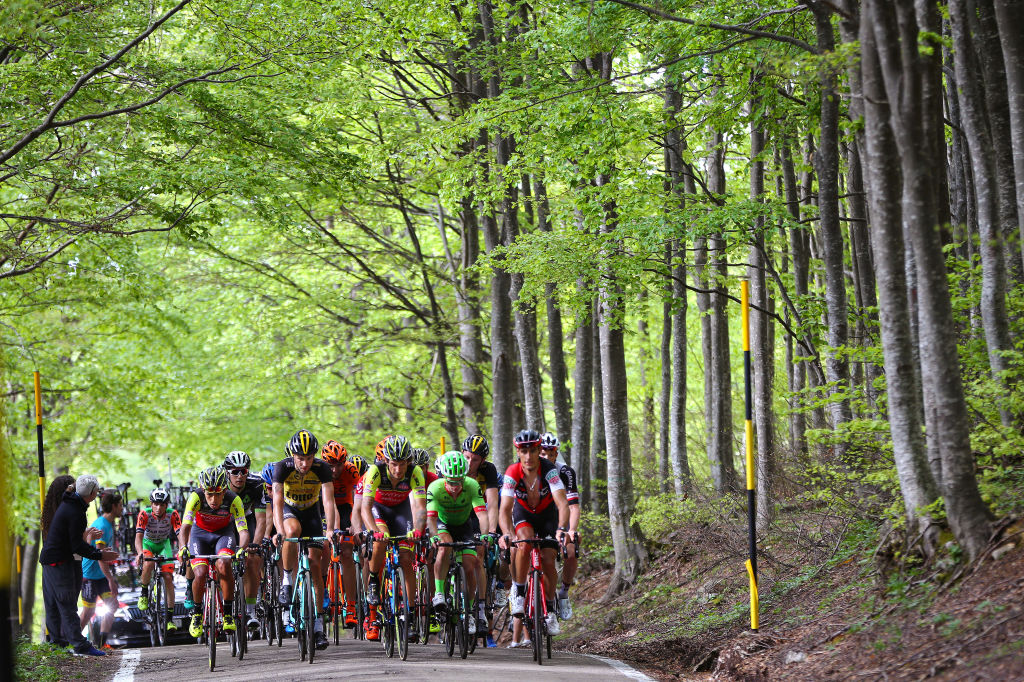
The peloton during the early part of the Blockhaus ascent in a previous edition of the Giro d’Italia (Image credit: Getty Images)
Certainly the unchangingly steep nature of the climb, rather than something more irregular, is one that’ll be to the Dane’s liking and where he can calculate the exact impact of his challenge. He also likes early, big statements in Grand Tour battles: in the 2025 Vuelta, an early, all-out attack to Valdezcaray ski station on stage 9 effectively put the GC all but beyond reach for his rivals. Such a scenario might be replayable in Italy en route to his first Giro d’Italia win, all over again.
History would stand on Vingegaard’s side, too. After all, Jai Hindley (Red Bull-Bora-Hansgrohe) is the defending champion at the Blockhaus, and in 2022 his win there proved a key milestone en route to overall victory for the rider from Western Australia.
Anybody in pink at the summit, then, could well be in the same colour once again two weeks later in Rome – but if that would be but a footnote in the history of such a legendary mountain, in terms of the Giro, the events on the Blockhaus could well become one of the 2026 race’s most decisive chapters.
Who will challenge Jonas Vingegaard at this year’s Giro d’Italia? Subscribe to Cyclingnews for unlimited access to our coverage of the Corsa Rosa. Enjoy unrivalled reporting from our team of journalists on the ground, including breaking news, analysis, and more, from every stage as it happens, plus access to the Cyclingnews app to follow the action on the go! Find out more.