
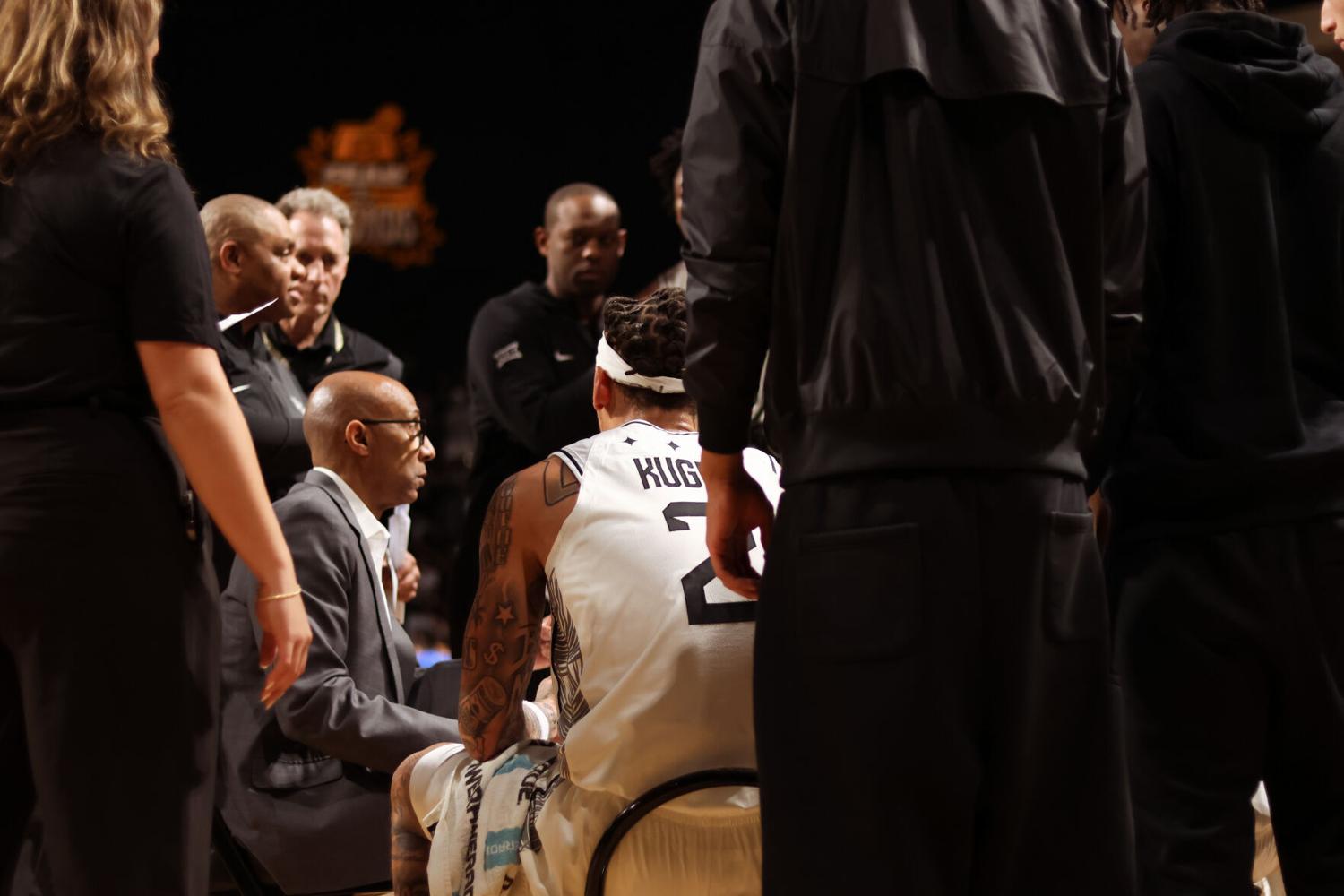

During a break at the Addition Financial Arena on Jan. 2 against the University of Kansas, head coach Johnny Dawkins sits at the head of the circle next to senior guard Riley Kugel (2) and leads the team for the next play.
Aryah Britt
An entirely new group of players became Knights for the UCF men’s basketball 2025-26 season with a common goal: to win.
What could have been a rebuilding year instead became a defining one. The 2024-25 season ended with a 20-17 finish and a 7-13 mark in conference play.
Since then, UCF surged to a 21-12 record, finishing 9-9 in conference play. This broke UCF’s program record of most wins against Big 12 opponents in a single season, according to UCF Athletics.
The team launched UCF’s men’s basketball program back to the NCAA Tournament for the first time in seven years as a No. 10 seed, marking the program’s second-highest at-large bid.
Head coach Johnny Dawkins, who earned recognition for the Jim Phelan National Coach of the Year, approached the season with an emphasis on taking each matchup one game at a time.
“All we can control is our preparation for what we’re going to play next and then move forward from there,” Dawkins said in the postgame press conference on Feb. 17 after defeating TCU.
According to UCF Athletics, the Knights scored an average of over 80 points per game — the highest under head coach Dawkins in the program’s Division I era — and broke a single-game record with 19 three-pointers.
Dawkins told reporters on Feb. 27 at a media availability that the reflection of the team’s success has more to do with the coaching staff and players than him.
“I have a terrific staff; those guys have done an amazing job evaluating and looking to bring the right young people into UCF as well as our players,” Dawkins said. “They care, they want to be really good, they want to win, and it starts with that.”
On Feb. 28, Baylor University head coach Scott Drew told reporters at the press conference how impressed he was by the team and coach Dawkins’ leadership.
“This is an unbelievable coaching job,” Drew said. “I know how hard it is to flip as many people as he did, and the fact that they’ve had the year they’ve had is a tribute to him.”
Before the Big 12 conference on Dec. 17, at the postgame presser against Mercer, senior forward Jamichael Stillwell and junior forward Jordan Burks told reporters that the team’s identity is “defense.”
Burks said what makes this their defense so special is the accumulation of their length, physicality, toughness, and Stillwell. Burks said Stillwell is the “head of the snake” for the team’s defense and contributes a lot.
Burks said practices became a space for players to learn not only the system, but also each other. The Knights played against each other during practices, which Burks said helped him and others develop.
“He makes it where you are competing all the time, and that’s what I love about coach,” Burks said about coach Dawkins. “He makes it to where you can’t be complacent at all.”
At media availability on Feb. 27, junior guard Chris Johnson told reporters how his game has changed.
“I think I’ve improved in all aspects of my game, especially my defense,” Johnson said. “I want to thank my coaches and thank my teammates for helping me do that as well.”
At the last home game, March 3 against Oklahoma State University, junior guard Chris Johnson (right) grabs senior guard Riley Kugel (left) and helps him off the ground.
Aryah Britt
Very quickly into the season, UCF no longer looked like a newly assembled roster. With an 11-game winning streak midway through the season, the group developed an identity rooted in a phrase.
“We started saying every day,” Fulks said. “We all we got, we all we need.”
Fulks said that simple phrase unified the Knights and strengthened their connection.
University of West Virginia head coach Ross Hodge told reporters on Feb. 14 at the postgame presser his outside view of the team.
“I’m impressed by their competitive spirit, and they are a very connected group to each other,” Hodge said. “To have no returners and a brand-new team and put that team together to have them in the position they are in right now is to be commended.”
But Fulks said that the foundation didn’t come easily.
“It was tough at times, but at the end of the day, we had a team,” Fulks said. “This is the first time I’ve been on a team where everybody liked each other. We always kept the main goal, which was winning.”
Dawkins’ impact extended beyond strategy. Fulks said his leadership style and player-focused coaching put the team in the right position to win.
Throughout the season, the Knights showed flashes of potential, earning three AP-ranked wins, but struggled with consistency, with two losing game streaks of three losses in a row towards the end of the season.
Shortly after the release of seeding placements for the NCAA tournament, coach Dawkins told reporters in media availability on Mar. 15 what he thought about his team and their mindset throughout the season.
“I thought they came almost every night with a certain level of competitiveness and a certain level of hunger in our games,” Dawkins said. “That’s what you have to have to be consistent, to win, and to be an NCAA tournament team.”
The turnaround did not just redefine expectations for one season — it also raised new questions about what comes next. With several key contributors moving on, UCF will once again face the challenge of rebuilding.
This year’s team not only ended a seven-year NCAA Tournament drought — it showed what is possible when all the pieces come together.