
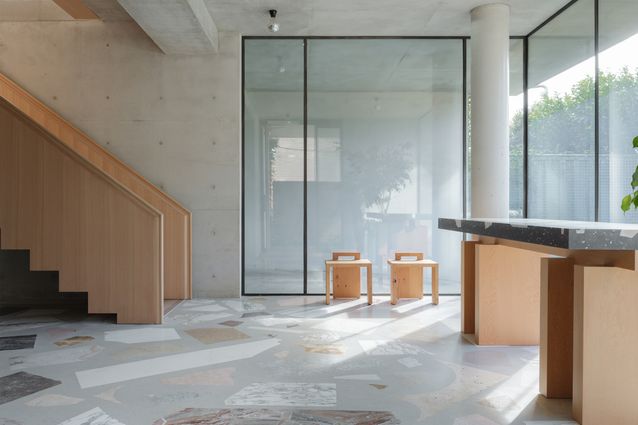
Sydney studio Second Edition was born in 2021 from an ambition to curtail how much construction and demolition waste is destined to end up in landfill. Whether they are designing with offcuts and overstock, exploring new waste streams, or advocating for repair over replacement, Second Edition is hard at work exploring how construction can be less wasteful.
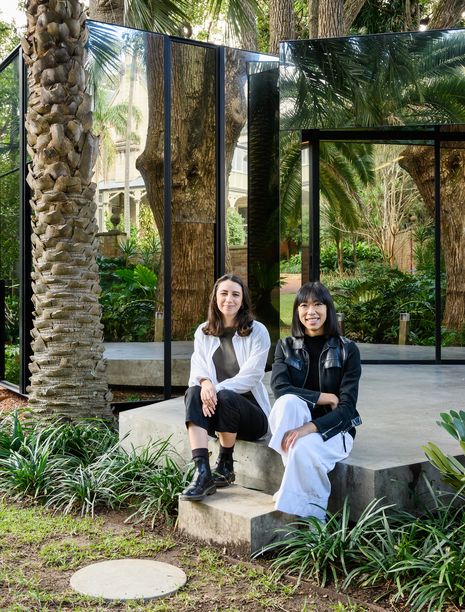
Here, practice founders Shahar Cohen and Amy Seo talk about the obstacles and opportunities for material salvage and reuse, the importance of collaboration and observation, and how the appetite for reuse has changed in five years of practice.
View gallery
Alexa Kempton: Waste sorting and material reuse are often perceived as time-intensive, or more complex, compared to the relative ease of buying new. In almost five years of practice, what have you learned about how to make it financially viable?
Shahar Cohen: It is a balancing act, one we are constantly adjusting. It is about knowing which materials to collect and store, and how to document everything carefully. We only take materials we know will have a destination, whether for resale or for use within one of our own projects, and we retain on-site only what we know will be put back in. A lot of the inefficiency happens when you collect or store material that ultimately doesn’t get used.
When comparing material supply cost only, reclaimed material can generally be found to be cost-neutral compared to purchasing new. However, when it comes to the labour cost to process the material, it will often cost more. That’s something we’ve come to accept. Rather than fight it, we’ve focused on building efficiencies into every other part of the business, so we have more capacity to spend time on the processes for material reuse that matter to us.
For clients, we try to gather as much information as possible about the material and the process before committing, so they go in well-informed. Our target is always to come in with a price that is equal to or less than new – and of course “less than” is the harder goal. What tends to happen is that across a project with several reuse elements, one might come in over, and another under, in hopes that the costs balance out overall.
AK: In Australian homes, kitchens are often ripped out and replaced after a relatively short lifespan, creating significant waste. You’ve taken a critical lens to this in projects such as Offcut Kitchen, Yarranabbe Apartment and Potts Point Apartment. What have you discovered is easy to repurpose in kitchen renovations, and what tends to be more difficult?
Amy Seo: It really depends on the kitchen. Older kitchens without carcass systems – such as timber frames, like the one at Potts Point Apartment – are often easier to work with, because the structure itself is worth retaining. In that case, it was also helped by the client’s willingness to have open shelving, since retrofitting doors onto a framed kitchen can be labour-intensive. Modern joinery production is so streamlined that it can be hard to match.
On other projects we’ve reused carcasses where only the fronts were dated. We’ll keep the carcasses, reconfigure them based on their dimensions, and then either refinish the existing fronts or have new fronts made. If it’s a polyurethane colour, the original fronts can be refinished. If it’s a veneer, we’ll make new fronts for the existing carcass system.
Appliances are another item we’ve found surprisingly easy to repurpose. Sometimes they come from the project itself, other times we’ve salvaged them separately. We have quite a few in the warehouse right now that we’ll specify into upcoming projects. People discard appliances that are barely five years old and still perfectly usable in the right context.
People discard appliances that are barely five years old and still perfectly usable in the right context.
AK: What design and construction decisions most often complicate disassembly and reuse?
SC: The biggest one is full demolition. When a project is slated to be completely demolished, it often requires a mechanical demolition process, which makes any hand or slow deconstruction cost-prohibitive. We’ve consistently found it very difficult to salvage materials from sites headed for full demo unless the client is genuinely willing to invest in it.
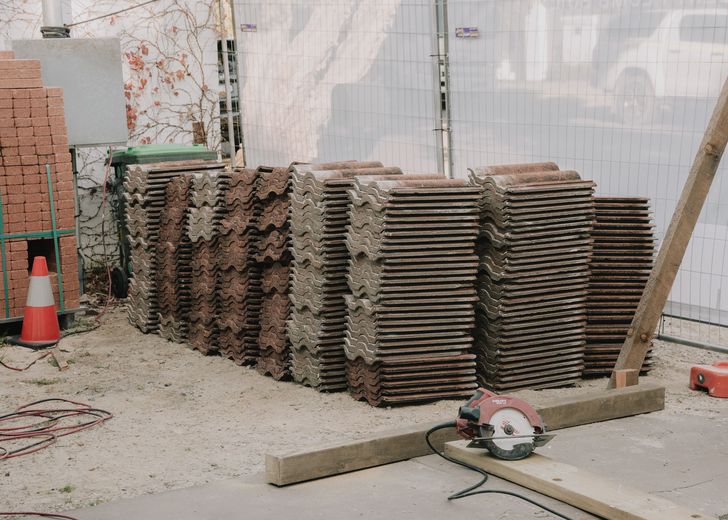
One example of a successful outcome was a house in North Bondi by Anthony Gill Architects, built by Robert Plumb Build. Because of our close relationship with Robert Plumb, and their genuine interest in deconstruction as a process, we were able to carefully take apart the roof tiles, the timber flooring and the bricks. Some bricks were reused on site, while others went to other projects – that’s one advantage of working with a residential builder running multiple sites simultaneously. The roof tiles were sold to a second-hand supplier.
View gallery
The other key issue is when reuse is considered after the design has already been resolved. Trying to retrospectively embed salvaged materials rarely works well – it’s essentially rework, and neither the client nor the architect tends to have much appetite for revisiting decisions that have already been made. The earlier it’s considered in the process, the better.
Trying to retrospectively embed salvaged materials rarely works well … the earlier it’s considered in the process, the better.
AK: You’ve experimented with renders and terrazzo made from crushed stone off-cuts. At this stage, the method seems quite bespoke. Do you see potential for it to be scaled beyond prototype applications?
SC: Absolutely. The processes developed at Rochester Street Office [with Allied Office, Akin Atelier and Dangar Barin Smith] and Love Shack can definitely be replicated, and replicated at scale, it’s really just a matter of finding the right contractor to work with. On those two projects we worked with Eric Moroney from Lusso Venetian Finishes and Natural Brick Company, who were open to testing the process with us. Once it’s been tested, it’s also possible to establish a square-metre rate for it as a product, and the quantity of material required is relatively straightforward to calculate.
The main hurdles have been finding the right contractor for crushing, particularly at smaller quantities, and for screening, which we had to do manually on site. Getting the aggregate to the right consistency is critical for it to perform properly as a render, and that’s where precision matters.
AK: A recent project, Surry Hills Terrace, was built using overstock and seconds materials. How does that specification process work, and does it introduce additional complexity during construction?
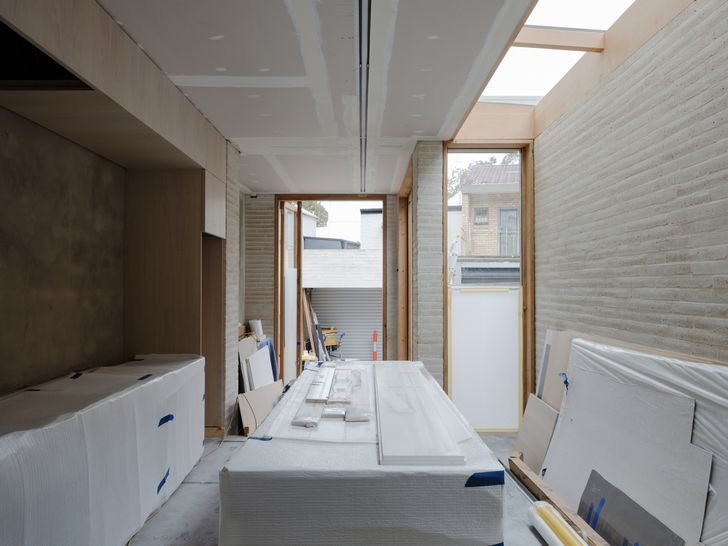
AS: Overstock and seconds are actually one of the easier material streams to work with. The quantities are known upfront, the material usually comes from an organised supplier, and it’s already palletted, counted and ready to go. Often the reason for a materials’ “seconds” status is well documented, which means you understand what you’re dealing with before you commit.
For Surry Hills, the process was straightforward: we sourced samples, the client was happy, we knew the quantities, and the material arrived on site. The complexity comes from the fact that every second has its own quirks. If the bricks aren’t perfectly straight, it affects your detailing and how they’re installed. If there’s colour variation within the batch, a sample alone won’t necessarily tell the full story. Each material brings its own set of considerations, but within the seconds world, those considerations are usually very manageable.
View gallery
AK: You run a materials bank of salvaged materials ready for reuse and accept sourcing requests. What have you learnt about the appetite for reuse in recent years, and where does the resistance still exist?
SC: The appetite has grown significantly. When we started, there were maybe one or two people who were genuinely interested, and a lot of voices telling us it wasn’t financially viable. We’ve seen a number of companies in the reuse space close since then – usually small, local operators who’d been doing this work quietly for years, which has been disheartening.
The resistance that remains is, in our experience, primarily coming from clients. There’s still a strong perception that new is best, and in the current climate of rising construction costs, that’s becoming more entrenched rather than less. People want certainty, they want to know how a material will perform, that it’s covered by a warranty, that it won’t need unexpected maintenance. Reuse can’t always offer those assurances, and that’s a real barrier.
It also means reuse starts to make financial sense in the middle of the market. If someone is looking for the cheapest possible outcome, reuse isn’t the answer. But at a mid-range finish level, the numbers can work. On the builder side, there’s still some resistance around liability, because they’re responsible for everything they install, but in practice, once they’ve seen the material and understand it, most builders have been very willing to work with it.
AK: Knowledge sharing and collaboration are central to your practice. What networks or resources are most critical in making material reuse possible in practice?
AS: Close relationships with your builder and their subcontractors, and having a direct line to the subcontractors themselves, is probably the most important thing. They’re working with the material day in and day out, and some of our best reuse ideas have come from them. Someone will say, “wouldn’t it be interesting if we did this with that?” and then it becomes a back-and-forth that produces a solution that neither of us would have arrived at alone.
Beyond that, talk to the makers and fabricators, spend time in industrial areas to see what people are discarding or producing in an ad hoc way, and think about how that could translate into design. A lot of what we do starts from just paying attention to what’s already out there.
A lot of what we do starts from just paying attention to what’s already out there.
AK: Are there particular waste streams you’d like to investigate further?
SC: There are two that we’re really focused on at the moment. The first is papers and plastics. They’re the major bin-fillers on most construction sites, and while we’ve done a lot of work with marble, timber and brick, there’s a huge volume of plastic waste we haven’t yet found a streamlined way to address.
The second is metal offcuts. We’ve been spending time with a few metal laser cutters recently and it’s struck us just how much offcut material is generated. It does get recycled, but the recycling process is carbon-heavy and often involves shipping offshore. The potential we see is more direct: the majority of small fixtures and fittings we specify on projects could actually be made from these offcuts. It’s a reliable, continuous waste stream, and it maps almost directly onto things we’re already sourcing.
View gallery
AK: What one piece of advice would you offer to others who want to integrate material salvage and reuse into their work?
AS: Speak to the client about it early. That’s harder than it sounds – as a small practice, you’re often just trying to win the work and you don’t want to complicate the conversation before it’s even started. But the projects where reuse has really worked are the ones where, from the very beginning, we’ve said: “This is something we care about, and we think it could genuinely add value to your project, aesthetically, and in terms of the story it tells.”
Speak to the builder early, too. Get everyone on board so it doesn’t arrive as a surprise halfway through. The worst version is when reuse comes across as an afterthought, something tacked on at the end. When it works, it works because it was considered from the start.