
Three years ago, baseball needed fixing.
The sport had grown slow and tedious. Pitchers paced the mound between maximum-effort heaves. Hitters sold out for power, tolerating strikeouts as a means to an end.
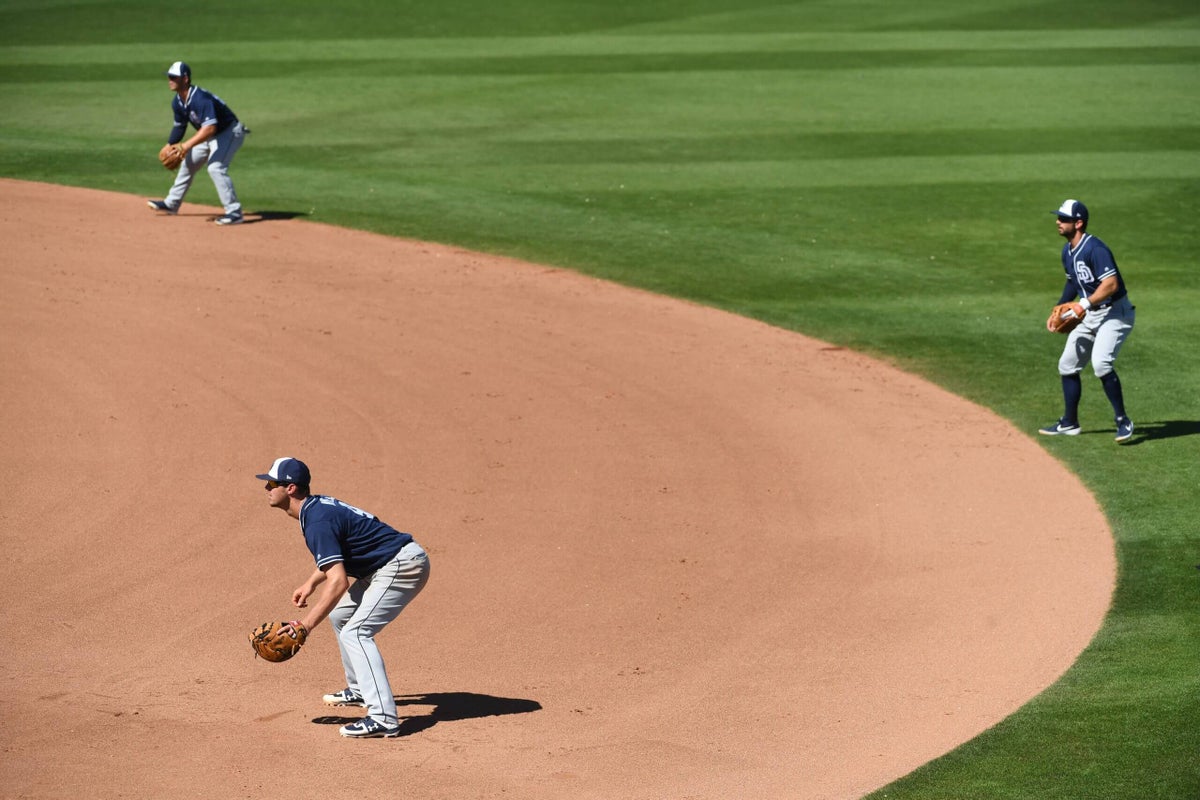
Even more glaring was the spread of the infield shift: Index cards tucked into caps and back pockets provided precise defensive positioning, directing infielders onto the outfield grass to swallow up base hits.
“The game has evolved in a way that nobody would have chosen if we were sitting down 25 years ago to chart a path toward the best version of baseball,” Theo Epstein, the three-time World Series-winning executive turned league rules consultant, said at the time.
The league craved the action of a bygone era — more balls in play, more athleticism — and was no longer willing to wait. It installed pitch timers and enlarged bases, and it banned the extreme infield shift. No longer could defenders range into right field to gobble up balls that would have been singles in any other era. Hall of Famer Johnny Bench speculated some hitters would gain 10 to 15 points of batting average.
Today, MLB’s rule changes are hailed as a resounding success for the sport. Game times are down. Stolen bases are up. Even strikeout rates have flattened.
Yet restricting the infield shift did not bring back the base hit. In 2026, league-wide batting average remains at its lowest point for position players in the Modern Era (.243) and batting average on balls in play (.291) is up only one point from 2022.
By the numbers, MLB’s hitting crisis continues.
But if the game looks more normal, does anyone care?
Introducing the new rules in 2023, MLB commissioner Rob Manfred said fan sentiment was the league’s “guiding star”: “What do our fans want to see on the field?” The response spoke to a desire to restore both action and a traditional aesthetic. Fans wanted steals, gappers and web gems; they didn’t want hyper-optimized defensive alignments.
The thinking was that restricting the shift would also incentivize left-handed sluggers — the hitters most frequently facing four-outfielder formations — to put the ball in play rather than swing for the fences. But in MLB front offices, there was little optimism that batting averages would bounce back.
“Most people thought the science was right and we weren’t going to see teams hitting .270,” said an American League executive, who was granted anonymity in exchange for their candor. “But we were going to see people less frustrated with the idea that David Ortiz is up and there are three guys standing in a triangle between 150 and 200 feet from home plate.”
That triangle has been banished, yet the root issue remains. Banning the shift revived one type of hit — lefties’ BABIP on pulled ground balls is up 24 points since 2022 — but did not alter the sport’s prevailing hitting philosophy.
“Even though we changed the shift in the infield,” Detroit Tigers manager A.J. Hinch said, “we didn’t change that the optimal ball in play is the ball in the air.”
Batters are lifting and pulling the ball more than ever. No batted-ball type has a lower batting average than a fly ball, and ever fewer are dropping for hits as clubs move toward increasingly athletic outfield trios.
For MLB, solving the sport’s most vexing trend — the death spiral of contact hitting — would require far more aggressive rule changes. And are fans asking for that?
“Maybe this is looking for a solution to a problem that people don’t really care about right now,” the exec said. “Maybe they will at some point, if batting average crosses sub-.200 and it becomes unmanageable. But I feel like right now, people go to a baseball game and like what they see.”
One afternoon last August, Athletics first baseman Nick Kurtz applied a piece of textbook hitting to a 98 mph sinker on the outer half of the plate. Kurtz scorched the baseball back up the middle at 100 mph. It zipped past the pitcher and skipped almost directly over second base.
Kurtz instantly knew what TV viewers only learned once the camera angle changed: It was a routine out. Los Angeles Angels shortstop Zach Neto took a half-step to his left, picked the rocket smoothly and threw out Kurtz by three steps.
If MLB asked fans which type of field out they’d most like to eradicate, the overwhelming choice would be the one turned by a middle infielder shading as close as possible to second base — the surviving (and legal) remnant of the infield shift. Big leaguers were taught as Little Leaguers to drive the ball back up the middle. That hard contact turning into outs bothers them, too. “There’s always a split second where you’re expecting it to be a hit,” said A’s DH Brent Rooker. “Then you realize there’s a guy right there to take it away.” Kurtz added: “That part of (the game) is just gone.”
The out that truly surprised Kurtz occurred just two weeks into his AL Rookie of the Year campaign last year. In the eighth inning of a tied game, Kurtz stayed on a two-strike curveball and roped it to the opposite field at 105 mph. A gapper. Kurtz hauled around first base, helmet flying off, only to see center fielder Julio Rodríguez make a sliding catch.
That, Kurtz said, was his “welcome to The Show” moment.
Every hitter can relate. Red Sox shortstop Trevor Story is still stupefied by the ball he hit on the screws (translation: a 108.1 mph exit velocity) and was caught by a jogging left fielder in the gap. “That’s been a hit your whole life,” Story said. “That’s what you’ve been taught to do. But that’s part of the game now. Everything’s optimized.”
No one would suggest those snags are bad for the sport, yet better athleticism and more precise positioning in the outfield are impacting the run-scoring environment more than the shift ever did. In 2021, Baseball Prospectus researcher Rob Arthur found that improved defense was costing MLB thousands of hits; the shift, he wrote, was “the tip of a defensive efficiency iceberg that’s walloping offense across the league.” Because the bulk of that run-suppressing iceberg has managed to build without harming the aesthetic of the sport like the infield shift did, MLB has left it alone.
Doubles and triples are disappearing as fielders play deeper than ever to prevent balls over their heads. Outfield catch probability is rising. BABIP on barreled balls is nosediving.
A barrel is a ball struck at 98-plus mph and at an ideal launch angle to result in an extra-base hit. Hitters hunger for barrels. The search for more of them gave way to a launch-angle revolution, as teams sought slugging and hitting labs trained their pupils to produce it. But as the number of barrels has increased, more and more are being caught. In 2016, barrels to the outfield generated a .529 BABIP. In 2025, that figure dwindled to .392.
The desire to take away extra-base hits has led many teams to back up, shade the gaps and stack the outfield with rangy defenders. The Brewers’ starting outfielders — Jackson Chourio, Garrett Mitchell and Sal Frelick — are in the 90th percentile or better in sprint speed. “We’ve got all center fielders,” the Brewers’ Christian Yelich said. The Chicago Cubs employ the league’s best outfield defender, Gold Glove center fielder Pete Crow-Armstrong, and boast the lowest opposing BABIP in the majors (.270) since the start of the 2025 season.
“You don’t just stick a slugger in left field and say, ‘Whatever you catch out there is a plus,’” Yelich said. “The game is not like that anymore. You can quantify how much that hurts you if you have poor outfield defense now.”
A hitter with an all-fields approach forces defenses to play neutral positions — “A well-rounded hitter is the most difficult one to defend,” Hinch said — yet many batters find the back-side, or opposite-field, outfielder is the best positioned. A pulled ball is often struck well enough to be a hit either way, Rooker said, and it’s “the flares, semi-barrels to the opposite field that tend to be taken away.” In 2026, BABIP on pulled balls to the outfield is .623, according to Statcast, while BABIP on opposite-field balls to the outfield is .363. Both are down more than 40 points over this past decade.
Sal Frelick, the Brewers’ right fielder, delights in such back-side thievery.
“If they hit a 107 mph ball off the fence, I’ll tip my cap and give him a double,” Frelick said. “I’d rather take away the flare.”
Last year, the Tigers’ Zach McKinstry won a Silver Slugger as a utility player. He did so using an approach that has grown increasingly uncommon: targeting the open grass in front of the outfielders. McKinstry had average bat speeds and exit velocities among the lowest in the league. He said he tries to stay with a launch angle between 11 and 14 degrees — a low line drive — and often finds that his harder-hit balls are outs.
Before each at-bat, McKinstry checks the defense’s positioning. He has noticed it varies greatly based on his recent tendencies.
“You don’t really get to guide the ball to where it’s going,” he said, “but you have a gist of where the hits are.”
If any team exemplified how to win when hits are increasingly hard to find in the air, it was the 2025 Brewers. Milwaukee’s short kings led the majors in singles, infield hits and bunt hits. They inflicted pain by putting the ball on the ground. They had the league’s fourth-lowest average launch angle and average exit velocity, yet scored the third-most runs. They led the National League with a .305 BABIP.
The Brewers won 95 games and advanced to the NLCS.
This year, Milwaukee is the only offense in the majors with a ground-ball rate over 50 percent. But their BABIP is down 10 points year over year, and they’re second-to-last in the league in homers. The Brewers are currently fourth in MLB’s most competitive division. It’s hard to sustain offense on singles.
Banning the extreme infield shift did not alter the direction of the game. Hitting has never been harder. Pitchers add velocity and new pitches each year. Defenders are quicker and in better position. Just aim where they aren’t?
“It’s too hard of a game to do that,” Story said. “Just hit the ball hard, that’s the main thing.”
Yet fighting power with power hasn’t solved the issue, either.
If MLB is still serious about charting a path toward that “best version of baseball,” as Epstein put it, the league may need to take what it began with the shift restrictions — giving middle infielders a line they cannot cross — and go further: standardized positioning. A fixed starting spot for each of the seven field defenders, with only minimal flexibility given based on the game situation.
“That would definitely change the game,” the AL exec said.
The Athletic’s Jayson Stark wrote in December that MLB studied a similar concept in extended spring training in 2022, drawing an arced line across the outfield to mark a maximum starting depth.
“For all the talk about infield defense restrictions,” Epstein told Stark previously, “I think you actually would get a greater impact on batting average on balls in play, and increase action in the game more, if you could find just the right tweak to outfield positioning — and really bring back a lot of action and drama on balls and plays in the outfield.”
But that benefit comes with a trade-off. The triumph of MLB’s 2023 rule changes, said the AL executive, is that they were “pretty seamless for something that could have been a fiasco.” The changes soon went largely unnoticed by fans; they felt less new than they did familiar. “It didn’t radically change the character of the sport,” the exec said.
A line mowed across the outfield grass would not go unnoticed. Dots on the field directing position players where to stand wouldn’t fit the sport’s traditional aesthetic, either.
But perhaps standardizing positioning in a more subtle way, or moving the pitcher’s mound back just a few inches, would allow the league to boost hitting without damaging the way the game appears to the audience.
For now, aggressive intervention may be a solution to a problem the public hasn’t yet flagged. Baseball looks like baseball again, even as batting averages crater and extra-base hits threaten extinction. In time, the league’s compass — What do fans want to see on the field? — may demand a different type of action: a few more balls that actually land.