
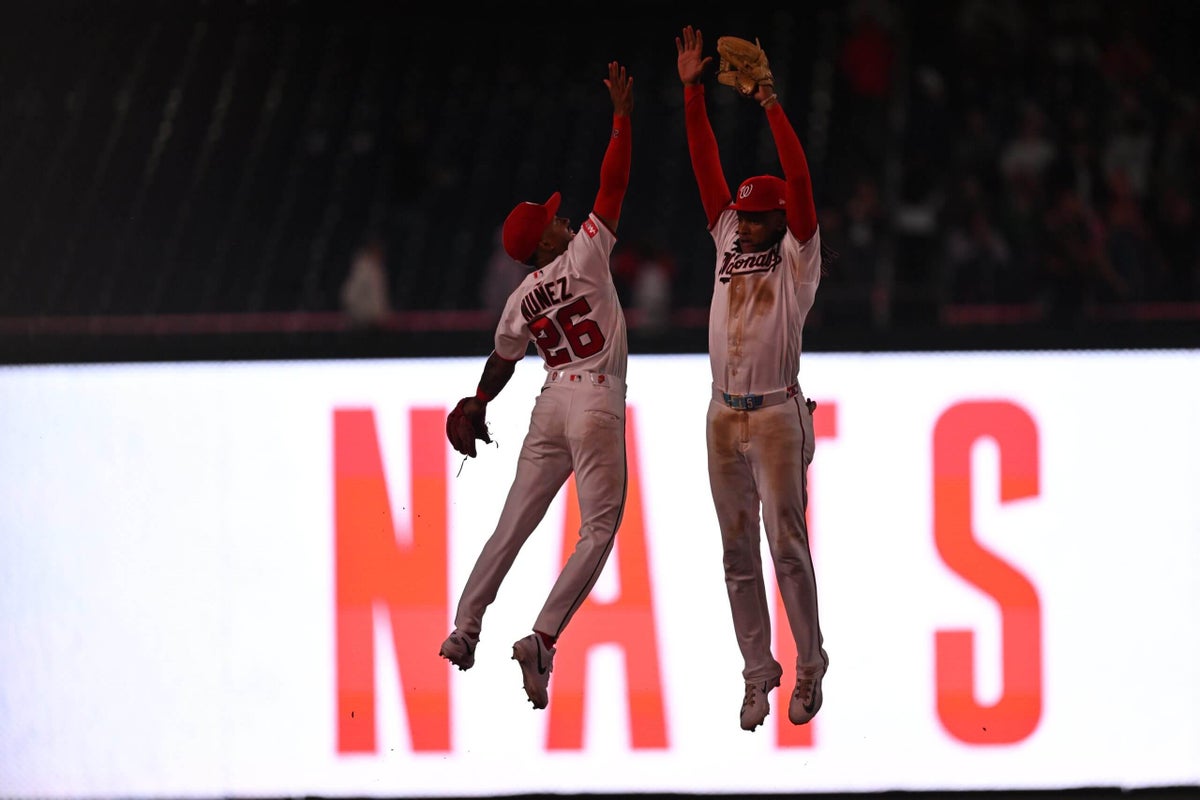
WASHINGTON — This is what the Washington Nationals want it to look like.
That doesn’t refer to the season-high 15 runs they scored in a walloping of the Minnesota Twins on Wednesday. Or the grand slam that CJ Abrams called from the dugout moments before he sent it a dozen rows deep. Nor the home run that Drew Millas said he called — his first this season — four hours before it actually happened.
Well, it kind of means those things.
Allow the route James Wood took after he recorded the first out Wednesday to paint the full picture.
First, he passed the on-deck circle to share a few words with Abrams. Second, he went down the dugout steps and walked to the end of the bench to chat with assistant hitting coach Andrew Aydt as DH José Tena listened in and two quick outs followed. Third, he went to an iPad as center fielder Jacob Young peered over a shoulder. Finally, it was back to another conversation.
This — 14 hits, five walks, four homers and conversations in the dugout to break it all down — is what the Nationals have missed as of late.
Through the first four weeks of the season, they were a top-five offense in baseball. In the two weeks that have followed, they’ve had the lowest OPS in baseball. At least, that was the case before Wednesday’s outburst.
Why the oscillation?
“Sometimes, we think we’re going to be pitched a certain way, and it doesn’t necessarily go that way — and I think we can be a little bit slow, maybe, to adjust and realize how we’re being pitched,” manager Blake Butera said before Wednesday’s game. “We need to be able to make that adjustment in game, rather than waiting until the next day.”
Perhaps the complaint had some merit.
Before the game, Washington’s left-handed hitters prepared to see loads of off-speed pitches. Against Twins right-hander Bailey Ober, they got heaters inside. They did not reach base in their first turn through the order.
In Nationals hitters’ second and third times against Ober, they got six hits in their next 12 at-bats with three doubles, two walks and a homer. Though it’s a fool’s errand to read too closely into one game, you don’t run into 15 runs by accident.
“Lefties talk to each other, and righties as well,” Abrams said. “We go over anything he has in the meeting, and then as the game goes on, we see what he’s doing to us.”
“Our hitting coaches did a tremendous job of recognizing that (plan) first time through, and then our players were talking with one another about what they were seeing, how they were getting attacked,” Butera said.
“I think we generally have decent conversations between each other, but I think after guys have good at-bats — after guys see pitches really well or have long at-bats — we need to have more of those (conversations) derived from those guys,” Millas said.
Although, Millas conceded, Wednesday might have just been more about momentum.
“You could feel it,” he said.
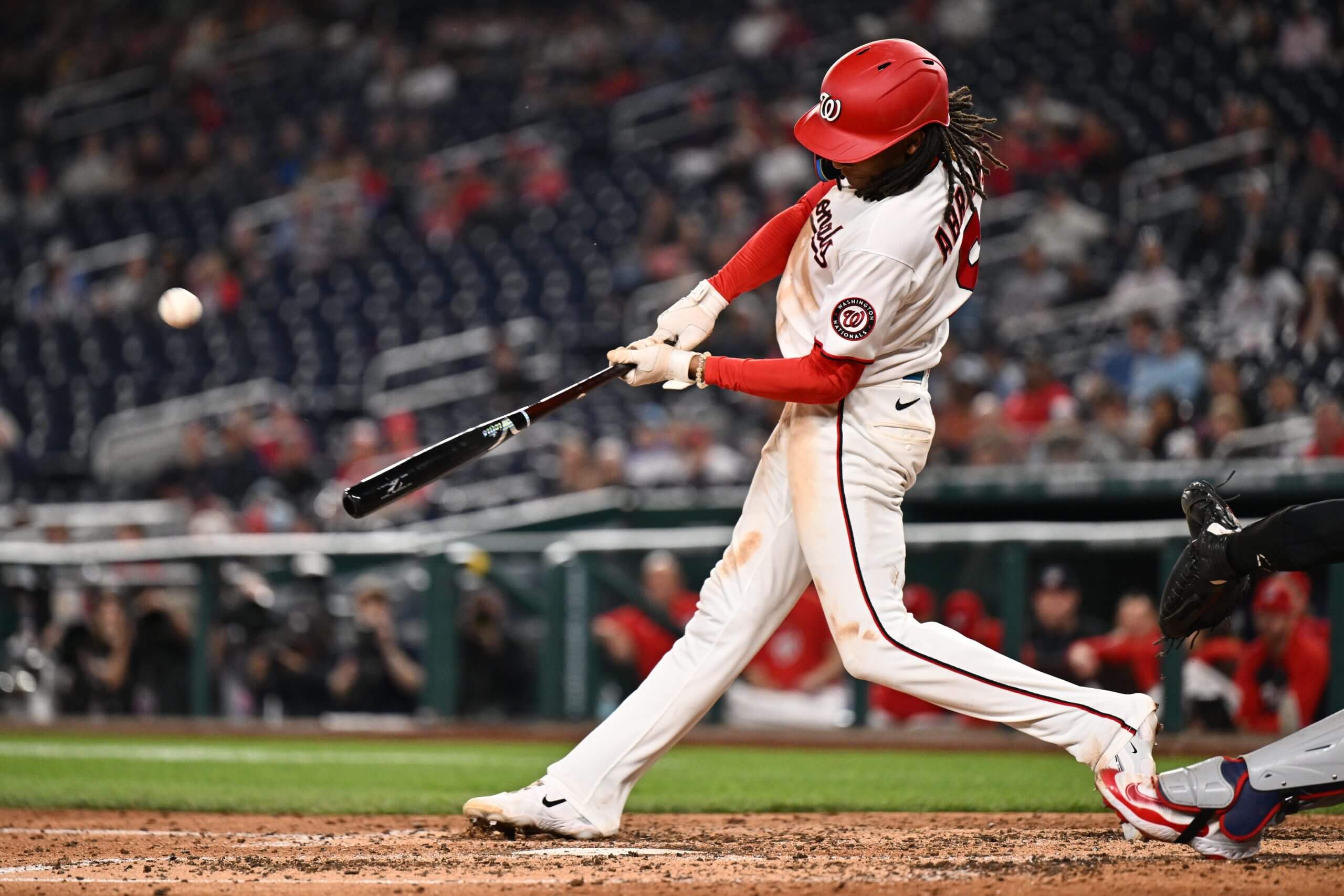
CJ Abrams’ grand slam helped push the game out of reach in the Nationals’ favor. (Jamie Sabau / Getty Images)
While Butera has challenged his team via news conferences before, previous instances often involved critiques of their mental mistakes in the field or on the bases. If anything, the first-year skipper has preached about pregame preparation. But preparing for games and adjusting within them are two separate tasks.
Especially, hitting coach Matt Borgschulte said, when the calendar turns to May.
“This is kind of the point in this season where pitchers start to see how hitters have done against certain pitches, and start to make their adjustments from what they’ve seen this year, as compared to what’s happened in the past,” Borgschulte said. “So I think that’s part of what’s happening with some of the adjustments that other teams are making.”
Borgschulte tries to touch base with each player when he gets back to the dugout. He also believes the dugout iPad can be useful — as does Butera — when it’s used correctly. They want players to look at the pitch location, sequencing and their own reaction, rather than their mechanics.
At no point did Butera or Borgschulte reference the age of their players (the Nationals are the only MLB team to not have a player over 28 years old take an at-bat). Josh Bell, who was in his 10th MLB season on last year’s team, was the Twins’ cleanup hitter Wednesday. Abrams was the only player in Wednesday’s game with at least three years of service time.
The Nationals believe they can teach these habits even without the benefit of a veteran on the top rail. The first few weeks showed that the team is equipped to adjust.
It’s about putting in the effort to do so.
“Other pitchers are making those changes from start to start,” Butera said. “So our coaches can do all of the homework they want to, but, at the end of the day, if a pitcher makes a slight change prior to that outing, it’s so important for our players in the box to relay what they’re seeing.”
The absence of conversation is why the Nationals went from one of the best fastball-hitting teams in MLB (slugging .494 against fastballs through April 22) to one that struggled against them (.255 slugging percentage on fastballs from April 23 through Tuesday). It’s the middle innings often came and went without a big swing. It’s why there were some lineup slumps.
The next step for this lineup is to have those conversations even when everything feels as if it is collapsing at the plate. Abrams has done an exceptional job of that this season and has limited his longest slump to a nine-game stretch. Wood also falls into that bucket, where the floor of his slumps still seems rather high because he works counts and stays on the fastball.
Sure, they might be uncanny examples, but it feels rather applicable to the entire lineup, especially on a chatty night when every player reached base.
“There’s going to be parts in the season where you’re not swinging it as well,” Borgschulte said. “For us, it’s, ‘How can we make those stints a little bit shorter, and then also still find a way to make them productive,’ even when your swing might not be in the best spot, or your approach might be a little bit off here and there.”