
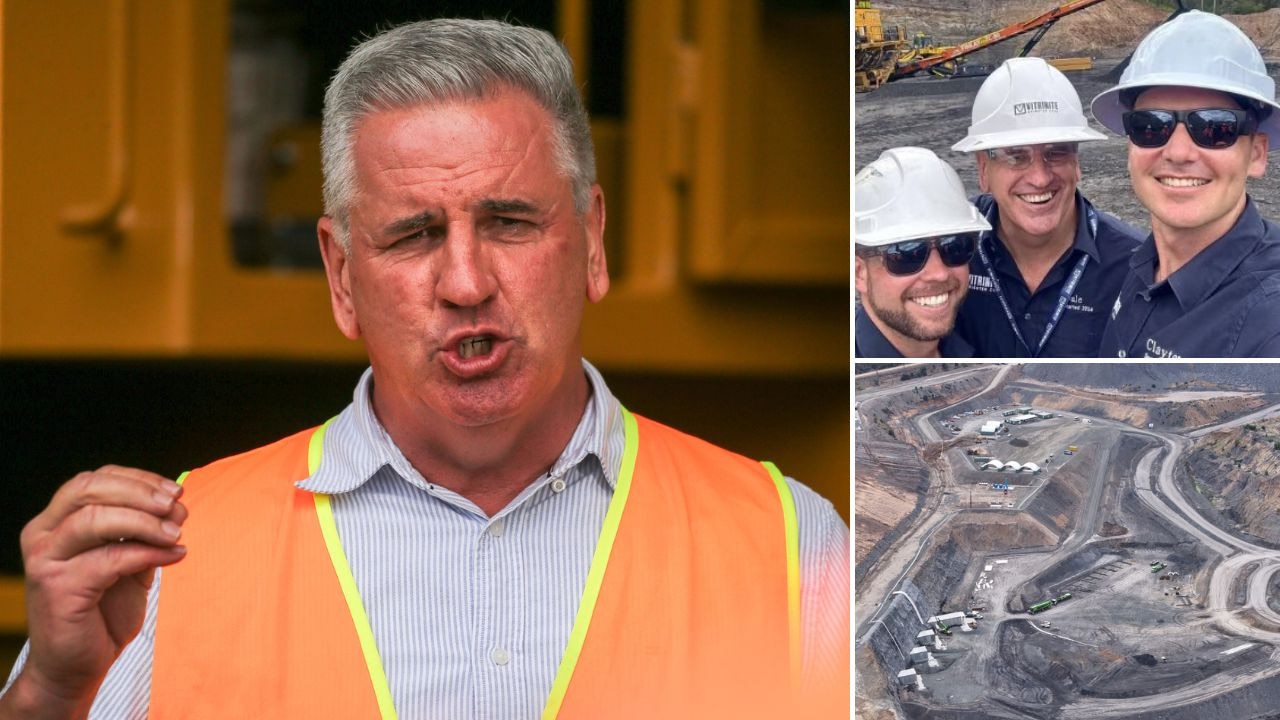
Coal projects championed in ministerial photo opportunities as job-creating wins for Queensland are unravelling, with company collapses leaving creditors chasing millions and hundreds of jobs in doubt across the Bowen Basin.
Vitrinite collapsed into receivership and administration in February this year, less than a year after Resources Minister Dale Last visited the company’s Vulcan South mine near Dysart in March 2025, where the project was promoted as a major jobs boost for the region.
At the time, government statements said the mine was expected to create up to 450 jobs by 2027 — jobs that have not materialised following the company’s collapse.
Council documents show the company had also sought approval to lift restrictions on haulage routes to enable the disposal of stockpiled coal to Anglo American, highlighting efforts to generate cash in the lead-up to its collapse.
Creditor documents show the scale of the fallout, with more than $2.8 million owed to unsecured creditors and more than $1 million owed in employee entitlements, leaving suppliers, contractors and service providers exposed.
The company’s filings also reveal spending across a range of items, including a $53,000 keg system listed among assets.
PHOTO OPS TO COLLAPSE
In December 2024, Mr Last officially opened Coronado’s Mammoth Underground Mine, which was expected to create 259 full-time jobs over the life of the operation.
Within a month, the company announced a 30 per cent reduction in headcount across its Australian operations, offsetting any gains from the newly opened project.
THE UNRAVELLING
In a separate collapse that sent shockwaves through the region, Bowen Coking Coal entered administration in July 2025, placing more than 500 jobs at risk at its Burton Mine near Moranbah and leaving tens of millions of dollars in creditor claims tied up in the process.
Administrators and directors pointed to a “challenging environment” driven in part by higher royalty rates introduced by the Queensland government in 2022, alongside cash flow constraints and disputes with key contractors.
MILLIONS UNPAID, PRESSURE MOUNTS
In a statement to News Corp, mining contractor BUMA — which said it does not comment on confidential commercial matters — confirmed it was left unpaid for more than $15 million in work at the Burton Coal Complex, escalating the dispute to a $6.8 million statutory demand — amounts still outstanding when Bowen Coking Coal entered administration.
Despite completing its contracted work in full, BUMA said it was not paid, warning the financial hit had been “substantial” with direct consequences for its workforce.
Unsecured creditors are expected to receive only a nominal return under Bowen Coking Coal’s restructuring.
Administrators from McGrathNicol said the situation worsened when the Queensland Revenue Office refused requests to defer royalty payments, limiting the company’s ability to pursue recapitalisation and contributing to a broader liquidity crisis.
A Queensland Revenue Office spokesman said the agency could not comment on individual royalty cases, but confirmed it did not have the power to waive royalties and only offered payment arrangements on a case-by-case basis in instances of financial hardship.
However, it did not address administrator findings that a refusal to defer payments contributed to Bowen Coking Coal’s collapse.
In a June 2024 submission to a Queensland parliamentary inquiry, Bowen Coking Coal — led by then chairman Nick Jorrs — said increased royalty rates had “played a major role” in the closure of its Bluff mine in 2023, resulting in the loss of about 300 jobs.
In the same submission, the company said mining costs had risen by about 75 per cent over three years, leaving many Bowen Basin operations with break-even points above the new top royalty threshold — meaning some mines were effectively being taxed before turning a profit.
It collapsed into administration just over a year later.
The company’s market value had already deteriorated sharply in the lead-up to the collapse, with its share price falling to just cents before administrators moved in.
Subsequent filings indicated the shares were effectively worthless, with transfers lodged on the basis existing equity had been wiped out.
A SPLIT FUTURE
The collapse of Bowen Coking Coal triggered a complex carve-up of the company’s assets.
The Burton Mine Complex and related operations are set to be taken over under a deal involving Argo Bowen 2 Pty Ltd, which has recently received approval from the Australian Competition and Consumer Commission.
A spokesman for Argo Queensland said the operations had been placed into care and maintenance by administrators before the acquisition, but the company intended to restart them “in due course” as it worked through the ownership transition.
The Bluff mine, which has been on care and maintenance since 2023, remains subject to a separate proposal involving Maverick M Australia, backed by UK-based Meta Mines Investments, with no confirmed timeline for completion or restart.
ROYALTIES ROW INTENSIFIES
Separate analysis published by the Institute for Energy Economics and Financial Analysis stated some Queensland coal operations reopened during the sharp coal price surge following Russia’s 2022 invasion of Ukraine — including mines linked to Bowen Coking Coal — had come under renewed pressure as prices eased and operating costs continued rising through 2024 and 2025, with royalty settings compounding the squeeze on profitability.
CQUniversity economist John Rolfe has previously warned smaller and mid-tier coal operators can become particularly exposed during commodity downturns when operating costs remain high and prices begin easing from boom conditions.
The pressure on the sector has come amid ongoing debate over Queensland’s royalty regime, with Premier David Crisafulli maintaining the current settings despite growing opposition from parts of the mining industry.
Vitrinite co-founder Ryan Welker took aim at the policy environment publicly following the company’s collapse, criticising government settings in a series of LinkedIn posts responding to Mr Last and Mr Crisafulli.
“We are still losing jobs in the coal industry which is dying in Queensland,” he wrote.
In a separate post, he warned investment would continue to stall unless settings changed, saying producers were being “strangled … with royalties and taxes”.
The criticism has been echoed more broadly across the sector, with QMetco chief executive Andrew Boyd telling a recent industry forum Queensland was “going backwards” under what he described as an “onerous” royalty regime.
Mr Boyd said paying up to 40 per cent of revenue in royalties was “just obscene”.
Mr Last defended the government’s position, pointing to major investments and reiterating that there would be no changes to Queensland’s royalty regime.
But his response did not directly address questions about recent collapses and workforce cuts across the Bowen Basin, including Vitrinite and Bowen Coking Coal, or administrator findings linking royalty pressures and deferral refusals to the latter’s collapse.