
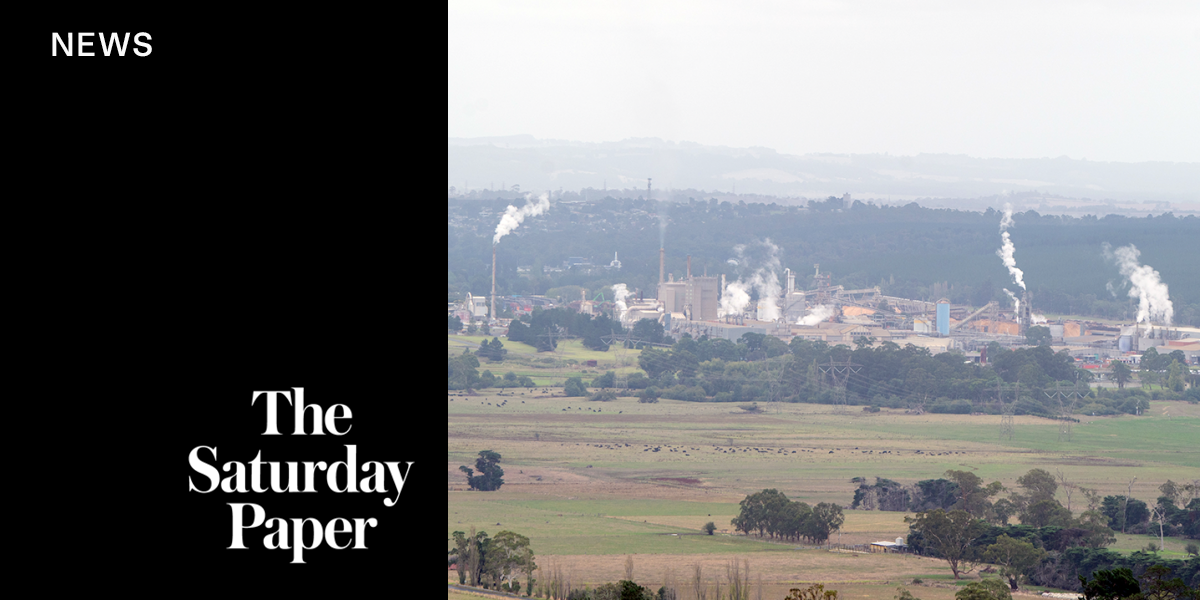
In 2025, the paper manufacturing company Opal, operator of the Maryvale pulp and paper mill in Victoria’s Latrobe Valley, started legal proceedings against the Victorian government, alleging a breach of the state’s obligation to supply the company with pulp logs for papermaking. The Maryvale Mill is demanding more than $400 million in compensation from the Victorian government.
The case came a year after the Victorian government announced the end of logging in the state’s native forests, a decision that meant Opal could no longer source its pulp logs from state-managed native forests. It remains unclear when the outcome of the court case will be known.
Opal claimed this decision forced the company to close its white paper production at the Maryvale Mill. However, there are other pressing issues at play. This closure also comes at a time when there has been a major and sustained “structural” decline in demand for white paper, not only in Australia but across the world.
This raises a critical question about the actual cause of the Maryvale Mill’s problems. Were these alleged losses the result of an interruption to log supply or simply part of the long-term decline of the white copy paper market?
At the centre of this dispute is a longstanding legislative agreement requiring the Victorian government to supply massive volumes of pulp logs from native forests to the Maryvale Mill. The agreement, formalised under the Forests (Wood Pulp Agreement) Act in 1996, locked in native forest pulp log supply obligations for more than three decades.
Unlike other contracts, this agreement between the state and the company is enshrined in law. Where other legal contracts are often flexible and responsive to changing conditions, a state agreement is rigid and locks in long-term arrangements that can be difficult to adjust as conditions change.
The intent of these agreements is to attract investment and provide resource security, but what happens when conditions – beyond the control of the government and the company yet subject to the agreement – change?
Over the past 20 years, the market for copy paper has undergone a profound structural decline. The digitisation of communication has steadily eroded the demand for white copy paper. In Australia, consumption of printing and writing paper has fallen by nearly two-thirds since its peak in the late 2000s. This is not a cyclical downturn; it is a long-term shift in how information is produced and distributed.
Opal is a subsidiary of the Nippon Paper Group, based in Japan. It bought the Maryvale Mill in 2009 with the aim of becoming one of the top five pulp and paper companies worldwide. However, the Maryvale Mill has instead generated significant losses for the company.
In its 2024 annual report, the Nippon Paper Group partly attributes these losses to the end of native forest logging in Victoria, but there is more to the story. It also reports that global demand for white copy paper decreased by 33 per cent in the five-year period from 2019 and 2024, much faster than previously anticipated.
If the losses experienced at the Maryvale Mill had been supply-based, then we would expect imports of white copy paper to have increased to make up for the shortfall. This has not been the case. Instead, white copy paper imports have declined markedly over the past decade, almost mirroring the decline in consumption.
At the same time, the industry has been transitioning towards plantation-based wood fibre and recycled materials. In Victoria, plantation production has expanded markedly over the past two decades. It surpassed native forest wood supply by orders of magnitude more than a decade ago and well before the government’s announcement to end native forest logging. In fact, the previous owner of the Maryvale Mill, PaperlinX, made a commitment in 2006 to transition its log supply for the production of white copy paper from native forests and to 100 per cent plantations by 2017.
In Australia, consumption of printing and writing paper has fallen by nearly two-thirds since its peak in the late 2000s. This is not a cyclical downturn; it is a long-term shift in how information is produced and distributed.
If the underlying business model for paper manufacturing was already under severe pressure from consumer decline – as global and national data clearly indicate – then the assumption that continued log supply would have preserved profitability is impossible to sustain.
If losses are being attributed primarily to supply failure when they were in fact ultimately driven by structural market decline, then the basis for compensation sought by Opal becomes questionable. Governments may be obliged to honour state agreements, but they are not insurers against all forms of commercial risk, particularly those arising from predictable, long-term changes in technology and demand. In this way, the case moves far beyond a standard contractual dispute.
The parliament that passed the Forests (Wood Pulp Agreement) Act in 1996 locked Victoria into what may become a costly process for the state today. It envisaged a future of growth in white copy paper markets. The result was a rigid framework that locked Victoria into supplying a specific resource for a specific product over an extended period, with limited capacity to adapt as technologies evolved and demand declined. That rigidity is now being tested in a very public and financially significant way.
Nonetheless, markets evolve and technologies disrupt. It is an inherent feature of modern economics that entire industries can contract or disappear over time. The key question is how risk is handled when such changes occur. Should governments bear the cost of those shifts? Or should that risk sit, at least in part, with the companies operating in those markets?
The answer is not straightforward. Yet it cannot be resolved without careful attention to the underlying drivers of change. Even if the legal claim succeeds, it will not restore the market for white copy paper. Nor will it reopen the closed white paper production lines at the Maryvale Mill. The most likely outcome is a transfer of public funds to compensate for losses linked to a structural shift that extends far beyond Victoria’s forests.
This case is occurring at a time of great uncertainty for Victoria’s forests. The current Victorian government has left forest conservation in a politically precarious situation. It recently sought to abolish the Victorian Environmental Assessment Council, a longstanding expert panel established in the early 1970s to provide advice on protecting forests in national parks and other protected reserves. In the past two weeks, the government has also released its “State Forest By-Products Framework”, which allows trees that are cut down during the establishment of so-called firebreaks to be sold to sawmills and firewood merchants. The same framework permits mechanical thinning and salvage logging after fires and windstorms, again with the logs on-sold.
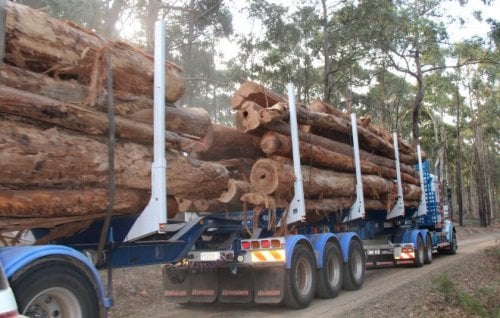
This framework has the potential to restart logging in native forests, with the possibility of there being few or no restrictions on logs being again pulped and made into paper. New terms such as “active management” are being used, whereby logging is rebranded as a form of rehabilitation for forests that were previously degraded by logging.
Australia needs to move on from logging native forests. Ending it can deliver clear environmental benefits: reduced greenhouse gas emissions and wildfire risks, greater water yields and improved biodiversity outcomes.
As this Opal court case illustrates, however, policy decisions of this kind may conflict with existing contractual arrangements in ways that create unexpected financial liabilities in the future. Governments acting to protect biodiversity, limit wildfire risks, and reduce emissions by ending native forest logging may still face substantial costs arising from agreements tied to those very activities.
Those costs may influence the willingness of governments to pursue similar reforms in the future. This would not only be disastrous for the Australian environment and its biodiversity but would also inhibit progressive and economically beneficial transitions.
The case, currently before the courts, is the legacy of decisions made decades ago. It reflects a time when the future seemed more predictable than it was. The question now is whether the law will require the public to pay for a market that no longer exists.
This article was first published in the print edition of The Saturday Paper on
May 9, 2026 as “Not worth the paper…”.
For almost a decade, The Saturday Paper has published Australia’s leading writers and thinkers.
We have pursued stories that are ignored elsewhere, covering them with sensitivity and depth.
We have done this on refugee policy, on government integrity, on robo-debt, on aged care,
on climate change, on the pandemic.
All our journalism is fiercely independent. It relies on the support of readers.
By subscribing to The Saturday Paper, you are ensuring that we can continue to produce essential,
issue-defining coverage, to dig out stories that take time, to doggedly hold to account
politicians and the political class.
There are very few titles that have the freedom and the space to produce journalism like this.
In a country with a concentration of media ownership unlike anything else in the world,
it is vitally important. Your subscription helps make it possible.
Send this article to a friend for free.
Share this subscriber exclusive article with a friend or family member using share credits.

Used 1 of … credits
use share credits to share this article with friend or family.
You’ve shared all of your credits for this month. They will refresh on June 1. If you would like to share more, you can buy a gift subscription for a friend.
SHARE WITH A FRIEND
? CREDITS REMAIN
SHARE WITH A SUBSCRIBER
UNLIMITED
Loading…
News
The cost of native forest logging
Sophie Cunningham
The closure of a major paper mill is an opportunity to end logging in native forests, which would spare both the environment and significant public funds. So why the reluctance to transition to plantation timber?