
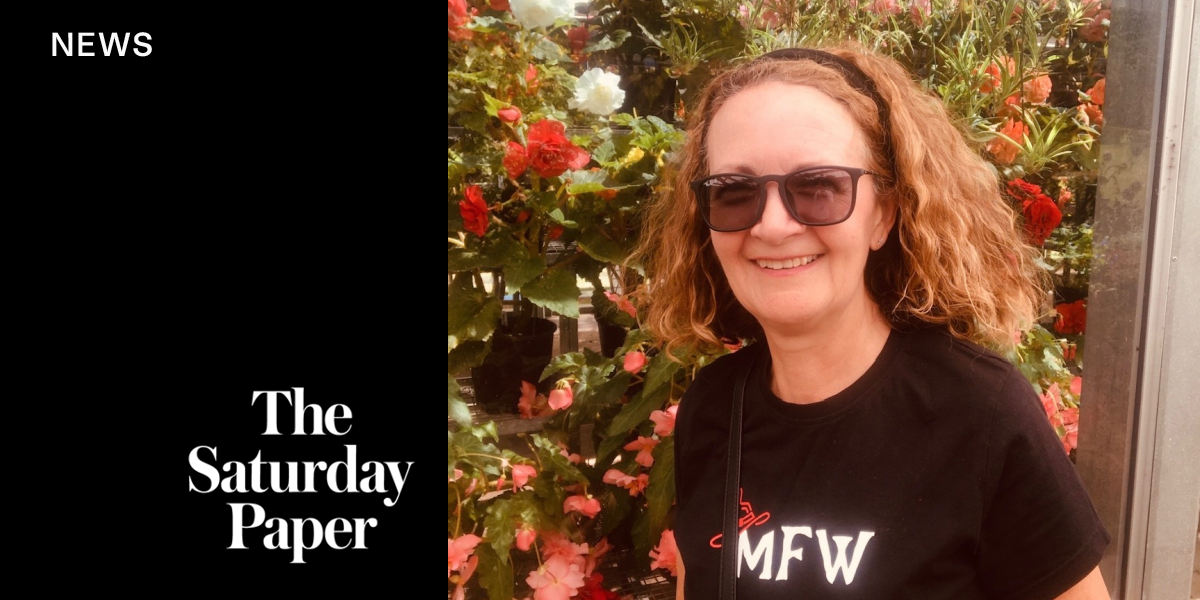
At the centre of this story is a coven, which takes its name from then Liberal MP Peter Dutton’s reference to a senior female journalist as a “mad fucking witch”. Their aim is to stop media profiting from hate speech.
It began almost a decade ago during the #MeToo movement, when rage became a global language for women. Disclosure after disclosure exposed their abuse by powerful men, and they took to the streets in growing numbers around the world, because the violence was enduring and everywhere: in homes, on streets, in workplaces.
The founder of Mad Fucking Witches, Jennie Hill, is clear about what drove her. “Twelve months before I started it, I’d been sexually assaulted.”
As protests gained momentum in 2017, she was confronting silence. At the age of 50, attending a funeral, Hill was sexually assaulted by the friend of a relative. She stayed silent for two years to avoid fracturing the family.
When she finally disclosed, she received the response so often used to protect perpetrators, limit fallout and bury these stories: agonising scrutiny and further silencing. The assault wasn’t her first, she says, and “the trauma was double what it would otherwise have been, because everything came back from the first attack”. At the age of 10, she was sexually abused by a priest at a summer camp. Even then, she understood the mechanics of power: no one would believe her.
The Mad Fucking Witches did not begin as activists – for Hill, the intention was to support other women who had experienced abuse. It was supposed to be equal parts sweary, funny and comforting. “In those early years of MFW, it was a place to share, to rage, to hold each other… It actually saved me,” she says. The group soon attracted more than 200,000 followers online because, as Hill puts it, “people identified with the fury”.
Then, in 2019, 2GB radio host Alan Jones galvanised the MFW community. That August, Jones stated on air that New Zealand prime minister Jacinda Ardern should have a “sock shoved down her throat” and recommended then prime minister Scott Morrison give her a few “backhanders”.
MFW mobilised on Facebook. “We just put a post up saying, ‘Is there anyone who’d like to help us do this?’” says Hill. Volunteers researched advertisers and wrote en masse. The sheer volume of public pressure led advertiser after advertiser to pull money from the program.
Advertisers didn’t appreciate the volume of MFW missives, which endlessly sampled Jones’s “disgusting commentary”, says Hill. “There are a lot of companies who sent very angry, nasty messages and emails back to us saying things like ‘Our staff, who are reading these emails, are really upset’.” Hill laughs at the irony of those messages being funded by the very companies who were taking offence. Her response was to point out their role: “‘Look, we understand that and we don’t like sending these things any more than you like receiving them. Literally, all you have to do is say you don’t want your ads played during that show. That’s it.’”
Hill remembers Jones phoning her directly to ask the MFW to drop the campaign. He was emphatic that he didn’t deserve it.
“Alan. Alan. Alan … No one here at MFW thinks you’re a personally violent person, but you have to understand that the things you say on air validate other men who are violent to continue their violence.”
Hill says it was impossible to get a word in during that exchange: “I’m yelling at him, ‘Alan. Alan. Alan.’ And eventually he was quiet, so I said, ‘No one here at MFW thinks you’re a personally violent person, but you have to understand that the things you say on air validate other men who are violent to continue their violence.’ He continued to tell me how many women he employed and how many loved him.”
Almost a year after those comments, the Australian Communications and Media Authority concluded that Jones had breached broadcasting decency standards. By this time, he had accumulated more than a decade of misconduct warnings, including ACMA’s finding that his broadcasts leading up to the 2005 Cronulla race riots were “likely to encourage violence or brutality” and “vilify people of Lebanese and Middle Eastern backgrounds”. Linking broadcasting to harm was significant, as research clearly indicates that racist and misogynistic language validates and endorses violence.
In 2020, Jones retired. Not because his audience abandoned him – he still held a 17 per cent market share – but because advertisers did.
Since then, the MFW have targeted the likes of Sam Newman, Eddie McGuire and, in an ongoing project, the media monolith the group refers to as #NewsCorpse.
This year they claimed another major victory. Kyle Sandilands, like Jones, built his career on outrage, riding out a steady stream of complaints, investigations and warnings. His hit show with Jackie “O” Henderson on KIIS 1065 ran aground after his cohost, complicit in his approach for 25 years, objected to his abuse.
Months before, however, the show’s attempt at a Melbourne launch had already redoubled a longstanding campaign by MFW. Volunteers on a #VileKyle mission bombarded the many advertisers listed on the MFW website, who pulled funding in large numbers. Both Sandilands and Henderson were in court this week with separate claims to rescue the $100 million, 10-year deals each signed in 2023, and their former employer, ARN, is countersuing.
Court documents quote Sandilands saying of MFW: “I’ll have [private investigators] following everyone they’ve ever known till I find some shit on these folks… They’re a bunch of lunatics. They’re actually very threatening.”
So successful was MFW, Hill says, that incoming ARN Media chief executive Michael Stephenson contacted them before he formally took the position.
She believes Stephenson was not just concerned with the bottom line: “I think he was appalled by things Kyle was doing. He also cared about the bullying of staff and things like that.”
This week, Stephenson told shareholders at the ARN Media annual general meeting that $26.4 million of its 2025 revenue declines were due to “clients who had chosen not to advertise with ARN because of issues relating to brand safety”.
To this day, Hill is surprised by how effective the MFW campaigns have been. She says a high-profile journalist once rang after he said something nasty about a female politician. “He somehow found my phone number and rang me in a panic and said, ‘Please don’t do it. Don’t campaign on me.’”
Hill’s response was to make it clear that the MFW “only run campaigns on people who are serial repeat offenders who don’t apologise and make amends”.
For Hill, this is proof that they are cutting through. In a recent episode of the podcast Game Changers Radio, Marty Sheargold described being sacked from Southern Cross Austereo after comments he made about the Matildas soccer team. He suggested that once he knew the Witches were on his case, he was a goner.
“People know the Witches are there, and we’re ready to go,” Hill says.
She is confused by broadcasters who refuse to change or make amends. “It could be so simple,” she says. “None of them took us seriously until very recently.
“A lot of what our witches do is for free, and most of it is quite low paid. They can’t imagine a world in which people do things for genuinely altruistic reasons.”
Hill knows this kind of campaigning cannot happen without the sheer number of people who are willing to boycott and lobby the money. It’s using capitalism to unmoor the arch capitalists – the commercial talkback model Hill describes as “punch down profit”.
“That’s been a media model for quite a long time, and I think it’s probably been an extremely successful media model… What MFW have done is to demonstrate that if that’s your media model, we’re not going to let you profit from it.”
Hill, who tells me she grew up in a small country town, says: “A lot of this is about class – maybe even more than feminism.”
Commercial radio talkback hosts occupy elite positions while cultivating audiences shut out of the halls of power, using the familiar device of “us versus them” to bridge the gap and encouraging solidarity by referring to listeners as “battlers” from “struggle street”.
The late-’90s “cash for comments” scandal exposed how this dynamic has been exploited. The Australian Broadcasting Authority revealed companies were paying stars such as Jones and John Laws for favourable commentary presented as independent opinion. In his own defence, Laws insisted: “The battlers have always known I have been getting money.”
Ultimately, Laws was right. This degradation of broadcasting ethics had almost no impact on audience numbers.
Given that loyalty, and the money and careers at stake, MFW’s work isn’t without serious risks for the coven – violent threats are common both on- and off-air within the industry. Hill says she’s received them from right-wing anti-women groups, and recalls a chilling email from a current high-profile media personality. “He didn’t like something we said and so he sent me an email with my last three addresses on it, saying he knew where to find me.”
Hill sparks up when I ask if she has enough energy to continue the fight. “We’re all very tired. We’re thinking about our next campaign,” she says, adding that it may not be against an individual.
To that repeated criticism that the witches just hate men? “Men don’t realise that this is for them too,” Hill says. “The system is hurting everyone.”
This article was first published in the print edition of The Saturday Paper on
May 9, 2026 as “The witches are coming”.
For almost a decade, The Saturday Paper has published Australia’s leading writers and thinkers.
We have pursued stories that are ignored elsewhere, covering them with sensitivity and depth.
We have done this on refugee policy, on government integrity, on robo-debt, on aged care,
on climate change, on the pandemic.
All our journalism is fiercely independent. It relies on the support of readers.
By subscribing to The Saturday Paper, you are ensuring that we can continue to produce essential,
issue-defining coverage, to dig out stories that take time, to doggedly hold to account
politicians and the political class.
There are very few titles that have the freedom and the space to produce journalism like this.
In a country with a concentration of media ownership unlike anything else in the world,
it is vitally important. Your subscription helps make it possible.
Send this article to a friend for free.
Share this subscriber exclusive article with a friend or family member using share credits.

Used 1 of … credits
use share credits to share this article with friend or family.
You’ve shared all of your credits for this month. They will refresh on June 1. If you would like to share more, you can buy a gift subscription for a friend.
SHARE WITH A FRIEND
? CREDITS REMAIN
SHARE WITH A SUBSCRIBER
UNLIMITED
Loading…