
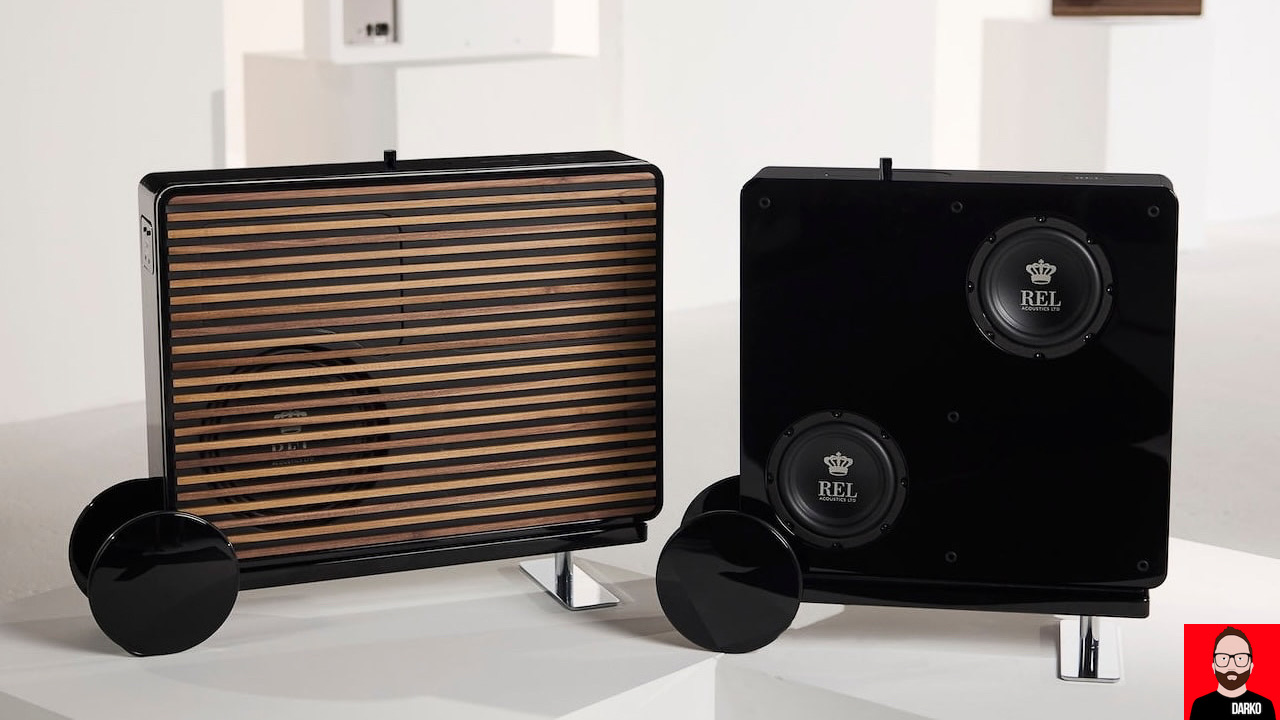
The typical hi-fi subwoofer spends most of its life on the floor, wedged wherever there’s space. Aesthetics rather than acoustics often decide placement: people put subwoofers where they cause the least visual offence, which may or may not coincide with the position that sounds best.
Slimline wall-mounted, or wall-proximate designs sidestep that compromise: deeper bass without a box squatting in the middle of the room. A small cluster of manufacturers is now arguing that boundary placement, pressed tight against a wall (or mounted to it), is also the acoustically preferable position.

REL PL-1 and PL-2
It was REL’s announcement of its new Planar Series last week that prompted this roundup.
The incoming ‘slimline’ PL-1 and PL-2 lean the furthest into the boundary placement concept of the three options presented here. Both measure just 5.7″ deep and ship with wall-mounting hardware included. REL says the mounted position is preferred because it sets a precise gap between the rear-firing passive radiator and the wall, which it claims optimises bass performance. For those who want to experiment before committing to fixings, an optional wheeled Planar Cart converts either unit to a floor-standing position.
Despite the name, neither PL-1 nor PL-2 uses a planar driver. The Planar Series designation refers to the flat, wall-hugging cabinet format. The smaller PL-1 carries dual 6.5″ FibreAlloy long-throw drivers paired with a 10″ passive radiator, powered by a 300-watt Class-D amplifier, with low-frequency extension specified at 31Hz at -6dB. The larger PL-2 uses a single 8″ FlatPiston long-throw driver with the same passive radiator arrangement and a 550-watt Class-D amplifier, reaching down to 24Hz at -6dB.
Both models share high-level Neutrik Speakon, low-level RCA, and LFE RCA inputs. And both ship with REL’s AirShip Direct wireless transmitter module, a US$399 item when purchased separately. The wireless receiver is housed in a side panel and is described by REL as user-replaceable should the wireless standard evolve. Neither model is fully cable-free, however: mains power is, of course, still required.
Finish options are Piano Black Lacquer and Gloss White Lacquer, with interchangeable cloth and premium wood grilles available for both. The Planar Series ships on 20th May, though REL has yet to confirm pricing, a curious omission given that date is only days away.
Buchardt SUB10
The Buchardt SUB10 (introduced in 2024) has been on the market long enough to have acquired a solid reputation, and its placement options are the most versatile of the three here. At 6.3″ deep, it can be wall-mounted, stood upright against a boundary, or laid flat beneath a sofa, useful in rooms where a wall fixing isn’t practical. Buchardt specifies low-frequency extension between 16Hz and 25Hz, depending on Mastertuning.
Inside its heavy cabinet sits a single 10″ long-stroke driver driven by a 400-watt Hypex Class-D amplifier. WiSA wireless connectivity is built in, and like the REL, the SUB10 requires a power connection regardless of whether the audio signal path is wireless.
Lyngdorf BW-2 and BW-3
Lyngdorf takes a different position, both philosophically and physically. Its BW-2 and BW-3 are ‘boundary woofers’ rather than wall-mounting subwoofers: they sit on the floor pressed against a wall or into a corner, where boundary reinforcement does the acoustic heavy lifting in place of cabinet volume. These are not products for people who want the subwoofer away from the floor. They are for people who want their subwoofer/s to sit close to a boundary, where room gain is most predictable.
The BW-2 and BW-3 measure 6.8″ front to back, making them the deepest of the three options here. The BW-2 uses a 10″ long-throw driver with a 400-watt Class-D amplifier; in standard line-in mode, its frequency range runs from 25Hz to 200Hz, extending to 800Hz in bypass mode when connected directly to a Lyngdorf amplifier. The smaller BW-3 uses an 8″ long-throw driver with the same amplification, with ranges of 27Hz to 200Hz and 27Hz to 800Hz in line-in and bypass modes, respectively. Both are hardwired and built to work in close partnership with Lyngdorf’s RoomPerfect DSP, which handles the equalisation that boundary loading can require.
The BW-3 retails at €1300 / US$1500 and the BW-2 at €1500 / US$1750.

The broader question
Boundary placement increases bass output through room gain: acoustic theory holds that each additional boundary roughly doubles pressure, yielding around +6dB from floor placement in open space, +12dB with a wall added, and up to +18dB when tucked into a three-surface corner. The catch is that it also tends to emphasise upper-bass frequencies. Buchardt addresses this through the SUB10’s app-controlled DSP suite, which includes room correction and manual EQ. Lyngdorf leans on RoomPerfect for a similar effect. REL, by contrast, relies on careful placement and crossover tuning rather than DSP correction and has not (thus far) detailed any equivalent DSP capabilities for the Planar Series.
Where the Planar Series lands on price will determine how this conversation goes. REL’s Serie T/x tops out at US$1699 with the flagship T/9x. The Serie S begins at US$3299. If the Planar models clear the Buchardt and Lyngdorf alternatives on price, they will be selling on design and flexibility as much as bass performance. Given the bundled AirShip Direct module and REL’s usual market positioning, expect to pay accordingly.
Further information: REL | Buchardt Audio | Lyngdorf
