
The Australian Government announced its financial year (FY) 2026-27 (July 2026 to June 2027) on 12 May 2026. The budget reflects the government’s efforts to face a complex economic and geopolitical environment and balance fiscal discipline with cost-of-living measures, while managing inflation risk. The budget focuses on getting through the global oil shock and taking pressure off Australians, while continuing to build a stronger economy, provide a better tax system, a fairer housing market and a more sustainable budget. The Australian economic outlook is expected to remain highly uncertain in the coming quarters, as the conflict in the Middle East has triggered economic and energy disruptions across the world and has put upward pressure on global inflation. As a result of the ongoing global conflict and the oil shock, economic growth in Australia is forecasted to slow from an estimated rate of 2.25% in FY25–FY26 to 1.75% in FY26–FY27. Higher fuel prices are expected to dampen consumption and put pressure on business operations. Particularly, in sectors such as agriculture and construction, these impacts will be exacerbated by higher fertiliser and plastic (use of Polyvinyl chloride or PVC) prices.
As part of the latest budget, the government is estimated to spend A$833.3bn ($537bn) in FY26-FY27; this marks a 2.6% increase compared to an expenditure of A$812.1bn ($523.4bn) estimated to be spent in FY25–FY26. 37.1% of the total expenditure estimated to be sent in FY26-FY27 – equivalent to A$308.7bn ($199bn) – accounts for social security and welfare; this is followed by health (16.4%), education (6.9%), defence (6.2%), general public services (3.9%), and transportation and communication (1.8%). Over the next two financial years (from FY27-FY28 to FY28-FY29), the expenditure is estimated to average A$879.9bn ($567.1bn).
Australia, general government sector expenses (A$bn) 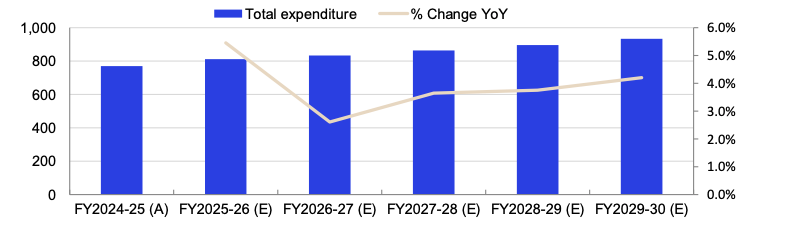 A = Actual; E = Estimate.
Source: Budget 2026-2027. ©GlobalData.
The Albanese government continues to focus on transport and community infrastructure, with A$12.1bn ($7.8bn) allocated for this purpose in FY26-FY27. Of the total, A$10.3bn ($6.6bn) has been allocated for transport infrastructure projects; A$976m ($629m) for transport; and A$803m ($517.5m) for community infrastructure. The government is maintaining a rolling infrastructure pipeline of more than A$120bn ($77.3bn) over ten years, with short‑term profile adjustments made in response to the effects of the Middle East conflict and potential constraints on capacity. As of May 12th, 2026, the government’s total commitment to states and territories under the Infrastructure Investment Program (IIP), over the next ten years, has reached A$85.3bn ($55bn). 31.1% of this total allocation – equivalent to A$26.5bn ($17.1bn) – has been allocated to Queensland. This is followed by 25.2% to Victoria; 20.3% to New South Wales; 9.5% to South Australia; 7.4% to Western Australia; 3.3% to Northern Territory; 2.6% to Tasmania and 0.8% to Australian Capital Territory.
Story Continues
The Albanese government continues to focus on transport and community infrastructure, with A$12.1bn ($7.8bn) allocated for this purpose in FY26-FY27. Of the total, A$10.3bn ($6.6bn) has been allocated for transport infrastructure projects; A$976m ($629m) for transport; and A$803m ($517.5m) for community infrastructure. The government is maintaining a rolling infrastructure pipeline of more than A$120bn ($77.3bn) over ten years, with short‑term profile adjustments made in response to the effects of the Middle East conflict and potential constraints on capacity. As of May 12th, 2026, the government’s total commitment to states and territories under the Infrastructure Investment Program (IIP), over the next ten years, has reached A$85.3bn ($55bn). 31.1% of this total allocation – equivalent to A$26.5bn ($17.1bn) – has been allocated to Queensland. This is followed by 25.2% to Victoria; 20.3% to New South Wales; 9.5% to South Australia; 7.4% to Western Australia; 3.3% to Northern Territory; 2.6% to Tasmania and 0.8% to Australian Capital Territory.
Some of the existing projects which received significant allocations in the latest budget include:
A$3.8bn ($2.4bn) to Victoria’s Suburban Rail Loop East project
A$372.5m ($240.1m) to Victoria’s Western Highway – Ballarat to Stawell Duplication project
A$251.2m ($161.9m) to Queensland’s Bruce Highway – Tiaro Bypass project
A$166.3m ($107.2m) to Queensland’s Cairns Western Arterial Road Duplication project
Some of the new projects which received significant allocations in the budget include:
A$812.5m ($523.7m) for Queensland’s Bruce Highway – Gateway Motorway to Dohles Rocks Road (Stage 2) project
A$552m ($355.8m) for Western Australia’s Westport – Anketell Road Upgrades – Stage 1A and 1B projects
A$76.4m ($49.2m) for Victoria’s Melton Line Electrification – Development project
A$50m ($32.2m) for the Australian Capital Territory’s Drake Brockman Drive Duplication project
A$50m ($32.2m) for Victoria’s Western Freeway Upgrade (Melton to Caroline Springs) – Preconstruction works
In addition to funding for the transport infrastructure projects, the government is also providing grant funding to help investments in local communities. This includes:
A$750m ($483.4m) to deliver new rounds of the Thriving Suburbs and Growing Regions programs
A$500m ($322.2m) to build on the ‘Active Transport Fund’ – to provide active transport options, like walking and cycling
Housing, healthcare, and supporting business are the other focus areas mentioned in the FY26-FY27 Budget:
Housing
In the latest budget, the government has announced several measures to boost housing supply and improve home ownership. The housing measures announced in the budget include:
Making the tax system fairer for first home buyers to help more Australians buy their own home. The tax reforms announced for housing are estimated to support an additional 75,000 homeowners over the decade.
Tackling the issue of housing shortage, by investing an additional A$2bn ($1.3bn) in enabling infrastructure, speeding up housing approvals, cutting red tape, and increasing the skilled construction workforce. This funding will support approximately 65,000 homes over the decade and brings the government’s total investment in housing‑enabling infrastructure to A$6.3bn ($4.1bn)
Extending the ban on foreign investors buying existing homes until mid‑2029.
Strengthening renter protections and expanding long‑term rental supply, by working with states and territories to get renters a better deal.
Supporting at-risk young people to get into secure housing – the government is investing A$59.4m ($38.3m) to help Community Housing Providers provide social housing for more than 4,000 young people aged 16–24, who are at risk of or experiencing homelessness.
Releasing an additional A$100m ($64.4m) from the Housing Australia Future Fund to improve the quality of housing for First Nations Australians in remote communities.
Healthcare
The government is delivering A$25bn ($16.1bn) in additional funding for public hospitals, to reach a record A$220.3bn ($142bn) over the next five years. The budget provides A$1.8bn ($1.2bn) to secure the future of Medicare Urgent Care Clinics, as permanent features of the Australian healthcare system. This builds on previous investments to expand the total network to 137 clinics across Australia.
Lowering taxes for businesses
In the latest budget, the government announced the following measures to support business risk-taking and resilience.
Providing a refund, from FY2026–27, to eligible companies that make a loss in the current income year, against tax paid in the prior two income years. This measure will benefit up to 85,000 companies, mostly small businesses
Introducing loss refundability to support new start‑up businesses. From FY2028–29, small start‑ups in their first two years of operation will be able to get a certain amount of refund for tax losses. This measure will benefit up to 25,000 young companies each year
Improving cash flow for small businesses by permanently extending the A$20,000 ($12,890) instant asset write‑off from July 1st, 2026. Small businesses with turnover up to A$10m ($6.4m) will be able to immediately deduct eligible assets costing less than A$20,000 ($12,890), thereby boosting investor confidence. This is estimated to improve cash flow for small businesses by around A$890m ($573.6m) over the next five years.
The FY26-FY27 Budget is expected to provide a boost to the Australian construction industry through the A$47bn ($30.3bn) housing package, massive civil infrastructure funding, and regulatory measures to reduce red-tape for boosting industry productivity and lowering construction costs. In an effort to simplify building regulations, the government has announced that it will make all mandatory Australian standards free – including across sectors such as construction, occupational health and safety, and product safety – thereby helping small electrical, plumbing and construction firms save up to A$1,600 ($1,031.2) in access fees. Simplifying building regulations is expected to reduce building costs and improve construction productivity. Additionally, under the National Competition Policy, the government is delivering new agreements with states and territories to remove barriers to modern methods of construction in housing and streamline commercial planning and zoning regulation.
“Australia announces FY26-FY27 Budget, with significant boost for infrastructure” was originally created and published by World Construction Network, a GlobalData owned brand.
The information on this site has been included in good faith for general informational purposes only. It is not intended to amount to advice on which you should rely, and we give no representation, warranty or guarantee, whether express or implied as to its accuracy or completeness. You must obtain professional or specialist advice before taking, or refraining from, any action on the basis of the content on our site.