
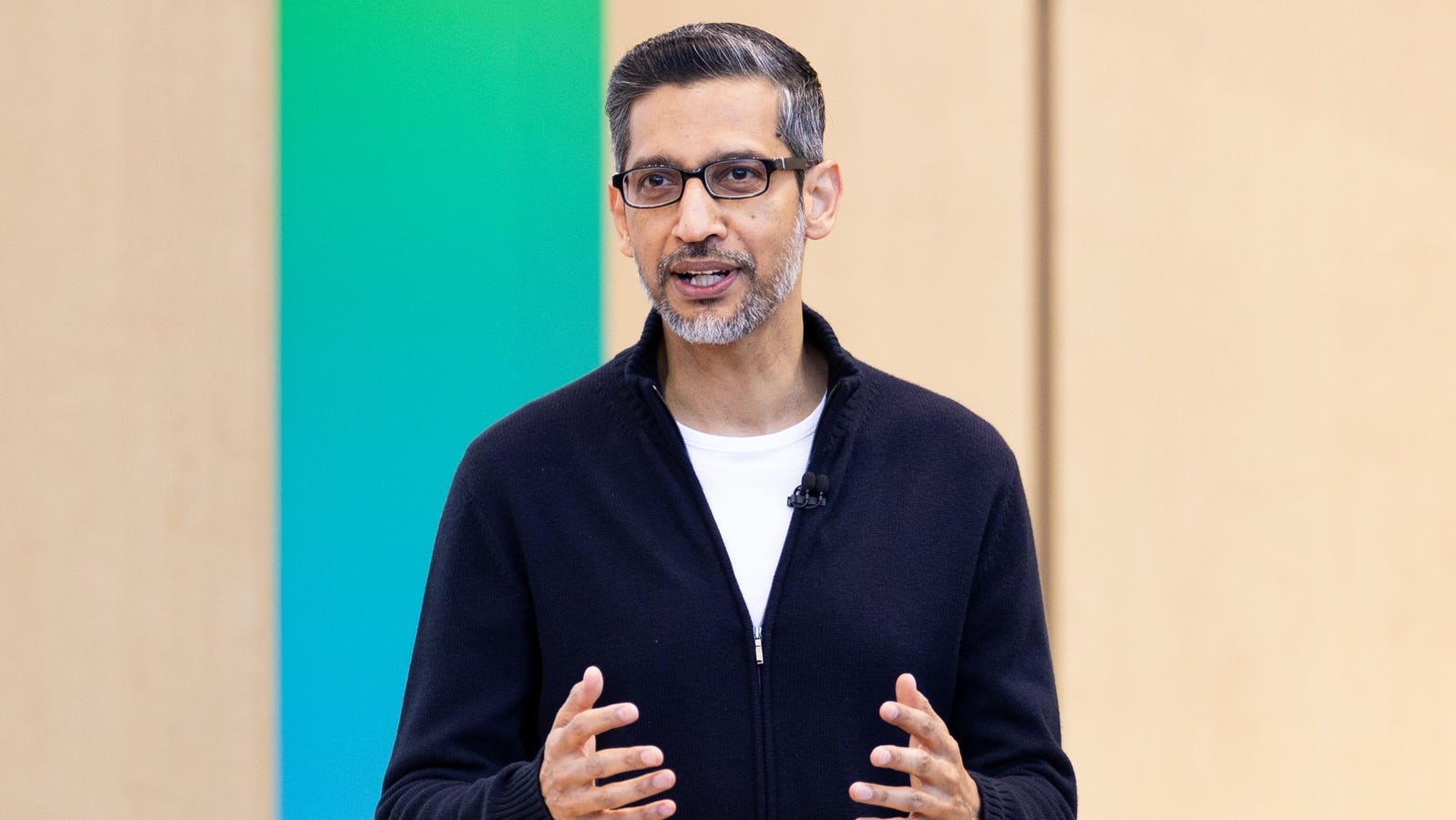
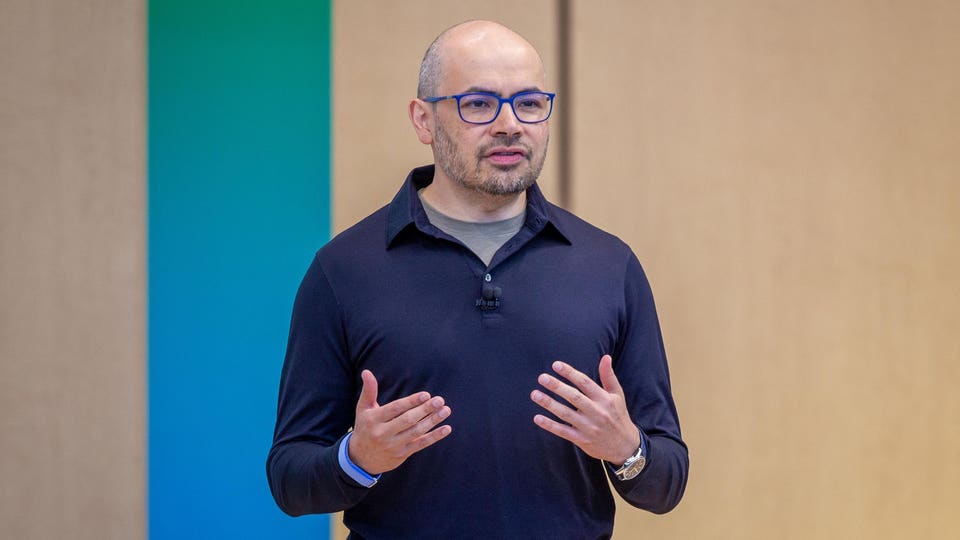
CEO of Google DeepMind, Demis Hassabis, speaks at the 2026 Google I/O conference in Mountain View
AFP via Getty Images
I’m sat here in the Shoreline Amphitheatre, in Mountain View, having just listened to the Google I/O 2026 keynote. The line I can’t shake came from Demis Hassabis, the Google DeepMind CEO. Near the end of his segment, almost as an aside, he said that when we look back at this moment we’ll realize we were “standing in the foothills of the singularity.”
The singularity is the point at which AI becomes capable enough to improve itself, and the rate of progress runs away from us. The moment the curve goes vertical. For a long time it was a thought experiment. Hassabis was telling a room of developers it’s a landscape we’ve already started walking into.
I’d just watched Google demo an AI agent that built a working operating system from scratch, for under a thousand dollars in API credits, and then run DOOM on it. The foothills line landed.
After the keynote I sat down with Chris Phillips, VP and General Manager of Education at Google. He’s the person responsible for how all of this lands in classrooms.
Here’s what educators actually need to know.
Gemini Stopped Answering And Started Doing
If you take one thing from today, it’s that Gemini is no longer a chatbot you ask things. It’s an agent that goes and does things.
The product is called Gemini Spark. In the live demo we saw a block party organized with one sentence. Spark built a live RSVP tracker in Google Sheets, drafted chase-up emails to neighbors who haven’t replied, pulled the HOA rules out of his Drive to check what time he can set up the bouncy castle, builds a slide deck for the kids’ games. All done in the background.
Then there’s Daily Brief, which trawls your inbox, calendar and tasks overnight and gives you a synthesis with next moves. Docs Live, where you ramble into your phone and Gemini structures the document around the rambling. Ask YouTube turns the platform into a tutor, where you ask a question, then jump to the ninety seconds that actually answer it.
Now think about what students are submitting next week.
I asked Chris Phillips which announcement K-12 principals should focus on. I expected him to say Spark. He didn’t. He pointed at the learning-specific demos, such as guided learning, study guides, test prep, and used the phrase “still led by the teacher” about six times across our conversation. That repetition wasn’t accidental. It was him telling me what Google wants the story to be.
The harder story is that whatever your AI policy says, students will walk in with Spark on their phones. The agent in their pocket will be better than the one your IT team approved. You won’t police that. You’ll have to teach into it.
The Announcement No One Will Headline
Everyone in the press room was waiting to hear if Google had beaten Claude Mythos. They haven’t. The new flagship, Gemini 3.5 Flash, sits below the frontier on most benchmarks.
But Pichai stood up and said top Google Cloud customers could save over a billion dollars by shifting 80% of their workload to Flash. Four times faster. Less than half the price.
That number is the one to watch if you run a school or a trust. AI procurement in education has been bottlenecked by cost. A Flash-class model that’s good enough for almost everything you’d want in a classroom, at a fraction of the price, changes the math.
Google also dropped the results of its largest randomized controlled trial yet, where around 1,763 learners in Sierra Leone had meaningful learning gains in teacher-led classrooms, with Gemini. The biggest gains came from students who clocked around twelve hours of use, equivalent to moving a student from the 50th to the 64th percentile in mathematics, or roughly 1.8 to 2.5 years of extra learning progress.
I asked Chris whether schools should think about AI exposure like a dosage. He pushed back:
“It doesn’t need to be huge amounts of usage to deliver big results. You can take a complex topic and break it into smaller pieces, or build a lesson plan that’s got three versions for the different kinds of learning happening in their classroom.”
He also mentioned Don Bosco in Italy, where there was a 70% reduction in teacher admin time, reallocated to one-to-one mentorship. I told him that figure would stick with every educator reading this.
The Digital Literacy Tool We’ve Been Asking For
Google is rolling SynthID and C2PA content credentials into Search, Chrome and the Gemini app. You will be able to right-click any image and ask if it’s AI-generated. You get a clear answer of which tool made it, whether it’s been edited. OpenAI, TikTok and ElevenLabs have all signed up.
It’s not perfect. It only works when creators use participating tools, and the worst actors won’t. But it’s the first piece of infrastructure that takes deepfakes seriously, and it’s free.
The End Of “I Can’t Code”
This was the demo that changed how I think the next two years go.
Google’s team used Antigravity 2.0 with Gemini 3.5 Flash and gave it a task: build a working operating system from nothing. Twelve hours later the agent had written every line of code, run its own tests, made over 100,000 model requests, spent under a thousand dollars.
The OS isn’t the point. The point is that the threshold for I had an idea and I built it just collapsed. Any teacher who’s ever said “I wish there was an app that did exactly this for my grade 9 class”, can do it in an afternoon. Custom flashcards tied to your exam board. An attendance tool that talks to your school’s MIS. None of it requires a full developer team anymore.
The skill isn’t writing the code. It’s decomposing a problem, specifying it cleanly, and verifying what comes back. These will also be essential skills for our students.
Search Is Becoming Something Else
In a demo, a Googler asked Google Search “how do black holes affect spacetime?” and instead of ten blue links, Search built a custom interactive visualization on the fly. Sliders for mass and orbital separation. Real-time gravitational waves. After a follow-up of “show me how binary black holes create waves”, Search then built a new, deeper simulation right there.
Then it built a custom weekend planner for a family. Pulled receipts from Gmail. Blocked the calendar around a basketball game. Suggested restaurants. Shared with the partner.
This is generative UI. Search isn’t returning information anymore. It’s building bespoke interfaces around your question.
Students will start expecting information to shape itself to their question, interactively. Reading around a topic doesn’t go away, but it will no longer the default.
The Question Teachers Keep Asking
Will our kids stop thinking as they outsource their cognition?
I put it to Chris directly. He went back to teacher agency:
“When the teacher leads with ‘here’s the appropriate use of AI, here’s how we’re going to change how we assess what you learned, here’s how we want you to explain what you understood’. That’s when we see really great things happening. They’re not just seeking the quick answer, they’re actually wanting to dig in and master a topic.”
My own observation matches his. The students I work with who are heavily using AI aren’t lazier, they’re cognitively busier. They’re running more ideas through more iterations than students could 3 years ago. The risk isn’t dependency. The risk is setting 2019 assessments and acting surprised when the work all looks the same.
Why Hassabis Said Singularity
The final segment belonged to Demis, and most people will skip it. Gemini for Science. WeatherNext predicting Hurricane Melissa more accurately than the National Hurricane Center, giving authorities the early warning that saved lives. AlphaFold derivatives designing medicines for diseases that have never had treatments. Virtual cells. The sober possibility of “solving all disease” within our lifetimes.
That’s the context for the foothills remark. Demis wasn’t being dramatic. The curve of scientific discovery itself is bending, and we don’t know how steep the climb gets from here.
I asked Chris what the singularity means for education. His answer was the most reflective moment of the interview:
“I’m really hoping we’re at the foothills that will advance upward into teachers having that confidence on how to use it. Students building critical thinking, communication, collaboration and resilience while they’re learning subjects, not as a separate thing, but integrated in. Students that might have been falling behind can now catch up. Teachers with large classrooms and tons of administrative overhead are now having that one-on-one time with their students. Some of the studies are showing kids that maybe weren’t as interested in maths now love maths.”
Is this marketing or a vision worth holding Google to. Probably some of both. But the man running education at Google is telling educators that the destination is more one-to-one time, deeper relationships, kids falling in love with subjects they used to hate.
Tomorrow Morning
If Spark will be able to do the task you’ve set your students, then you’re not measuring what you think. That’s not an argument for banning AI, it’s an argument for assessments that measure the thinking, not the artifact.
And the bit Chris kept circling. The 70% time-saving only matters if you reinvest the hours. Otherwise it’s slack that gets absorbed. Decide now where the time goes. Mentoring. Curriculum design. A coffee with the quiet kid.
We’re in the foothills. The view from here is already remarkable, and the climb it seems, is just getting started.