
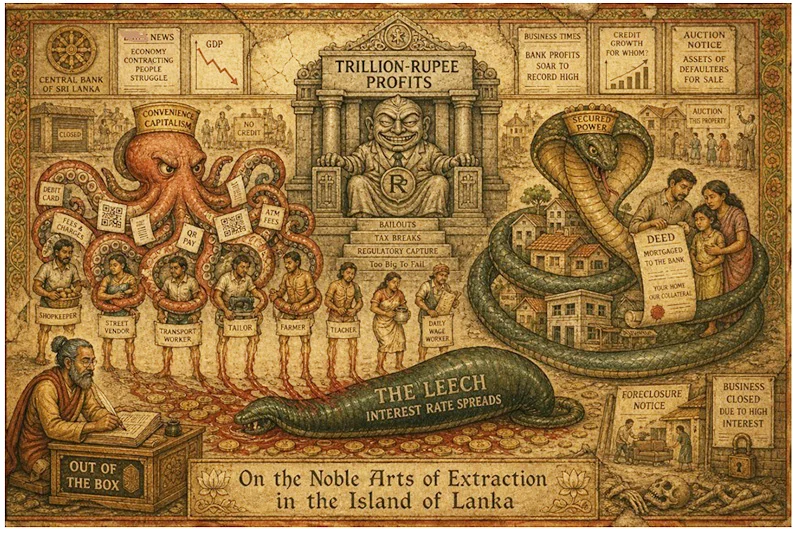
 Open any business newspaper in Sri Lanka on any given weekend and the headlines read like a celebration. Bank A’s assets have crossed Rs. 3 trillion. Bank B has reached the Rs. 2 trillion asset milestone. Bank C has posted a profit after tax of Rs. 6 billion in the first quarter of 2026 alone. Bank E has reported a profit before tax of Rs. 2 billion. Bank E has cleared Rs. 1.5 billion in pre-tax profit. Bank F revealed a profit after tax of Rs. 4 billion. The numbers are staggering in a country where per capita income remains fragile, the economic crisis of 2022 has left deep scars, and some 300,000 small and medium entrepreneurs are reportedly at risk of losing the roofs over their heads, and their businesses.
So, the question must be asked, loudly and without apology: how do Sri Lankan banks manufacture such colossal profits, and who, precisely, is paying for them?
The arithmetic of extraction
The answer lies in a three-digit spread that most depositors and borrowers never see printed side by side. Sri Lanka’s Central Bank has held its Overnight Policy Rate (OPR) at 7.75%, the mid-point of a corridor bounded by a Standing Deposit Facility Rate of 7.25% and a Standing Lending Facility Rate of 8.25%; a policy spread of a mere 1%. This is the rate at which banks lend to and borrow from the Central Bank overnight. It is the peg around which monetary policy turns. What happens when that peg meets the market is another story altogether.
A depositor walking into a Sri Lankan bank today will be offered somewhere between 6% and 9% on a fixed deposit, the rate varying by tenure, bank, and whether you qualify as a “senior citizen.” Average savings account rates sit between 2% and 5%, while fixed deposits offer 6% to 10%. Yet, the same bank will charge that depositor’s neighbour, who runs a hardware shop, a garment workshop, or a small hotel, between 14% and 24% to borrow. Credit cards carry rates at the upper end or beyond that range. The arithmetic is unambiguous: an interest spread of 8 to 14 percentage points, engineered on top of a policy rate corridor of just 1%.
A key driver of lending interest rates is the lending-deposit interest spread, which captures the efficiency with which banks allocate society’s savings to its most productive uses. High lending rates and spreads pose a challenge for policymakers: they can affect monetary policy transmission, hinder private investment and job creation, inhibit financial development and inclusion, and can ultimately compromise financial stability.
Sri Lanka’s spreads fail every one of those tests.
An international comparison that should shame regulators
To understand the scale of this extraction, one need only look at comparable economies. In India, the Reserve Bank’s repo rate stands at 6.5%, and commercial bank lending rates to prime borrowers average around 9–11%, yielding a spread of roughly 3–4 percentage points. Thailand and Vietnam, both developing Asian economies with nominal policy rates in the 2–4% range — maintain bank lending-deposit spreads consistently below 5 percentage points. Many countries in East Asia had average spreads of 5% or less during the 2010–2017 period, including China, South Korea, Japan, Myanmar, Thailand, and Vietnam.
Nepal, whose financial system is frequently and condescendingly compared unfavourably to Sri Lanka’s, reported a bank lending rate of 7.66% in late 2025, a figure that would be considered a floor, not a ceiling, in Colombo. Bangladesh records a lending rate of under 8%. Even Pakistan, whose policy rate touched 22% during a period of acute macroeconomic crisis, has since brought it down sharply, and its spread has never structurally embedded itself at the levels Sri Lankan banks now consider normal.
Move to advanced economies and the contrast becomes almost surreal. Japan’s policy rate remains effectively at zero; bank lending rates for business borrowers sit between 1% and 2.5%. Australia’s Reserve Bank rate stands at 4.35%, with commercial lending to small businesses typically in the 6–8% range, a spread of 2–3 points at most. New Zealand, Canada, and the United States operate within similar parameters: policy-to-lending spreads that are measured in single digits and that tighten competitively as banking markets mature.
Sri Lanka’s banks, by contrast, operate as if competition does not exist, and as if SMEs have nowhere else to go. They are largely correct on both counts.
The three creatures: A taxonomy of bank behaviour
A financial analyst, speaking in a podcast that has circulated widely among the Sri Lankan business community, offered a metaphor that deserves wider currency. Sri Lankan banks, he argued, behave with a three-stage predatory logic.
First, they are the Octopus, embracing customers tightly, wrapping tentacles around every financial transaction, every salary account, every utility payment, every insurance product. The bank becomes indispensable. It is everywhere. Cross-selling, bundling, and lock-in are the tools of this phase. The small businessman who secures a loan quickly finds that his current account, his trade finance, his letter of credit, and his overdraft are all with the same institution. He is held, firmly, from all sides.
Then, once the embrace is complete, comes the Leech, the slow, persistent extraction of blood. The interest rate spread does its patient work over months and years. A loan taken at 18% for a business generating 12% returns is a slow death sentence, mathematically guaranteed. Fees compound on fees. Penal interest accrues on unpaid interest. The CRIB record, Sri Lanka’s Credit Information Bureau system, locks the borrower in place: miss a payment, and no other institution will touch you. The leech feeds undisturbed.
And then, when the blood runs dry, when the business can no longer service its debt and the collateral has been fully leveraged, comes the Snake. Sri Lanka’s Parate Execution Law, enacted under the Recovery of Loans by Banks (Special Provisions) Act No. 4 of 1990, gives licensed commercial banks a power possessed by almost no other creditor class in any comparable jurisdiction: the right to seize and auction mortgaged property without any court order, without any judicial oversight, and without any independent valuation requirement.
Parate Execution is deeply ingrained in Sri Lanka’s legal system and has been a crucial tool for banks in recovering debts. The Cabinet-of-Ministers’ approval for a temporary suspension until December 2024 reflects a response to economic challenges, particularly for small and medium-sized enterprises. In 2023 alone, over 1,750 properties belonging to SMEs were auctioned under the law. These were not abstract balance sheet entries. They were factories, workshops, warehouses, family homes pledged as collateral, and the accumulated savings of a lifetime. Around 10 SME associations are collectively pushing for the continued suspension of parate executions, warning that nearly 300,000 entrepreneurs risk losing their assets if the law is enforced without reforms.
The snake, once it strikes, leaves nothing.
The Gates Prediction and the clever adaptation
Bill Gates, in his 1997 book ‘Business at the Speed of Thought’, famously observed that banking is necessary but banks are not, that the dinosaur institutions of the financial world would be swept aside once the Internet captured the transaction infrastructure that sustains them. A quarter of a century later, the banks are still here, and in Sri Lanka they are more profitable than ever. Gates underestimated the octopus’s adaptability.
Sri Lankan banks did not resist digital disruption; they absorbed it and charged for it. Sri Lankan banks have a genuine claim to technological pioneering. They were among the earliest institutions in the world to deploy automated teller machines and some have argued that the island served as a live testing ground for ATM technology before the technology was ready for larger markets.
Internet banking reduced their branch costs while preserving their pricing power. Mobile apps deepened the lock-in. The spread, the core engine of extraction, was never threatened by technology because technology cannot dissolve a regulatory monopoly or a CRIB record. The dinosaur learned to code.
What did not adapt was the relationship between bank profit and productive economic activity. In a functioning market, high bank profitability should signal efficient intermediation, savings being channelled productively into investment, employment, and growth. In Sri Lanka, it signals the opposite: a structural transfer of income from the productive economy, particularly from small businesses, to the financial statements of financial institutions that operate with insufficient competitive pressure, inadequate regulatory oversight of pricing, and a legal recovery toolkit that would be considered extraordinary in almost any other jurisdiction.
The SME crisis: When the host dies
The damage falls most heavily on small and medium enterprises, the sector that, in Sri Lanka as in every economy in the world, provides between 60% and 80% of all employment and generates the majority of entrepreneurial activity outside the formal corporate sector.
The International Monetary Fund has called for the reinstatement of parate execution, warning that prolonged suspension hinders banks’ ability to manage non-performing loans and price credit risks, potentially destabilizing the financial system. The IMF’s concern is legitimate in principle but perverse in practice. Non-performing loans in Sri Lanka’s banking system did not emerge from borrower profligacy. They emerged from a combination of historically high interest rates, a catastrophic economic crisis that was itself partly the product of fiscal and monetary mismanagement, and a forced-sale recovery mechanism that, when applied during a downturn, a double blow, destroys the very collateral value it claims to protect. When 1,750 properties are auctioned in a single year, supply floods a distressed market and prices collapse, damaging the bank’s recovery as much as the borrower’s livelihood.
What must change
The case for structural reform is not a case against banking or against profitable financial institutions. It is a case against a system that has substituted regulatory capture for competitive discipline, and legal coercion for constructive engagement.
Three reforms are overdue and increasingly urgent
.
First, the interest rate spread must be subject to transparent regulatory oversight. The Central Bank publishes the Average Weighted Prime Lending Rate and related statistics, but there is no binding ceiling on the spread between what banks pay depositors and what they charge borrowers for equivalent-risk instruments.
Second, the Parate Execution Law requires comprehensive reform, a genuine rewriting that introduces judicial oversight, mandatory independent valuation, and a structured mediation requirement before any forced sale can proceed.
Third, SME credit must be deliberately repriced. A development banking framework, should offer structured SME lending at regulated spreads, with the Central Bank providing concessional refinancing. Several peer economies have such mechanisms. Sri Lanka has the institutional capacity to build one; what it has lacked is the political will to confront the banking lobby that benefits from the current architecture.
The parasite and the host
There is an ecological principle that even the most effective parasite must learn: if it kills the host, it dies, too. Sri Lanka’s banking sector has not yet killed its host economy, but the symptoms of dangerous over-extraction are visible in every gazette notice of a parate auction, in every shuttered workshop in Pettah, in every garment factory whose owner defaulted not due to bad management but due to the mathematics of an 18% loan in a 12% return environment.
The banks will continue to announce their trillion-rupee asset milestones and their billion-rupee profits. The newspapers will continue to celebrate. And the octopus will continue its embrace, the leech its quiet work, and the snake will wait, patient, unhurried, for the moment to strike. Unless someone intervenes.
(The writer, a senior Chartered Accountant and professional banker,is a professor at SLIIT, Malabe. Views expressed in this article are personal.)