
The Flipper Zero spent the past five years becoming the kind of device that people either own and love or have a strong opinion about despite never having touched one. It packaged NFC, sub-GHz radio, infrared, RFID, and a handful of hardware interfaces into a pocket-sized microcontroller toy that became unexpectedly serious in the hands of researchers, hobbyists, and the occasional teenager. It was hugely popular, and the company says that it generated over $150 million in sales with more than a million devices sold.
Flipper Devices teased a follow-up called the Flipper One many years ago, sharing an ambitious vision of a Kali Linux-powered portable device before quietly shelving it a while later. The company went back to the drawing board, and the Flipper One that’s been revealed today is more ambitious, grown up, and thought out. It’s not expected to replace the Flipper Zero either, and the company says that it’s a separate product line aimed at a fundamentally different layer of the stack. It’s a pocket-sized Arm Linux computer for IP networking, high-speed data processing, and on-device AI workloads, and the two products will be developed in parallel.
There’s a catch, though. Flipper isn’t announcing something you can buy right now, and there’s no price or release date to be found just yet. What’s being announced is the product as a project, alongside a Collabora partnership to push the Rockchip RK3576 fully into mainline Linux and a Developer Portal that opens Flipper’s entire development process to the public from day one. The hardware exists and works, but the CEO has previously said the business model may not hold up, and the company is just as candid now with that fact as it was back then.
The Flipper One is nothing like the original
Similar looks, totally different hardware
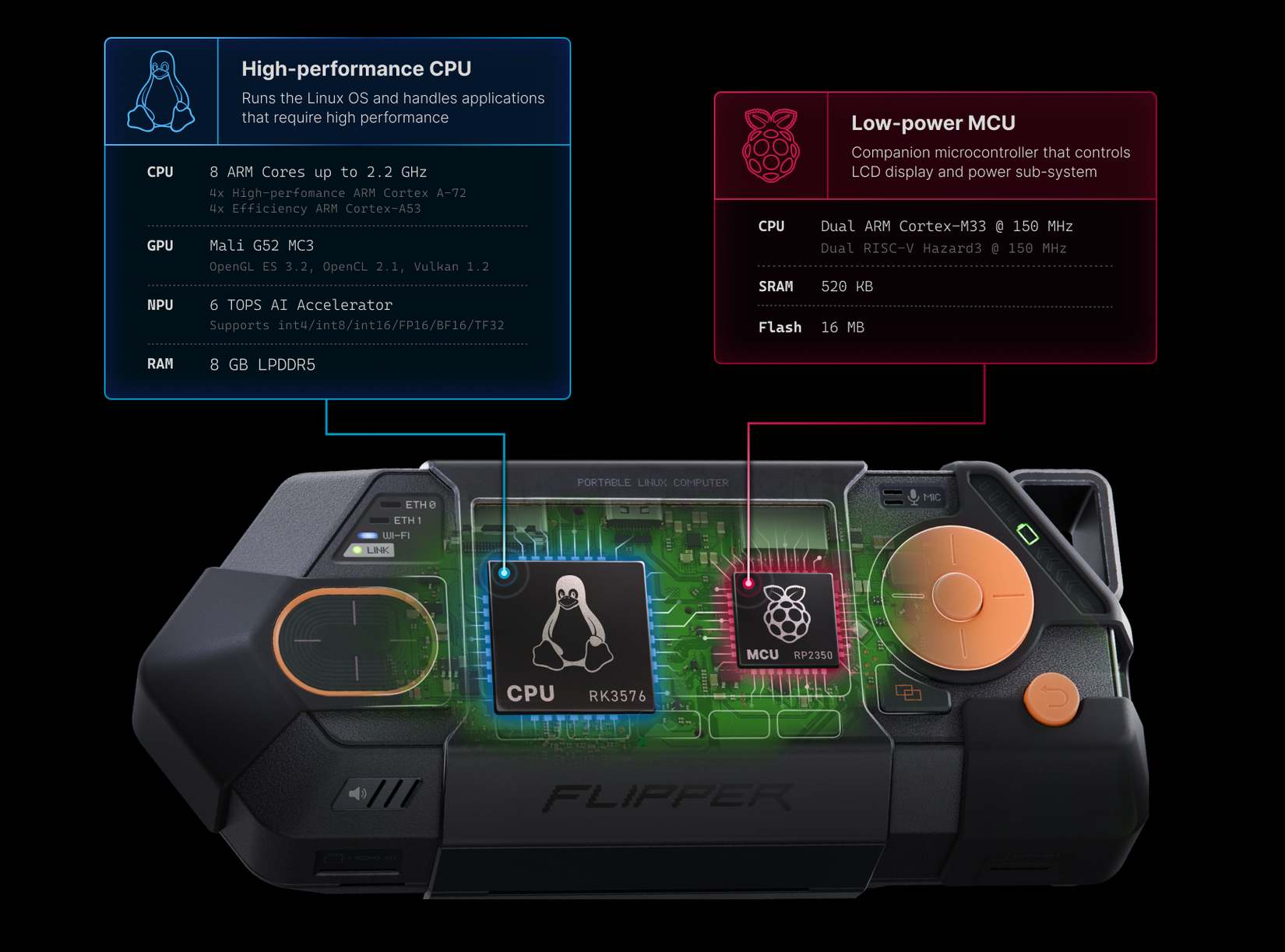
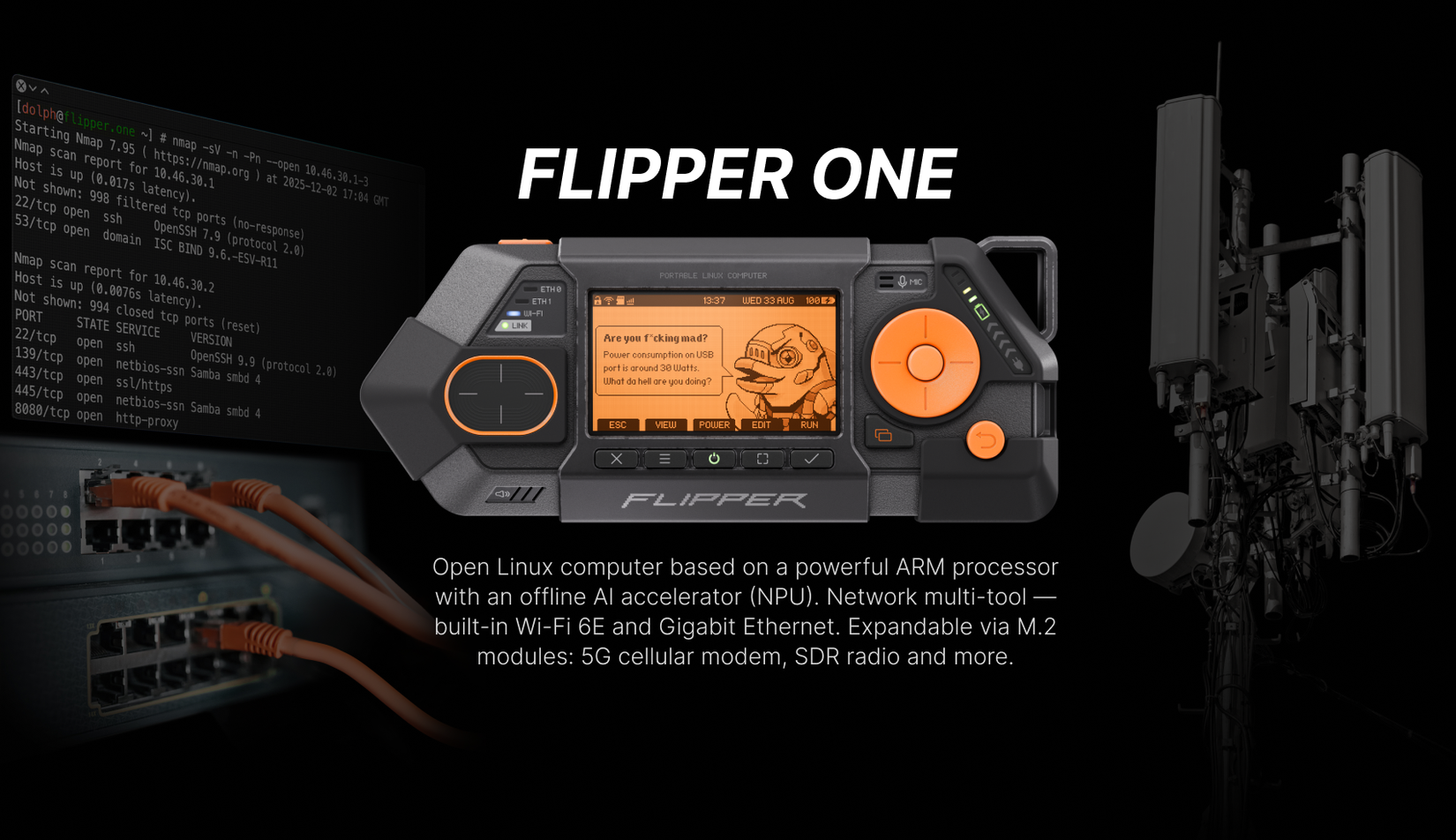
The Flipper One is built around the Rockchip RK3576, an eight-core Arm SoC with four Cortex-A72 cores running up to 2.2 GHz, four Cortex-A53 cores at 2.0 GHz, a Mali-G52 GPU, and a 6 TOPS NPU. There’s 8 GB of RAM and an RP2350 microcontroller acting as a co-processor for the display, buttons, touchpad, LEDs, battery, and power management. Linux runs on the big chip, FreeRTOS on the small one, with the two talking over SPI, I2C, and UART. The MCU also stays alive when the main chip is off, which is what makes the Flipper One usable as a USB-C power bank for other devices while it’s idle.
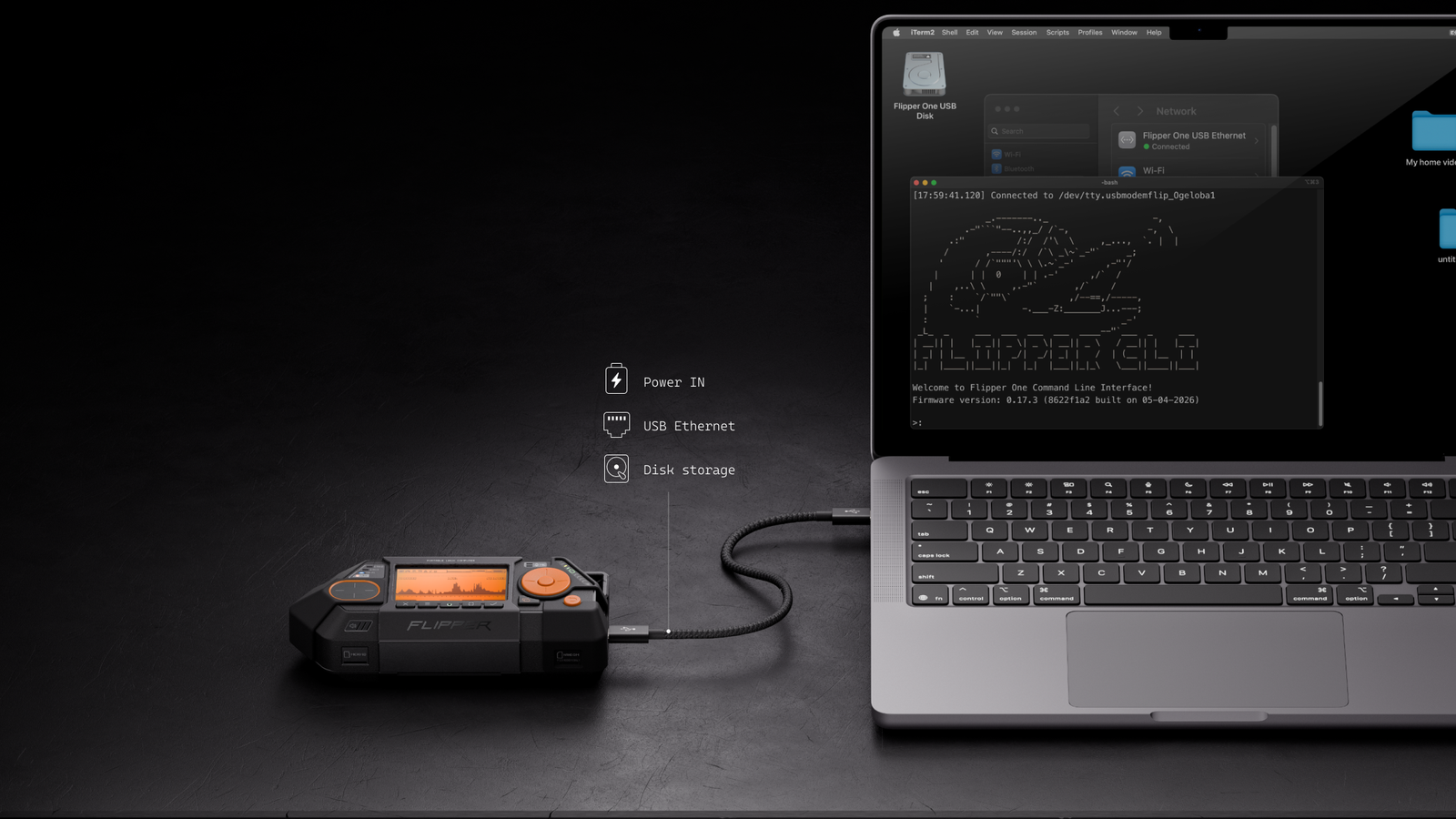
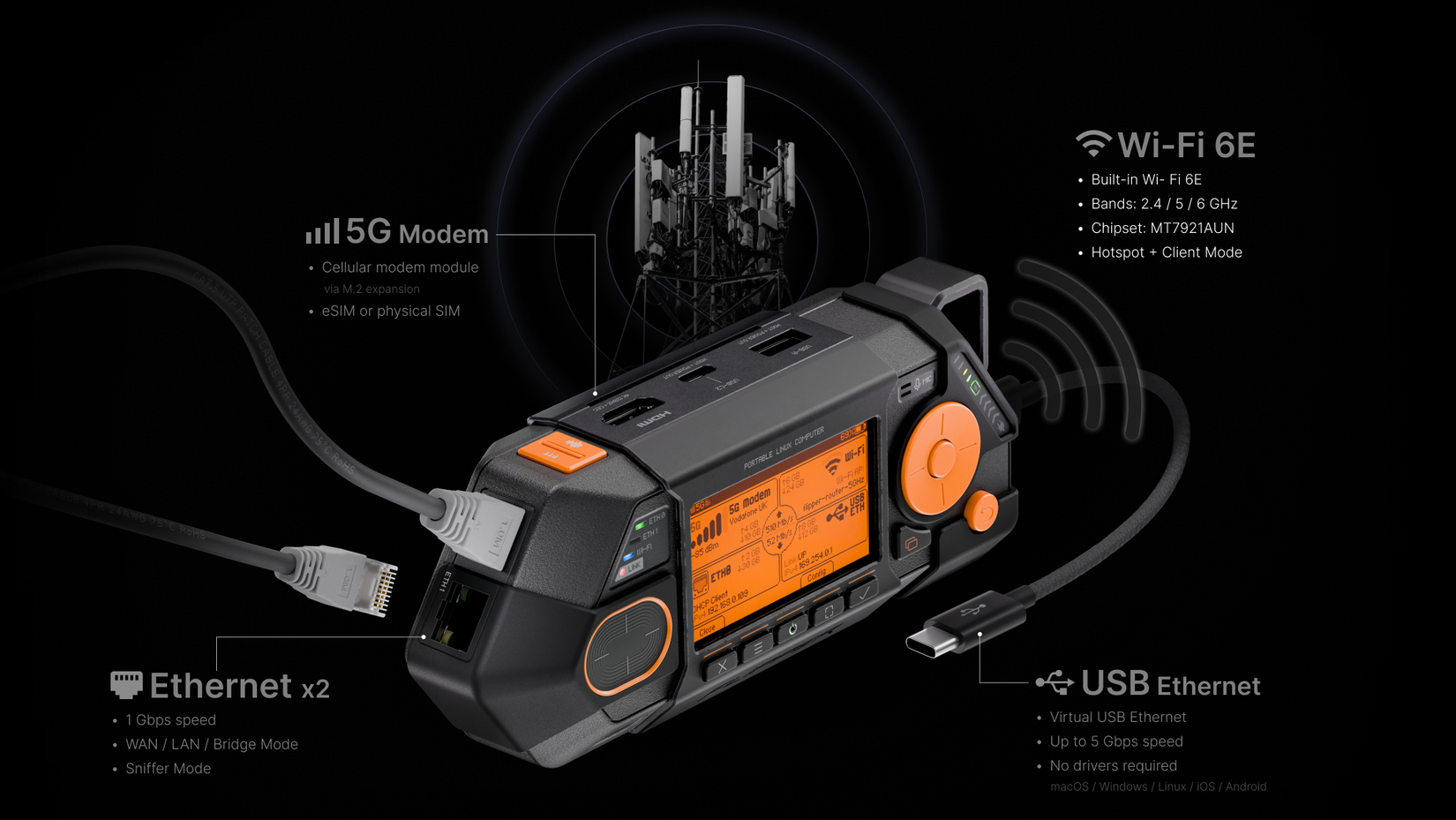
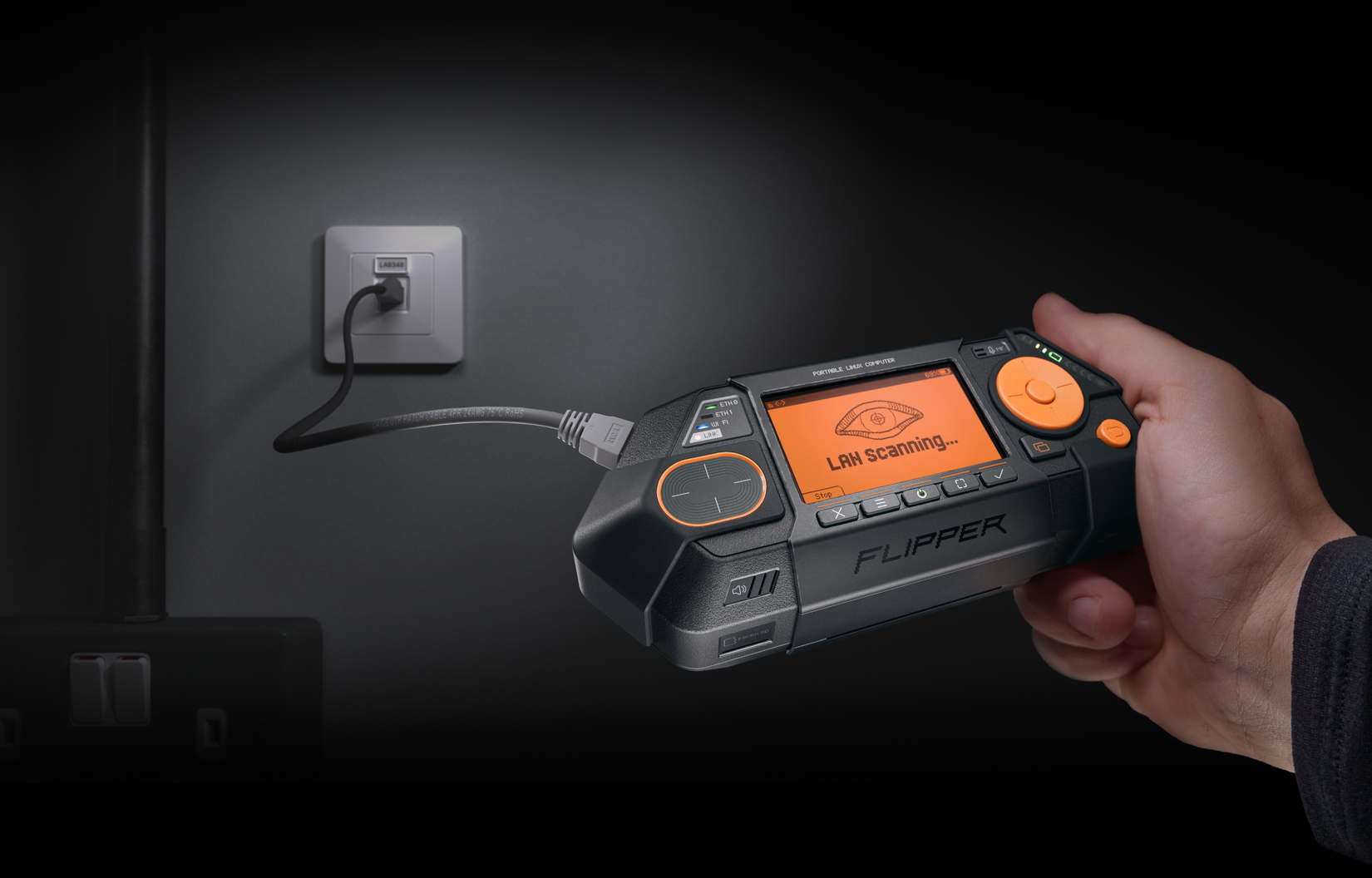
The networking side is where the device’s intent becomes clearest. It packs two Gigabit Ethernet ports, Wi-Fi 6E across 2.4, 5, and 6 GHz on a MediaTek MT7921AUN-based module, Bluetooth, and a USB-C port that can emulate an Ethernet adapter at multi-gigabit speeds. There’s a full-size HDMI 2.1 output capable of 4K at 120 Hz with CEC, and an M.2 Key-B slot that exposes PCIe 2.1, USB 3.1, USB 2.0, SATA3, SIM, UART, I2C, and audio lines for adding cellular modems, SDR cards, NVMe storage, or whatever the slot can physically accept. Key-B was a deliberate choice; Flipper confirmed to us that “almost all M.2 cellular modems use Key-B, and modems were exactly what we prioritized.” Key-B+M NVMe and SATA SSDs work in the slot too, while Wi-Fi cards will need an adapter. However, as the company also pointed out, there are almost no hacker-oriented Wi-Fi modules in M.2 form factor anyway, and the onboard MT7921AUN-based radio shares its chipset with the Alfa AWUS036AXML, a well-regarded Wi-Fi 6E adapter popular in the pentesting community.
Flipper also says it plans to produce its own M.2 modules and will try to convince other vendors to make Flipper One-specific ones. Powering all of it is a 24 Wh battery, although the company says it’s too early to commit to runtime numbers while active power-optimization work is still landing changes that improve battery life by 1.5x at a time.
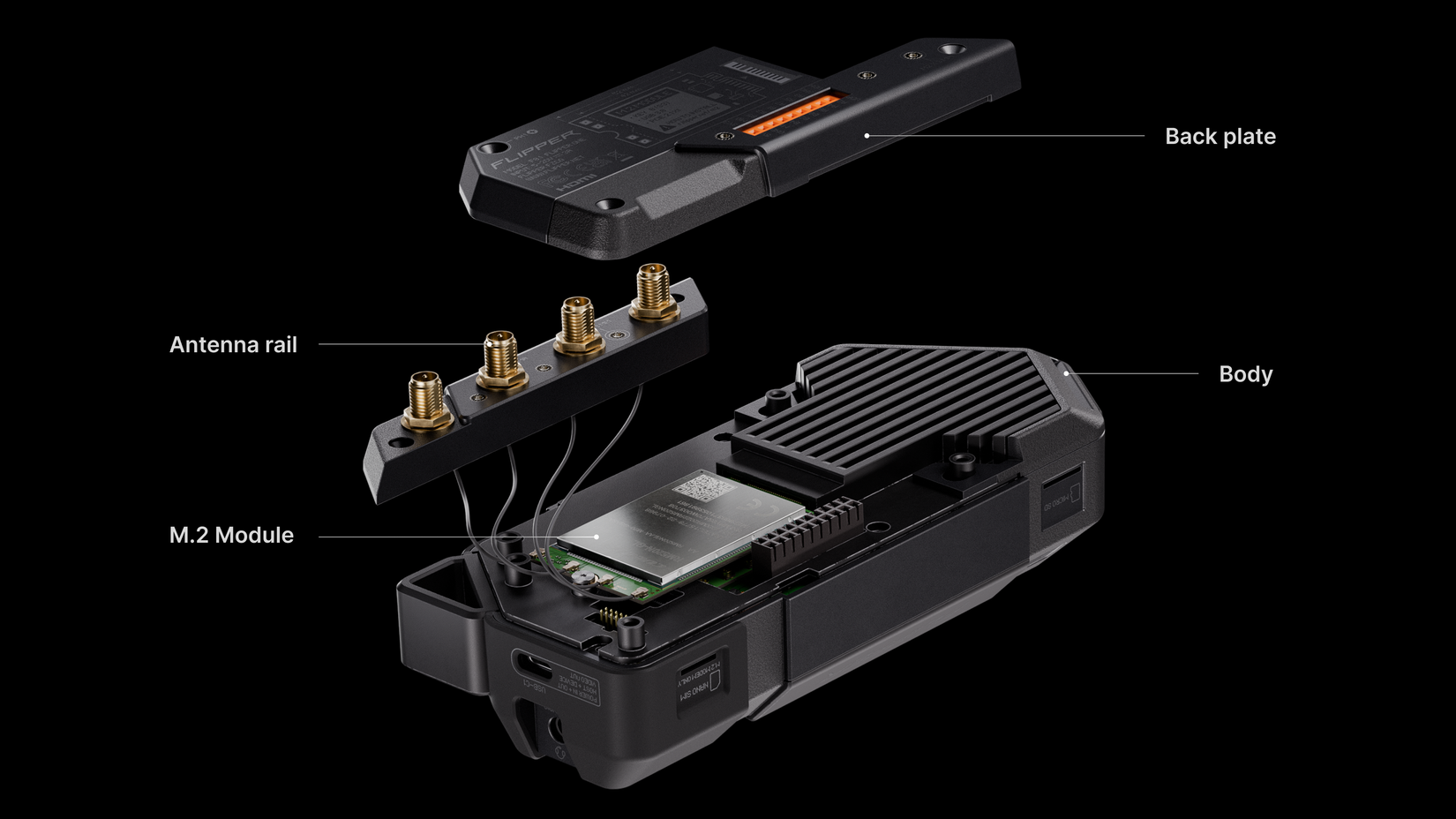
Alongside the M.2 slot, a 2.54 mm GPIO pin header and a custom threaded mounting grid let users bolt on their own modules with snap-on covers, the same DIY-extensibility approach the Flipper Zero leaned on.
None of the Flipper Zero’s signature radios are onboard, meaning that there’s no sub-GHz transceiver, NFC reader, or low-frequency RFID. Anything in that family arrives by way of M.2 modules, which means the Flipper One is closer in spirit to a small Linux SBC or pentest machine than it is to its sibling. The handheld itself does keep the visual lineage, though: a small monochrome LCD at 256×144 with the same amber-tinted aesthetic the Flipper Zero made its identity, paired with physical buttons and a touchpad. A demo Pavel Zhovner posted in April showed the device pulling 730 Mbit/s while acting as a USB-C-to-Ethernet bridge to an iPhone.
The framing Flipper uses for why this isn’t a Zero replacement leans on OSI network layers; the company says that the Flipper Zero operates at Layer 0, with direct interaction with physical signals through NFC, sub-GHz radio, infrared, low-frequency RFID, and GPIO. The Flipper One sits a layer above, as an IP-class machine designed to terminate or analyze network traffic, run packet captures, host services, and process data locally once that traffic arrives. The announcement is explicit that the two products “operate at different layers of the stack and will continue to be developed in parallel.”
The software stack is Debian 13 with KDE Plasma over Wayland, currently shipping Linux 7.0.0-rc3 on the mainline side with a 6.1.141 BSP kernel as a fallback. On top of that, Flipper is building “Flipper OS,” a profile-based layer of preconfigured snapshots so you can switch between configurations the same way SteamOS swaps between gaming and desktop modes. A separate menu-driven framework called FlipCTL wraps standard CLI tools like ping, nmap, and traceroute into something usable on the small built-in display, with the long-term goal of being installable via apt install flipctl. An offline LLM running on the NPU is meant to help with device configuration and on-device assistance.
Mainline-first Linux, not a vendor-BSP-first device
A rarity for this class of hardware
Plenty of Arm Linux devices claim to be open. Almost none of them ship with full mainline kernel support out of the box. Rockchip platforms in particular have historically depended on vendor board support packages, downstream kernel forks pinned years behind upstream, and binary blobs to get basic peripherals working. The Flipper One is built around the idea that you should be able to compile a stock Linux kernel, drop it on the device, and have everything work.
Getting there is hard, and Flipper isn’t doing it alone. The company has partnered with Collabora, the open-source engineering firm that handles a meaningful chunk of upstream Linux work for hardware vendors. Collabora has been mainlining RK3576 support since 2024, with initial kernel support landing in Linux 6.12 in December of that year, covering clocks, power management, storage, network, I2C, SPI, pin multiplexing, and GPU. Hardware H.264 and H.265 decoder support was merged into Linux 7.0 earlier this year. The remaining gaps include USB-C DisplayPort Alt Mode, NPU driver work, and a single proprietary blob: the DDR memory initialization code that comes from Rockchip’s rkbin repository in binary form only.
The relevant GitHub issue is blunt about what it is. “RK3576 can these days work with nearly all opensource code, except for the earliest part which initializes the DDR RAM. It is only available in binary form from Rockchip’s rkbin repository, so it’s unknown how it works and what exactly it does.” Removing it would make the Flipper One one of a very small number of consumer Arm platforms running entirely on open code from reset onward. Flipper is openly asking the community to help, but the company is unbothered about the timeline. The blob is “just a few kilobytes in size” and handles initial hardware initialization, with the company saying that “there is nothing fatal or particularly concerning about it being closed-source.” The plan is to lean on Rockchip to open it (which the vendor has already done for other projects) and to fall back on community or in-house reverse engineering if that doesn’t pan out. Either way, it won’t block the device from shipping.
The same goes for TEE-OS, the secure-world boot stage. RK3576 isn’t supported in upstream OP-TEE, and Rockchip’s technical reference manual doesn’t document the security hardware blocks. Flipper’s wording is unusually direct, asking for help “in obtaining the relevant documents and/or in implementing OP-TEE support for RK3576.” Every aspect of the build process is open, including the most critical aspects that will determine if the project can even ship.
The Flipper One is built in the open
Anyone can help
Most “open” hardware announcements involve a future promise to publish schematics, a tagline about community involvement, and not much else. The Flipper One arrives with six public repositories already on GitHub, an Altium 365 space holding schematics (though inaccessible at the time of writing), PCB layouts, Gerbers, BOMs, and STEP files, and a Developer Portal that organizes everything into seven sub-projects: hardware, mechanics, Linux and CPU software, MCU firmware, user interface, documentation, and testing.
The repositories themselves are interesting. flipperone-mcu-firmware is the RP2350 codebase, with open issues including features like a power-bank output mode and a screen for showing the Linux boot log on the small display. flipperone-linux-build-scripts is a general-purpose RK3576 image builder that already targets multiple non-Flipper boards including the Radxa Rock 4D, ArmSoM Sige5, and Firefly’s ROC-RK3576-PC. flipperone-hardware shows the device is on its second major PCB revision, with a long list of issues from a manufacturing partner covering 0201 component spacing, screw clearances, and connector land patterns.
Across all six repos, the opened issues line up exactly with the technical gaps Zhovner has described: the DDR blob, NPU support in mainline Linux and Mesa, OP-TEE for RK3576, mainline hardware video decoding aimed at smooth 4K and 8K playback in mpv, RK3576 boot-flow documentation, and a stray FreeRTOS debugger fix on the MCU side. The Developer Portal auto-aggregates all of these onto a single “Open tasks” page, so contributors don’t have to scrape multiple repos to find what needs doing.
More code is on the way, too. One open issue in the build-scripts repo is titled simply “Publish all repositories required to build the image,” and OpenWRT is tracked as a future build target alongside Debian. Internal Confluence documentation is also still being migrated into the public repo as the project opens up further.
Whether it actually ships is up in the air
There are a lot of doubts
The announcement is unusually honest about how uncertain this all is. Zhovner’s own blog post closes with this admission: “There’s a lot of uncertainty in this project, along with technical challenges and financial risks (like the current RAM chip crisis).” He’s said something similar in earlier Telegram posts, framing the choice as “be a naïve dreamer” versus “be a tough, pragmatic businessman; don’t take risks, forget about dreams.” The bill of materials has been a problem.
The RAM shortage isn’t a Flipper-specific issue. AI datacenter demand has driven DRAM prices hard upward, hitting everyone who needs to ship hardware with meaningful memory budgets onboard, and Flipper, unlike Raspberry Pi, doesn’t have an established revenue stream to absorb that on an unproven product. The Flipper One’s 8 GB of RAM puts it on the wrong side of that curve, and a device aimed at on-device AI workloads can’t realistically ship with much less than it currently has.
To really drive the point home, the announcement defers all the specifics: “developer hardware availability, pricing, and consumer release timing will be announced in a future update.” Prototypes exist, PCBs are on their second major revision, and the company is hiring around the project, all of which suggests Flipper still intends to ship. The question is what the shipping configuration looks like, at what price, and whether the BOM ever stabilizes long enough to commit to one. The company did offer one directional anchor when asked: it’ll “do our best to keep the device no more expensive than $350 in the base configuration without the cellular module.” That’s not far off the Flipper Zero’s $200 once you factor in that the Zero’s Wi-Fi dev board is a separate add-on too, which keeps the Flipper One squarely in hobbyist/enthusiast territory rather than pushing it into prosumer network-tool pricing.
Hardware-wise, the device is currently at the EVT stage with working prototypes in hand and core functionality operational, although the company cautions that some components may still change. The prioritization for software work flows directly from that: hardware can’t be patched after shipping, so anything needed to validate the PCB is taking precedence. USB-C DP Alt Mode is one of the active fronts, since the team needs to rule out driver issues to know whether the board layout is correct, and there’s a substantial amount of MCU-to-CPU interconnect work still ahead, particularly around moving Power Delivery handling out of Linux and down to the MCU, which Flipper describes as difficult so far. Things like the NPU and hardware video decode, by contrast, are explicitly post-launch problems. As the company put it, those “can be implemented after the device has already shipped to users — even a year later.”
What’s being announced today is closer to a transparent development update than a traditional product launch. The hardware works, the software is targeting full mainline Linux, the Collabora partnership has upstream kernel commits going back to 2024, and the Developer Portal already exists with task trackers, architecture documents, and a live kernel-status matrix. The call for contributors comes with specific issues attached, not vague invitations.
For anyone interested in the Linux side of consumer hardware, this is one of the few hardware announcements in years that’s actually pushing vendor practice toward open kernels and away from binary blobs. For everyone else, the answer is to wait. The Flipper One isn’t for sale and may not be for some time. Flipper is asking for help, not orders, and they’ve been clear about why. You can find out how to help by checking out the official announcement post.