
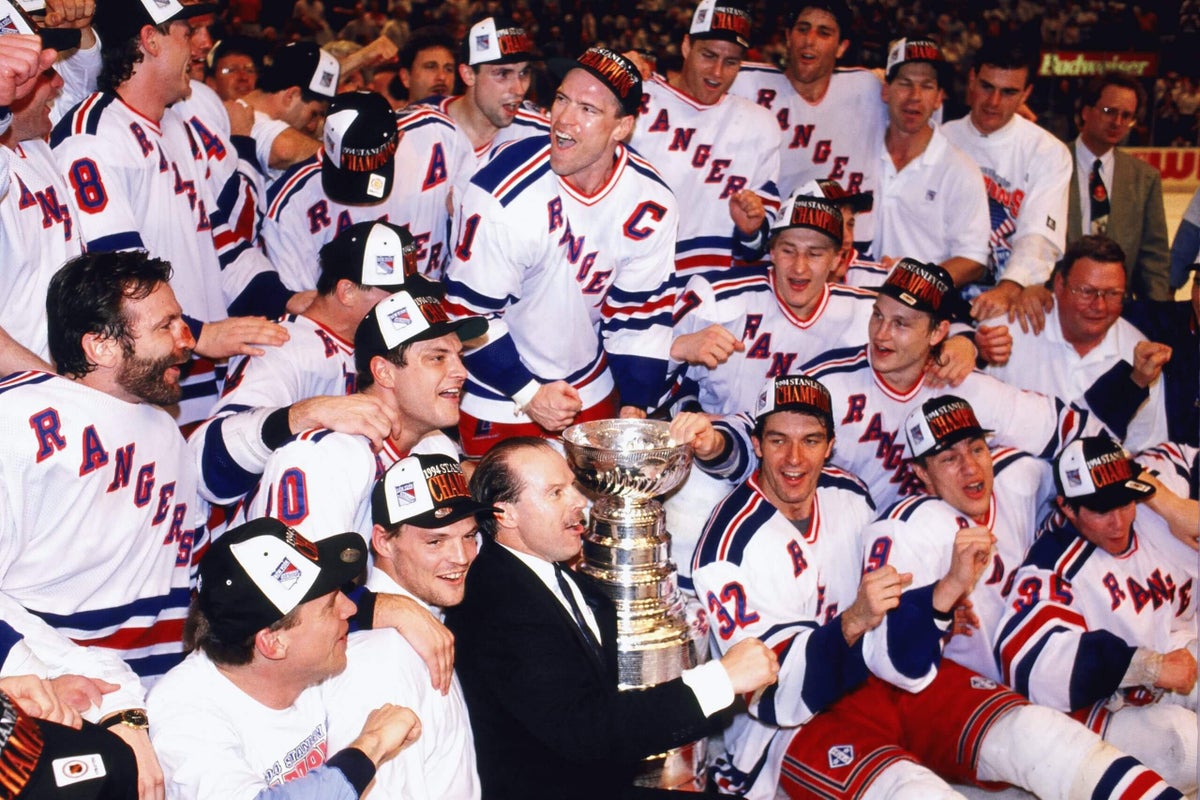
Editor’s note: This is the last in a four-part, season-long series looking back at the New York Rangers’ four Stanley Cup wins as the team celebrates its centennial season. Read Part 1 about the 1928 championship here, Part 2 about the 1933 title here and Part 3 about the 1940 squad here.
Following one of multiple benchings by New York Rangers coach Mike Keenan during the 1993-94 regular season, decorated defenseman Brian Leetch received a surprise phone call from fellow Norris Trophy winner Chris Chelios.
“What’s going on with Iron Mike?” asked Chelios, then playing for Keenan’s former team, the Chicago Blackhawks. “He called me the other night, and he’s trying to trade me for you. I don’t want to leave here. Do you want to leave New York?”
“No!” Leetch emphatically replied.
Tension would circle the Rangers throughout what became the most memorable season in the franchise’s 100-year history, which culminated with a seven-game series win over the Vancouver Canucks in the Stanley Cup Final. Keenan was at the center of it, with the abrasive bench boss creating constant turmoil and pushing his accomplished team to the edge of dysfunction. By the time the 1994 NHL playoffs began, though, Leetch was resolved to ditch the drama and move forward.
“When the playoffs started, I felt free,” the Hall of Famer recently said. “I was like, ‘This could be my last year in New York, so let’s just go play your game.’”
For the first two rounds, that’s precisely how it went. The Blueshirts swept the rival Islanders, then blew through the Washington Capitals in five games. Leetch registered points in all nine games, totaling 17 to lead the team.
But the player-coach friction that he thought he’d left behind came crashing back in an epic Eastern Conference final against the New Jersey Devils. The Athletic spoke to several players and involved parties about a moment that threatened to derail a championship season, as well as the fallout and ways that a veteran-laden team rallied to overcome it to attain what still stands as the Rangers’ most recent championship.
‘This is the f—ing playoffs’
The upstart Devils were loaded with emerging talent, including future Hall of Famers Martin Brodeur, Scott Niedermayer and Scott Stevens, and played a swarming, lockdown style using coach Jacques Lemaire’s signature neutral-zone trap. They finished second to the Rangers for the best record in the league and were considered the primary adversary in New York’s quest to end its 54-year championship drought.
“The intensity of that series would match, if not exceed, (that of the Stanley Cup) finals,” Keenan said. “It was competitive and razor-thin.”
With New Jersey in mind, Keenan, hired the previous spring after the Rangers surprisingly missed the playoffs, had spent much of the 1993-94 season hounding general manager Neil Smith to add bigger, stronger players with postseason experience.
“He didn’t feel that the team was good enough with the players we had,” Smith said. “And I knew who he didn’t like.”
The needling didn’t prevent Smith from aggressively fortifying the roster with in-season trades. He used players Keenan wanted to move on from, most notably skilled forwards Tony Amonte and Mike Gartner, to acquire veterans Glenn Anderson, Steve Larmer, Craig MacTavish, Stephane Matteau and Brian Noonan. The deals made the Rangers deeper, but Keenan’s forceful nature began to sour the GM-coach relationship.
“The problem was the way he goes about things,” Smith said. “(But) I didn’t want any excuses for us not to win the Cup.”
The Rangers were marching toward that goal when conflict bubbled back to the surface. Carrying a 2-1 series lead into Game 4, which was played at Brendan Byrne Arena near the swamps of East Rutherford, N.J., the team was outshot 11-3 during the first period while surrendering goals to the Devils’ Stéphane Richer and Bill Guerin. The latter prompted Keenan to pull starting goalie Mike Richter in favor of backup Glenn Healy.
“When he made the goalie change, was that to motivate the team? Was that to punish Mike, who had gotten us there?” Healy asked. “I don’t know that answer, but I know I wasn’t the elixir. I can tell you that. I was there to stop the bleeding. I was like that guy from Monty Python with no arms and legs going, ‘So you call a draw, do you?’”
The Healy-for-Richter swap raised eyebrows, but what came next was even more shocking. Early in the second period, Smith realized he hadn’t seen Leetch on the ice in a while. Noonan was benched, too, with captain Mark Messier also being held off for a brief spell.
“It was just horribly frustrating,” Smith said. “You’re like, ‘This is the f—ing playoffs. What are you doing?’”
Leetch would remain on the bench for the rest of the game at the instruction of assistant Colin Campbell. Keenan never spoke directly to his No. 1 defenseman, Leetch remembered, nor did the coach offer an explanation afterwards.
“I’m just sitting there, shaking my head,” Leetch said. “I’m thinking, ‘I can’t freaking believe this is happening.’”
The Rangers were reeling, yet kept the game within striking distance. Matteau scored at the 8:47 mark of the second period to cut the deficit to 2-1, but that wasn’t enough to convince Keenan to reinsert Leetch.
For players, the most maddening moment came early in the third when Guerin was called for high-sticking, giving New York a prime man-advantage opportunity to tie the score. Defenseman Jay Wells pleaded with Keenan to pull him in favor of Leetch, the team’s usual power-play quarterback, but to no avail.
At one point, Wells skated over to Leetch and told him to hop over the boards anyway. But Leetch was unwilling to make such a defiant gesture.
“Jay was so tired because he wasn’t used to playing every other shift, and he goes, ‘Just go! Just jump on the ice!’” Leetch recalled with a laugh. “I go, ‘No, Jay. He’s the coach.’”
Valeri Zelepukin extended the Devils’ lead to 3-1 with 6:42 to play, but Keenan chose to leave Healy in net in the waning minutes, rather than pulling the goalie for an extra attacker. It was the final curious decision in a game filled with head-scratchers.
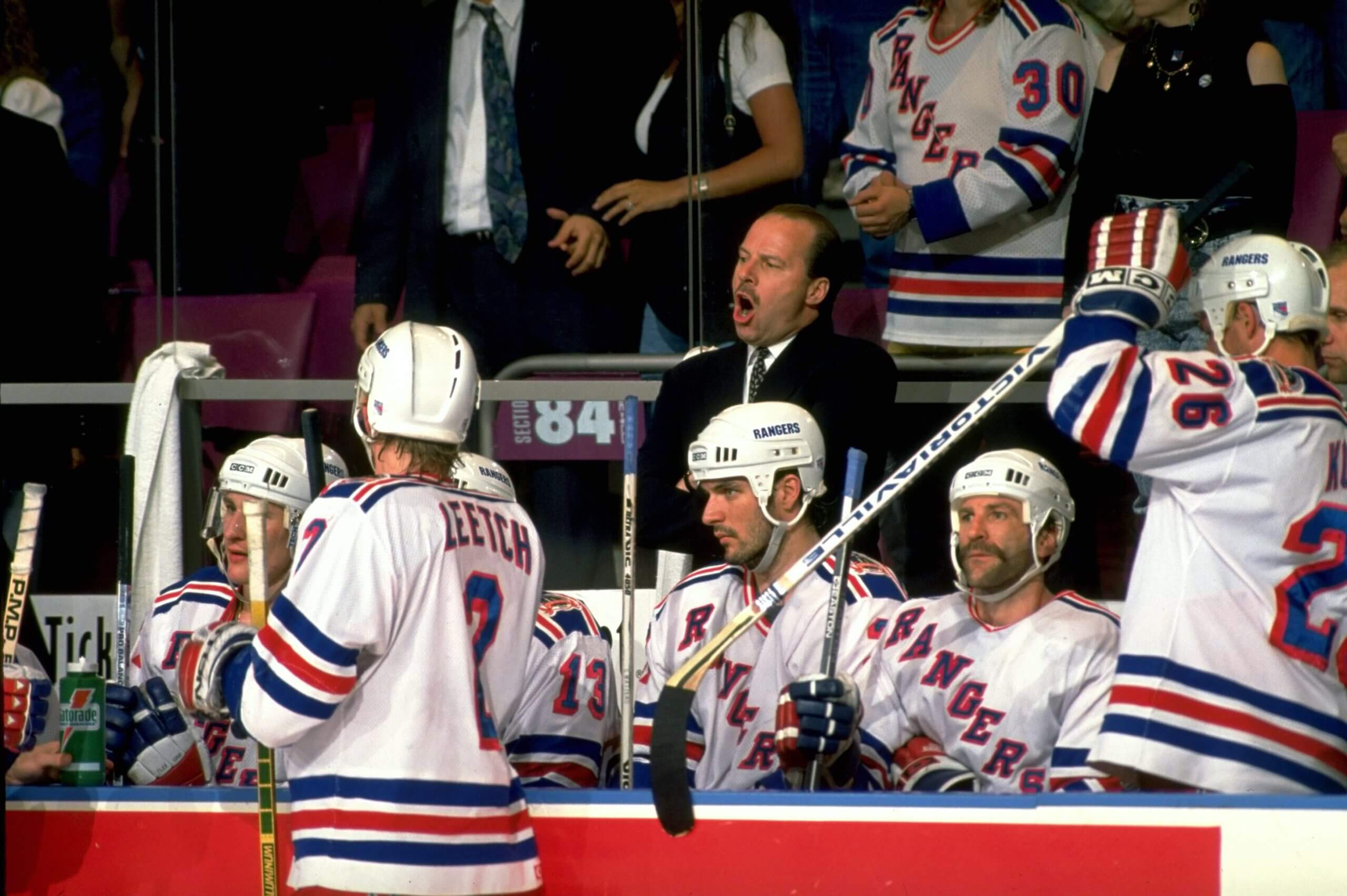
Keenan, shown here during the ’94 Stanley Cup Final, caused numerous playoff controversies behind the Rangers’ bench. (John Biever / Sports Illustrated via Getty Images)
An edgy confrontation
The Rangers were still seething as Keenan attempted to address the team following a demoralizing 3-1 loss, with a few snapping back or muttering under their breath. Then Eddie Olczyk decided to intercede.
The 27-year-old forward was in the midst of the most frustrating season of his career. He came to New York via trade the year prior, having registered nine seasons of 20 goals or more, including 42 in 1987-88. But he quickly found himself in Keenan’s doghouse and only appeared in 37 regular-season games.
Olczyk’s usage diminished even further in the playoffs, where he was a healthy scratch in all but one contest. Yet he remained one of the most respected voices in the room, with teammates voting him as the recipient of the annual Players’ Player Award for exemplifying “what it means to be a team player.”
“He was so important to our team,” Leetch said. “We all hear him on TV and know what he’s been through, but he’s like that on a daily basis. You really need a consistent, positive person in that room. He had no problem talking to Mike out loud at some meetings, because he’s like, ‘You’re not playing me anyway, so this is what’s going on. Why are you doing this?’ … But then he was like, ‘OK, back to work.’”
That was most evident in the edgy moments after Game 4, when Olczyk confronted Keenan in front of the entire team.
“In a way, I challenged him,” Olczyk said. “When you’re not playing and you’re not in the heat of the battle, it’s not easy to stand up in front of everybody and to be able to do that or say that. But you’ve just got to do what you think is best for the team, and you’ve got to know your role. And I felt that that was my role.”
News reports would later surface that Keenan was negotiating with the Detroit Red Wings during the Rangers’ playoff run, but Olczyk and many of his teammates had already heard whispers. And while Olczyk didn’t directly accuse him of flirting with another club after Game 4, Keenan fired back about what he perceived as a player questioning his loyalty.
“He told us to get the f— out of the locker room,” Olycyzk recalled. “And then (defenseman) Kevin Lowe said to him, ‘Mike, I think you should leave, because this is our room.’ And then (Keenan) got up and walked out.”
Messier addresses the mess
Prior to practice the next day at Rye Playland, Keenan summoned a select group of Rangers beat writers into his office and asked them to turn off their tape recorders.
“Leetch’s shoulder is f—ed,” he told them, according to longtime Rangers reporter Rick Carpiniello in his 2023 book, “The Franchise: New York Rangers.”
Years later, Keenan also pointed to an infected elbow that Leetch sustained following a slash from Devils forward Claude Lemieux as part of the reason for Leetch’s benching — a justification he reiterated during a recent interview. Leetch, meanwhile, has consistently pushed back on that narrative.
“It was not an injury issue,” Leetch said. “I was fine to practice. We’re all banged up, and there were multiple guys, myself included, taking the needle. But it had nothing to do with my play on the ice.
“When we read that the next day, (my teammates) were like, ‘Leetchie, you were hurt?’ I go, ‘No!’”
Regardless, the incident added to the disjointed feeling that was consuming the team, forcing everyone to “weed through what’s bulls— and what’s real,” as Healy put it.
That’s where Messier’s leadership came to the forefront. He often served as the buffer between Keenan and the rest of the team, with one of their most important meetings occurring before that May 22 practice.
“Mess had a one-on-one conversation with him, then Mess told us all that’ll never happen again,” Olczyk said. “It didn’t, and we ended up winning the Stanley Cup.”
It wouldn’t come easy. The Rangers still looked out of sorts while losing Game 5 at Madison Square Garden, 4-1, which pushed them to the brink of elimination. But they dug deep, with Messier guaranteeing a Game 6 win (sort of), then producing a legendary hat trick after Richter stood on his head to weather an early New Jersey onslaught. Game 7 went down as an NHL classic, with Matteau scoring his famous double-overtime winner to send New York to its first Cup Final since 1979.
“It’s one of the greatest series ever played,” said longtime Devils defenseman Ken Daneyko, who credited that experience for propelling Jersey to its first of three titles in eight years the next season. “That was our learning curve.”
The Blueshirts survived another seven-game series in the Cup Final to beat the Canucks and earn their first championship since 1940. Leetch finished with 34 points (11 goals and 23 assists) and a plus-19 rating in 23 games, receiving the Conn Smythe Trophy as the most valuable player of the postseason.
He would play nine more seasons with the Rangers and finish second in franchise history with 981 points, but the coaching situation was deemed untenable. Keenan left a month later to take over as GM and coach for the St. Louis Blues, leaving behind many frayed relationships in New York. It remained that way with him and Leetch for years, until the latter approached his former coach to clear the air at a charity event.
“Let me just say that I’ve only won one Stanley Cup,” Leetch said. “Mike Keenan’s on that with me.”
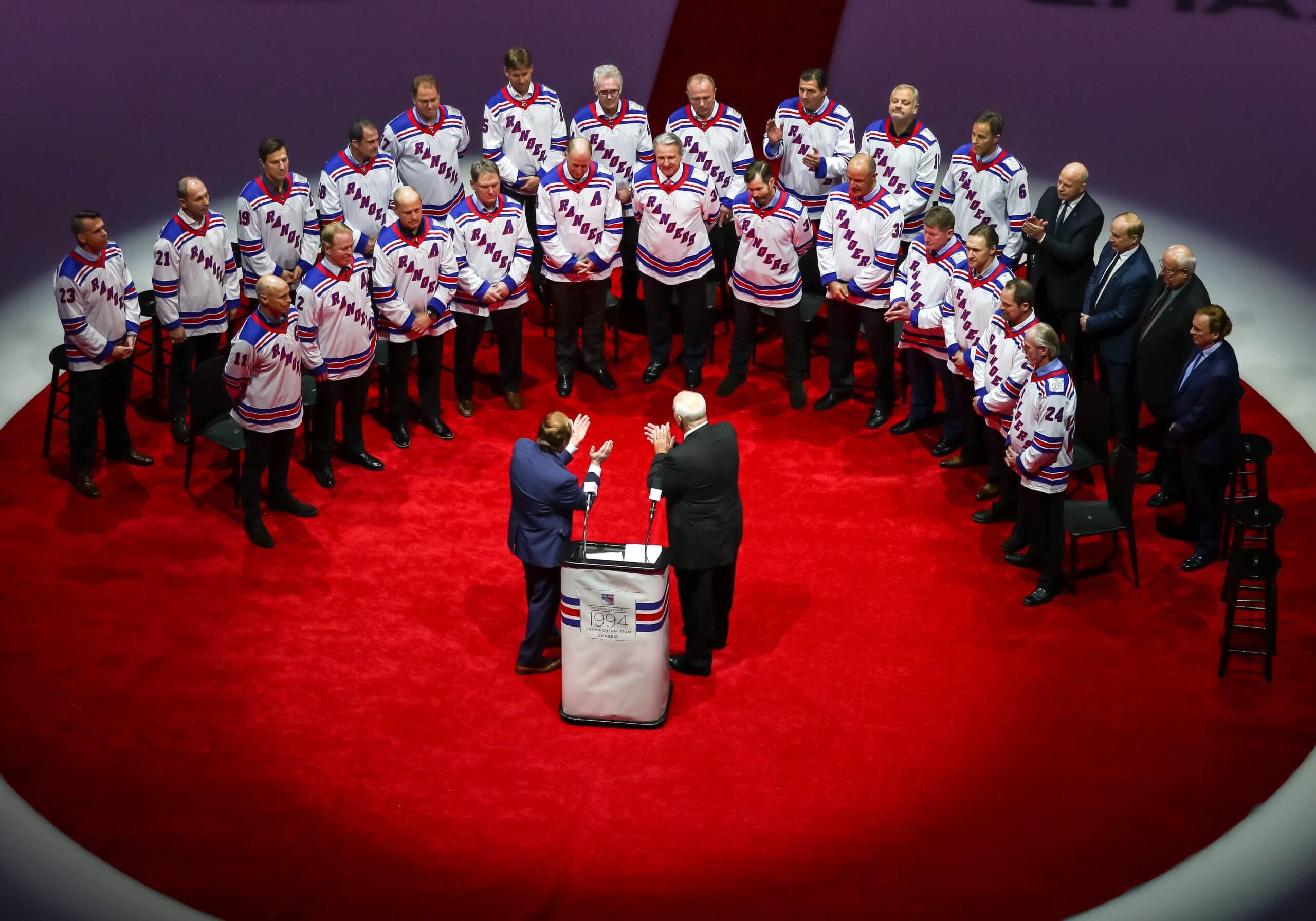
The 1993-94 Rangers reunited in Feb. 2019 for a ceremony at Madison Square Garden. (Joshua Sarner / Icon Sportswire via Getty Images)
‘I give Keenan credit’
Other members of the 1993-94 champion Rangers aren’t as forgiving, expressing mixed opinions over whether Keenan’s mind games benefited the team by bringing them closer together or became an obstacle they won in spite of. What isn’t debatable is that their blend of talent, experience and mental fortitude left them uniquely positioned to thrive under such tense conditions.
“A different type of team would have imploded,” Leetch said.
“When you look at the group and you look down the roster, this was a team that probably had nine or 10 guys that could have been the captain of the team, if not for having the greatest leader in all of sports (Messier),” added Healy. “We can paint a great little story, but I just believe it’s the players in that uniform that were the ones that said, ‘This year is our year. We’re not going to be denied.’”
For Keenan, time has led to a deeper appreciation of what his players endured. He again cited injury as his reason for benching Leetch and defended his decision to bench Richter as less about the goalie’s individual play and more because the team was “not playing up to standards.” But in a moment of self-reflection, he aptly told The Athletic, “There was no one in that locker room that, in my opinion, was a distraction — except for maybe myself.”
There will always be an undertone of uneasiness, but Leetch has chosen to focus on the positives, particularly how Keenan’s demanding style led to the best conditioning of his career.
“Our practices and our fitness level was as good as could be,” he said. “All of that is definitely a tribute to Mike. He got us ready to play.”
Indeed, whether Keenan’s approach was calculated or reckless, it produced the desired outcome. The Rangers have only won one Stanley Cup title in the last 86 years, and it came with one of the most volatile coaches in franchise history at the helm.
“If Mike hadn’t been the coach, I’m not sure that by the time the playoffs came, the team would have been as resilient and hard-nosed as they were,” Smith said. “If we had (previous coach) Roger Neilson there, who was a player’s coach and a great guy, maybe the team wouldn’t have bonded together like they did. They needed that kind of an asshole for them to all bond together, and so I give Keenan credit.
“We don’t win if we don’t have Keenan,” he said, before laughing and adding, “but that doesn’t mean that I had to like it.”