
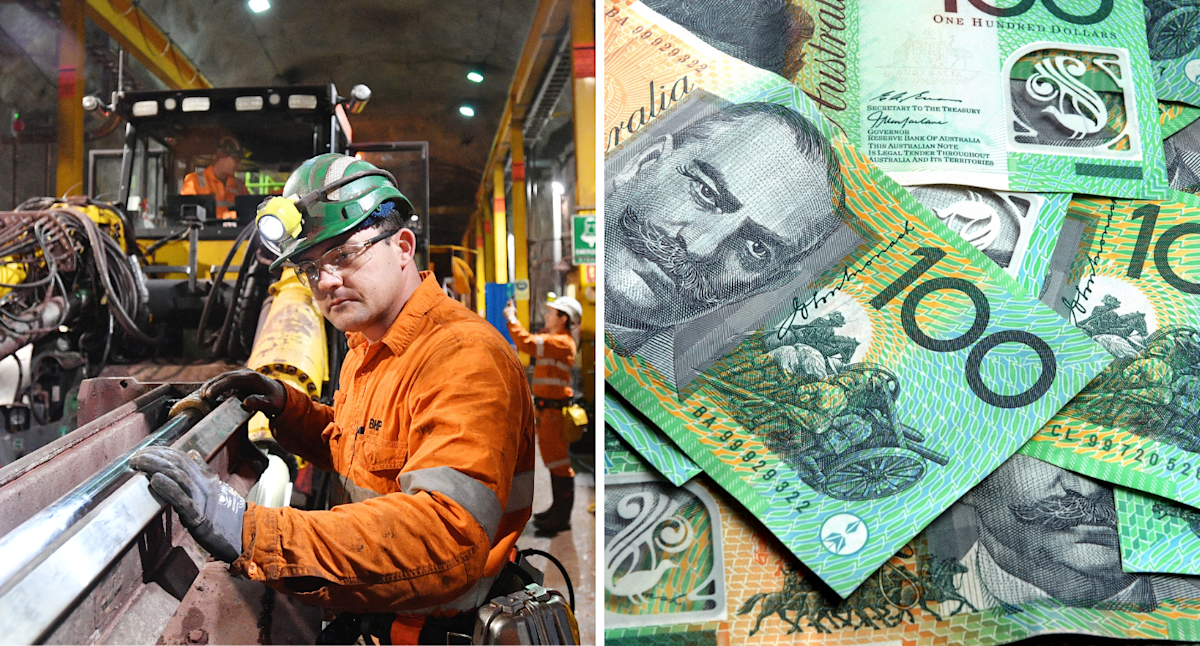
 Mining workers are the highest paid on average, new ABS data has revealed, raking in $3,174.50 per week. (Source: AAP/Getty)
The average Australian worker is earning more than $2,000 per week, fresh employment data has revealed. This is the first time full-time earnings have hit this milestone, with wages up 4.5 per cent annually.
The Australian Bureau of Statistics (ABS) found average weekly earnings for full-time adults hit $2,010 in May. This marks a rise of $86.60 a week from May last year, and works out to an annual pay of $104,520.
“This is the first time that average weekly ordinary time earnings for full-time adults have been greater than $2,000,” ABS head of labor statistics Sean Crick said.
“The growth of 1.7 per cent in average weekly earnings for full-time adults for the six months to May 2025 was similar to the rise of 1.8 per cent in the Wage Price Index for the same period.”
RELATED
Crick said average weekly earnings grew fastest for those in the private sector at 4.6 per cent, compared to the public sector at 3.6 per cent, which includes government workers like nurses, police and bureaucrats.
It’s worth noting these figures are based on full-time adult earnings. Across all employees, the average weekly total earnings were lower at $1,541.90 per week, or $80,178.80 a year.
The pace of wage growth held steady in the June quarter, growing 3.4 per cent in the 12 months to June. Private sector wages grew 3.4 per cent, while public sector wages grew 3.7 per cent.
The lift was attributed to backdated pay rises from previously approved enterprise agreements with state governments, coupled with regular scheduled pay rises.
Mining workers remain the highest paid on average, raking in $3,174.50 a week on average for full-time employees.
The lowest paid full-time workers were in accommodation and food services at $1,459.70 a week, and retail trade at $1,504.40 a week.
Here were the top 10 industries in weekly pay:
Mining: $3,174.50
Information media & telecommunications: $2,560.70
Electricity, gas, water & waste services: $2,366.80
Professional, scientific & technical services: $2,327.60
Financial & insurance services: $2,323.70
Public administration & safety: $2,103.30
Education & training: $2,098.30
Health care & social assistance: $1,978.80
Construction: $1,957.60
Transport, postal & warehousing: $1,925.70
ACT residents recorded the highest earnings at $2,236.60 per week, followed by Western Australia at $2,154.70. The lowest earnings were seen in Tasmania at $1,793 and South Australia at $1,894.10.
Story Continues
The unemployment rate dropped to 4.1 per cent in July, from 4.3 per cent in June. Employment rose by 25,000 people and the number of unemployed people fell by 10,000 people.
The Reserve Bank of Australia (RBA) maintained its forecast on Tuesday for the unemployment rate to sit at 4.3 per cent in December this year.
BDO economics partner Anders Magnusson said the latest figures would “dampen” hopes for back-to-back rate cuts when the central bank meets again in September and supported the case for “taking a measured approach to further easing”.
“While this still points to a gradual loosening in conditions, it suggests the labour market is holding up a little better than the RBA had anticipated,” he said.
The RBA cut interest rates by 25 basis points to 3.6 per cent this week. Markets have a 35 per cent chance of rates being cut in September and a 78 per cent chance of rates being cut by November.
Get the latest Yahoo Finance news – follow us on Facebook, LinkedIn and Instagram.