
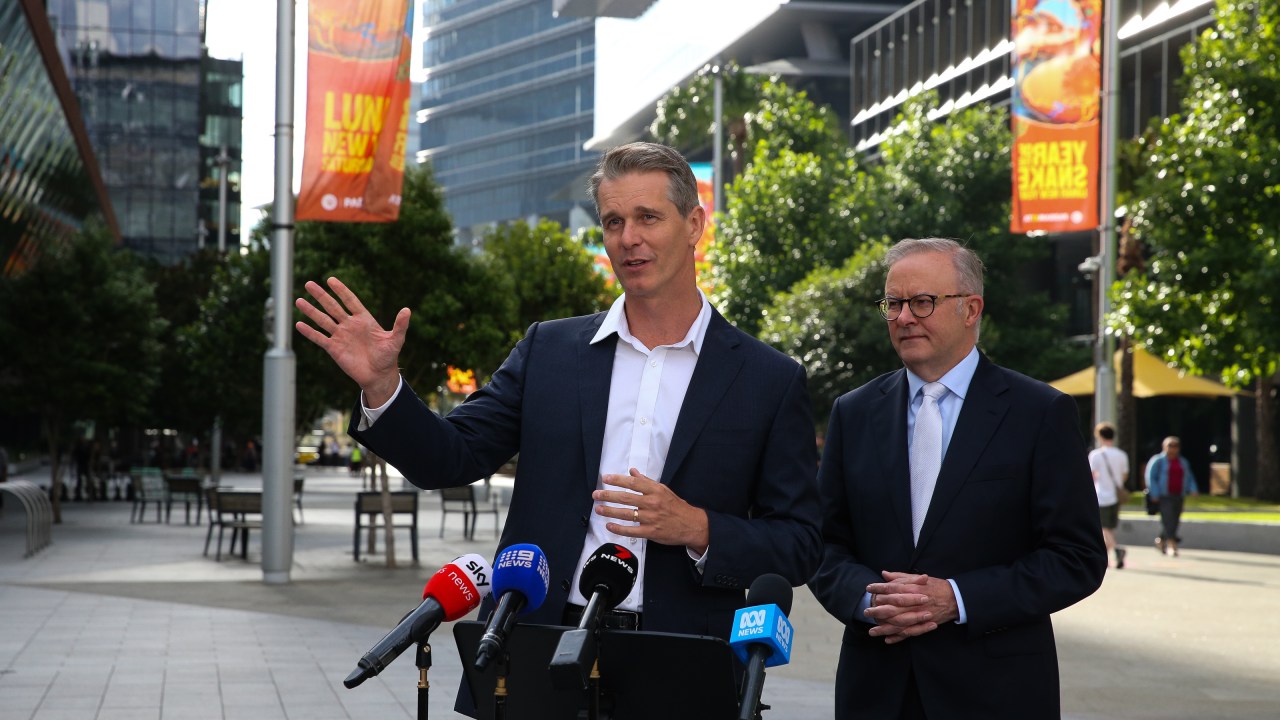
Labor Cabinet Secretary Andrew Charlton has conceded the capital gains tax reforms pitched in the latest budget do not “interact well” with small businesses of a low capital base.
Mr Charlton’s intervention marks the first time a senior member of the government broke ranks with Treasurer Jim Chalmers and Prime Minister Anthony Albanese.
While the Treasurer has said the government would consult with the start-up sector, he has not yet accepted the industry’s concerns.
Small businesses have publicly opposed the government’s decision to revert CGT to an index-based system with a minimum tax rate of 30 per cent.
Andrew Charlton said he understood entrepreneurs had “real concerns” in response to fierce backlash on Friday.
“Start-ups and some small businesses are a real concern because what I just explained is that we’ve got this new type of capital gains discount which is based on inflation, and the point that many start-up founders, the point that many small businesses have been making is valid,” Mr Charlton told Nine’s Today show.
The career economist all but validated the sector’s concerns suggesting scrapping the 50 per cent CGT discount would leave start-ups and small business “nothing to inflate off”.
“It’s a valid point because that new regime doesn’t interact well if you have a really low capital base, because you’ve got nothing to inflate off. So, there are real concerns out there.”
However, the Assistant Science Minister denied suggestions the government had “undercooked” the policies as ministers begin to consult with start-ups and small businesses.
Anthony Albanese had ruled out making major amendments to the announced reforms, but reports suggest he faces internal pressure over mounting disgruntlement in the business community.
Mr Charlton earlier this week leapt to the government’s defence on social media.
“We need to be a start-up nation, and we want to encourage start-ups in this country… And there is a lot in the budget for start-ups … there is support for start-ups in the budget,” he said.
He added Mr Chalmers was consulting with start-ups as the government was aware of the specific issues facing businesses’ abilities to respond to CGT reforms.
The government received numerous appeals for assistance from prominent business leaders and economists in the ten days since the budget announcement.
Independent for Wentworth Allegra Spender led a roundtable during the week with business leaders.
Represented technology companies included Canva – singled out by Paul Keating during the week – Blackbird, Safetyculture and other Tech Council and Investment Council affiliated businesses.
The Tech Council of Australia, headed by Atlassian co-founder Scott Farquhar, also held discussions over the week.
The council at the time of the budget advised “there is work to do to ensure Australia’s start-up community doesn’t become collateral damage as a result of proposed changes to CGT”.
Forty Australian founders under the age of 40 then penned a letter to the Prime Minister urging him to ditch the CGT reforms.
“The changes… will do nothing to make houses more affordable; all they will achieve is to suck the ambition, drive and hope out of the hearts of young business builders,” they wrote.
“This aspiration ambush doesn’t just impact tech start-ups either: it impacts every growing business in Australia. Meaning every small business that wants to become a medium-sized business and every medium-sized business that wants to become a big business.”
The comments echoed the Coalition’s line of attack on the budget.
They accused the government of “pulling that ladder up” on young Australians who will not benefit from the current CGT discount before the changes were officially announced.
AustralianSuper chairman and former government advisor Don Russell also advocated for a CGT carve-out for founders of fast-growing start-ups.
Some within the Albanese government anticipated changes will be made to the CGT reform to the benefit of entrepreneurs before the policies are tabled in Parliament.
Industry Minister Tim Ayres on Thursday told Sky News there was “plenty of room for a good discussion” with businesses on CGT changes.
“They [startups] are in a different situation. We’re working carefully with that community, with the tech sector, because that’s what’s in the national interest,” Mr Ayres said.
“There’s some implementation questions and I know, from my own discussions with that sector, there’s plenty of room for a good discussion there.”
Another minister implied the final policy could still see changes if the government determined it would have detrimental and “unintended consequences”.
Services Minister Tanya Plibersek told Sky News on Friday: “There’s always two tasks after a budget”.
“The first is to explain the actual impacts and not get sidetracked by the misinformation, disinformation,” she continued.
“And the second thing is to make sure that the implementation reflects the intention of the changes that we’re making.
“Our top line change, the thing that we are most concerned to do is make sure that young Australians have a chance of getting into a home of their own the same way that their parents and grandparents did.”