
The NHL is down to its final four teams in the Stanley Cup playoffs, which means 28 other organizations are already strategizing what their offseason will look like. With the league’s salary cap ceiling climbing from $95.5 million to $104 million, there won’t be as many teams navigating stressful cap situations this offseason compared to years past.
The Tampa Bay Lightning, for example — a team famous for its cap gymnastics in the flat cap era — enters the summer with roughly $15 million in cap space and 21 of its 23 NHL roster spots already filled. They can pretty comfortably afford to re-sign breakout defender Darren Raddysh, their only critical pending free agent, to a new contract. Whether Tampa Bay should buy high on Raddysh after a career year is another matter, but the point is, they at least have the financial flexibility to consider that option if they desire.
However, that doesn’t mean all clubs are clear of obstacles.
There are still teams with significant raises for top players kicking in next year, along with other key unrestricted and restricted free agents who will demand more expensive contracts. The combination of those forces will leave a few organizations without the requisite cap space to bring everybody back.
These aren’t desperate situations — we’re not talking about teams that are so strapped that they’ll have to move top-of-the-lineup pieces like the New York Islanders (Devon Toews), Minnesota Wild (Kevin Fiala) and New York Rangers (Pavel Buchnevich) had to do in the flat cap era — but the clubs in this article can’t afford to bring everyone back and will face some tough decisions.
Here are seven teams with fascinating cap crunches worth monitoring, with cap data from PuckPedia and CapWages, and contract projections from AFP Analytics.
Vegas Golden Knights
Projected cap space: $12.5 million (assuming Alex Pietrangelo ends up on season-ending LTIR next season)
UFAs: Rasmus Andersson, Reilly Smith, Cole Smith, Colton Sissons, Jeremy Lauzon, Brandon Saad, Ben Hutton
RFAs: Pavel Dorofeyev
Vegas’ projected cap space will climb to about $12.5 million if Alex Pietrangelo and his $8.8 million return to season-ending long-term injured reserve for next season. However, that still won’t be enough for the club to complete its major business.
Pavel Dorofeyev’s next contract is going to be a doozy after scoring 35 goals last season, 37 goals this year and lighting up the playoffs so far. The 25-year-old’s elite finishing ability is a unique, necessary skill set for a Vegas top six that already has many elite passers (Jack Eichel, Mitch Marner, Mark Stone) but not enough clinical scorers. AFP Analytics projects Dorofeyev’s next deal will carry an $8.99 million cap hit on a six-year deal.
A Dorofeyev extension in that range would leave Vegas with $3.5 million left over and still only 18 healthy NHL players under contract: 11 forwards, four defensemen and two goalies. After the haul Vegas gave up for Rasmus Andersson, it’s reasonable to assume the club will want to extend him as well, which would be an expensive proposition.
Andersson’s next deal is projected to cost $8.7 million annually over six years. Even if Vegas can get that down closer to a team-friendly $7.5 million AAV by flexing its no-state tax advantage and stretching the term of the contract out by an extra year or two, it would leave Vegas about $4 million over the cap with at least three more roster spots to fill out.
This is why Tomáš Hertl could become a cap casualty this summer. Hertl is owed a $6.75 million AAV by Vegas (San Jose still retains a small portion of that contract) through the 2029-30 season. He turns 33 in November, and even though he scored 58 points this season, he’s showing significant signs of slowing down as an even-strength play-driver. Hertl has a partial no-trade clause, but with how weak the league’s center market is, Vegas should still have plenty of solutions to offload his contract if necessary.
Beyond Hertl, Vegas also has a couple of handsomely paid bottom-six forwards without any trade protection in Keegan Kolesar ($2.5 million) and Nic Dowd ($3 million) who could be sacrificed if further space is needed to re-sign Dorofeyev and Andersson.
Colorado Avalanche
Projected cap space: $2.1 million
UFAs: Brent Burns, Brett Kulak, Nick Blankenburg, Joel Kiviranta
RFAs: Jack Drury, Zakhar Bardakov
The most talented team in the NHL probably won’t be quite as deep next season. Martin Necas’ brand-new $11.5 million AAV contract will be kicking in, Sam Malinski’s cap hit will jump from $1.4 million to $4.75 million, and Brent Burns hit his performance bonuses, which will lead to an overage charge in 2026-27.
There won’t be a critical exodus of key contributors, but the Avalanche have just over $2 million in projected cap room with only four defensemen under contract for next season. Some salary will clearly need to be shipped out.
Brett Kulak and Burns are the two critical pending UFAs. Kulak has been a major difference-maker on the back end, averaging about 21.5 minutes per game in the postseason, and Burns handles some important responsibilities on the right side. Is there a way to move money around and keep Kulak or will he be too expensive? Center Jack Drury is an RFA projected to cost $2.86 million against the cap on a three-year extension as well.
With Nazem Kadri and Nicolas Roy in the fold, it’d make sense for the Avs to shed a pricey depth forward or two like Ross Colton, who has one year remaining at $4 million, especially with the cheaper Gavin Brindley capable of playing in an everyday NHL role next season. After Colton, though, there aren’t many easy decisions to create cap room — Colorado will either need to consider trading solid depth pieces like Logan O’Connor ($2.5 million cap hit) or simply accept that their back end is going to be weaker next season.
Buffalo Sabres
Projected cap space: $12.9 million
UFAs: Alex Tuch, Beck Malenstyn, Josh Dunne, Logan Stanley, Luke Schenn
RFAs: Zach Benson, Peyton Krebs, Michael Kesselring
This is a tighter cap picture than you might expect for a core that’s still relatively young, but a couple of dynamics are at play.
Firstly, Jeff Skinner’s buyout will spike to a dead-cap charge of $6.44 million for 2026-27. It will go back down to $2.44 million per year in 2027-28, but next season is the peak of that buyout pain.
Secondly, a lot of Buffalo’s best players have already signed lucrative long-term extensions. This fall, for example, breakout winger Josh Doan’s second contract will kick in, with his AAV jumping from $925,000 to $6.95 million. That’s excellent cost certainty in the long run — those contracts will only look better as the cap rises — but it does leave the Sabres juggling some short-term challenges.
Buffalo has roughly $13 million of cap space to play with, and not enough room to sign every key free agent. Re-signing Zach Benson to a long-term deal should be priority No. 1 after his breakout playoffs. He’ll likely land in Doan’s ballpark on his next deal, with AFP Analytics projecting a $6.97 million cap hit on a seven-year deal.
That kind of extension for Benson would leave the Sabres with roughly $5.9 million in remaining cap room. $5.9 million should be enough to re-sign RFAs Peyton Krebs and Michael Kesselring (assuming he’s still in the organization’s plans after a down year) to affordable bridge deals, but there clearly isn’t enough space to re-sign pending UFA Alex Tuch. However, that’s not as big a “problem” as you might imagine.
Tuch has been a terrific player and a loyal soldier in Buffalo, but his next contract is projected in the $10.1 million AAV range on a seven-year commitment. That kind of deal could quickly become an albatross for a 30-year-old who is showing early signs of potential decline. The Sabres also have so much young forward talent that they can elevate into bigger roles. Yes, losing Tuch would hurt emotionally, but it’s probably in the team’s best long-term interests anyway.
Dallas Stars
Projected cap space: $11 million
UFAs: Jamie Benn, Michael Bunting
RFAs: Jason Robertson, Mavrik Bourque
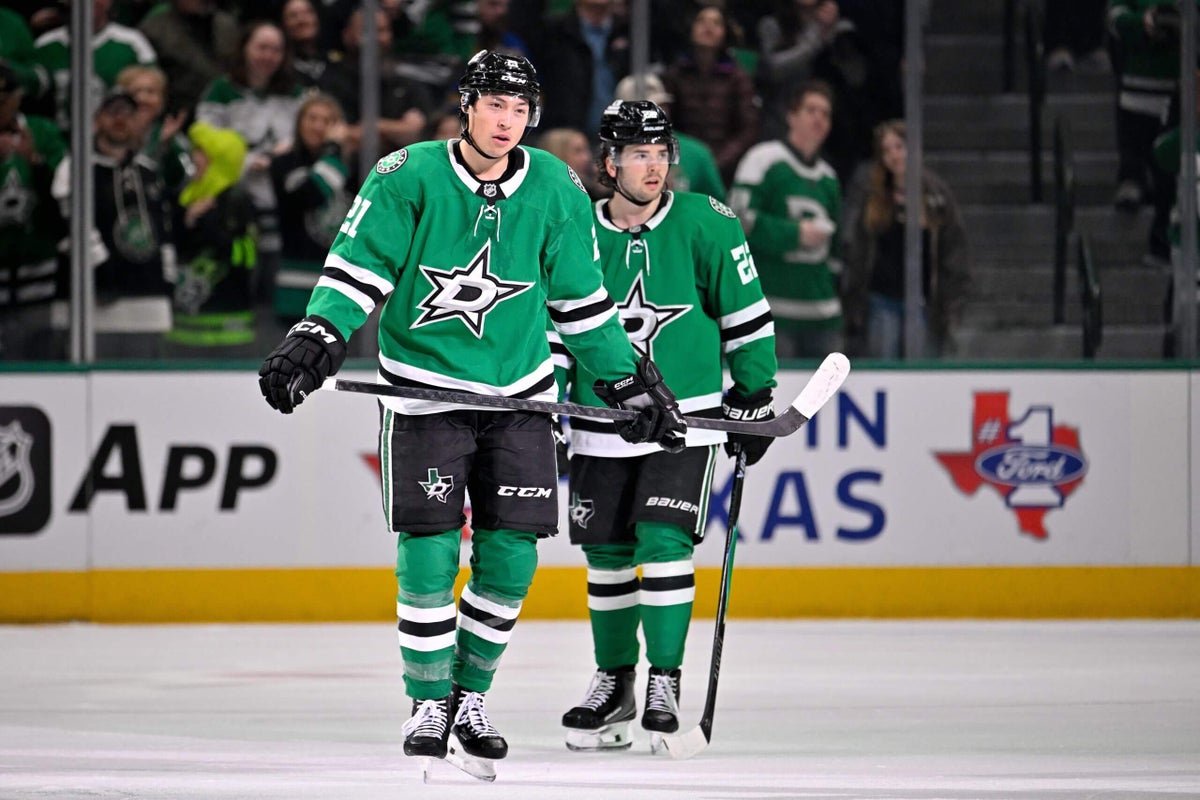
For the second offseason in a row, the Stars are navigating around one of the most complex cap crunches in the league. Dallas has most of its roster spots filled, but the issue is the team’s $11 million in projected cap room won’t even be enough on its own to re-sign Jason Robertson.
Robertson, a pending RFA, has a ton of leverage for negotiating his next contract. He’ll be eligible for unrestricted free agency next summer, he has arbitration rights, and he’s coming off a monster season where he led the team with 45 goals and 96 points, in addition to an excellent Round 1 performance against the Minnesota Wild. Mikko Rantanen’s $12 million AAV could be the ballpark for Robertson’s next deal, which would put the Stars slightly over the salary cap.
That doesn’t even account for promising 24-year-old forward Mavrik Bourque, who also needs a new deal this summer. Bourque broke out with 20 goals and 41 points in the regular season. AFP Analytics projects his next contract to be in the $2.96 million AAV range on a two-year bridge.
Signing Robertson at $12 million and Bourque at $2.96 million would push the Stars over the cap by approximately $4 million, with two final roster spots still to fill out.
We rarely see offer sheets, but Bourque represents an excellent opportunity for one if a rival club is bold enough to go down that path. A team could hypothetically offer Bourque up to a $4.77 million AAV, which Dallas would have a tough time matching, and it would only cost a second-round pick in compensation. Bourque was similarly there for the offer-sheet taking last summer and nobody stepped up, but perhaps his breakout this year changes that equation.
The Stars will need to move money out just like last summer. Ilya Lyubushkin should be the most obvious cap dump; he’s a 32-year-old No. 6/7 defender with one year remaining at $3.25 million. More will need to be done, though. If Jamie Benn extends on a cheap one-year deal, the Stars may need to ship out Sam Steel and/or Radek Faksa, who are both in the $2 million AAV range.
Minnesota Wild
Projected cap space: $15.3 million
UFAs: Mats Zuccarello, Vladimir Tarasenko, Marcus Johansson, Michael McCarron, Zach Bogosian, Nick Foligno, Jeff Petry
RFAs: Bobby Brink, Daemon Hunt
With Kirill Kaprizov’s $17 million AAV contract kicking in next season, the Wild will have some cap limitations to work around this summer. Minnesota has approximately $15 million in projected cap space, with several free agents to sign and only 13 skaters (eight forwards, five defensemen) under contract. This isn’t a dire or desperate cap crunch, but there are clear financial restrictions that could hinder the team’s ability to upgrade this offseason.
There will be changes up front because Zuccarello, Tarasenko, Johansson, McCarron, Foligno, and Brink would cost about $21 million to bring back, according to AFP Analytics, which the organization cannot afford.
The bigger issue, though, is that the Wild also need to do their best to trade for a No. 1 center to truly contend for a Stanley Cup next season. Most top-six centers come with a high cap hit, so GM Bill Guerin may need to get even more creative in moving contracts around to create the requisite space to go big-game hunting.
The good news is there are straightforward ways to free up more cap room if necessary. The 15-team no trade clause on Ryan Hartman’s contract (one year remaining at $4 million) will shift to a 10-team list. Quality but pricey bottom-six forwards Yakov Trenin ($3.5 million AAV) and Nico Sturm ($2 million) don’t have any trade protection.
Guerin won’t be handcuffed by the team’s cap situation, but he will need to wheel and deal creatively and will probably lose a quality depth player or two along the way this summer.
New Jersey Devils
Projected cap space: $11.9 million
UFAs: None
RFAs: Simon Nemec, Arseny Gritsyuk, Paul Cotter
The Devils have $11.9 million of cap space with 18 of 23 NHL roster spots filled. That space could disappear quickly depending on what happens with Simon Nemec.
Nemec’s offensive production, ice time and pedigree mean his next contract, provided it’s a long-term one, would be quite expensive; he’s projected to carry an $8.06 million cap hit on a seven-year deal. If New Jersey re-signs Nemec at that rate, it would leave only $3.8 million in cap room to extend Arseny Gritsyuk, a rising middle-six forward, and fill out the last 2-3 roster spots, which simply isn’t enough money. That’s before we even mention the Devils’ desperate need to find another top-six winger to bolster their offense.
This is where incoming GM Sunny Mehta faces fascinating decisions. One path would be to trade Dougie Hamilton and his $9 million AAV this offseason. However, if Nemec doesn’t see a long-term fit with the organization because of their logjam of defensemen and Luke Hughes blocking first-unit power-play opportunities, or if the Devils simply don’t think he’d be worth $8 million to them on a long-term deal, would they consider dangling him as a trade chip to land a dynamic top-six winger?
In any case, it feels like something has to give on New Jersey’s blue line because there are too many bodies and too much money tied up there.
Edmonton Oilers
Projected cap space: $15.5 million
UFAs: Connor Murphy, Jason Dickinson, Kasperi Kapanen, Connor Ingram, Jack Roslovic, Adam Henrique
RFAs: Colton Dach, Spencer Stastney
The Oilers aren’t as squeezed financially as they were last summer, when they had to shed Viktor Arvidsson and Evander Kane, but there still isn’t much cap room to work with given how many areas they need to upgrade.
Edmonton will likely make an effort to re-sign Connor Murphy, Jason Dickinson and Kasperi Kapanen — provided their asks are reasonable — because all three were effective in their roles. Murphy and Dickinson, in particular, excelled defensively. AFP Analytics projects Dickinson’s next deal will be in the $5 million AAV range, Murphy’s around $3.6 million and Kapanen’s around $3.1 million. Perhaps there’s a way to bring those AAVs down slightly by offering more term, but that’s the ballpark the Oilers would be looking at.
If Edmonton re-signs Dickinson, Murphy and Kapanen at those prices, it will be left with approximately $3.8 million in cap room and 19 of 23 NHL roster spots filled. The Oilers will likely need to let Roslovic walk — he was excellent in the regular season, with 21 goals in 69 games, but disappeared in the playoffs. They have more pressing needs to spend their limited cap space on, especially since Ike Howard could provide secondary scoring next season.
A little over $3 million, with a few final roster spots to fill, doesn’t seem too bad, but it’s not enough for meaningful upgrades. Edmonton is desperately missing a No. 1 goalie (Tristan Jarry is their only NHL netminder under contract for next season) and that obviously isn’t enough cap room to address that massive hole, let alone potentially tinkering with the back end or adding speed to the team’s forward group.