
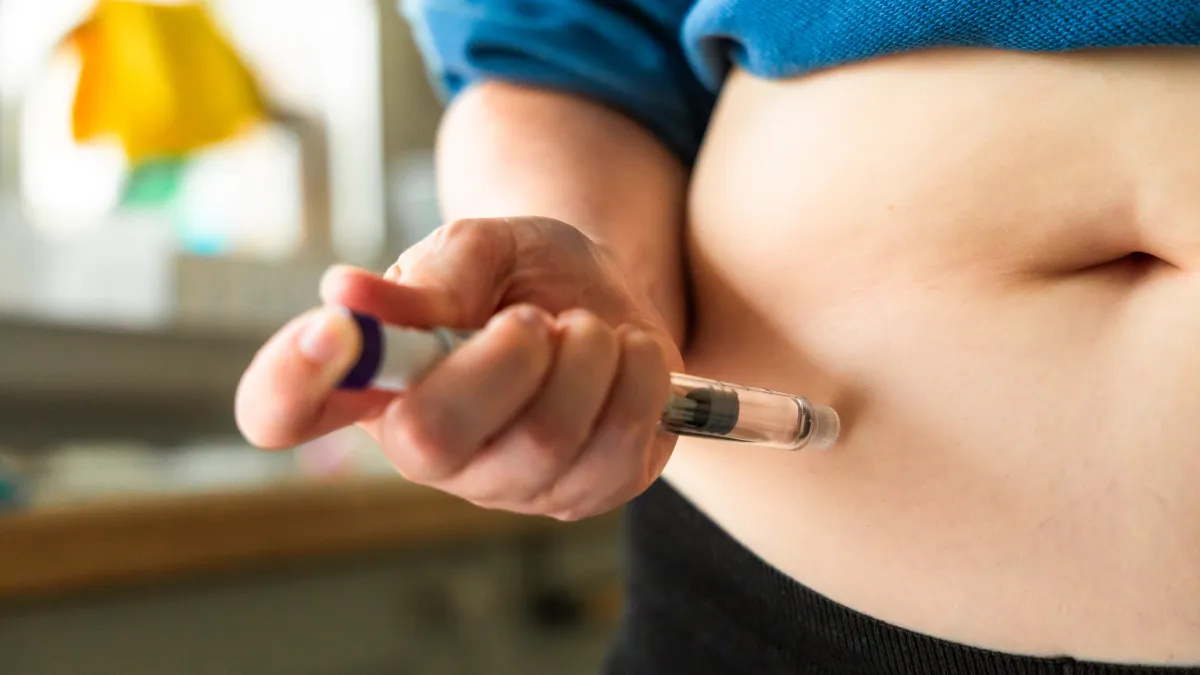
There’s a new weight-loss jab on the horizon, and it may mean bad news for the makers of Mounjaro and Ozempic. Retatrutide is not legally approved for sale in the UK — yet — but reta, as it’s known, is shaping up to be the most powerful obesity treatment we have.
This week, after months of anticipation from the medical establishment and longevity industries alike, Eli Lilly and Company released the results of a phase-three clinical trial for its new wonder drug. They were even more exciting than anticipated.
Over a period of 80 weeks, doses of 4mg, 9mg, and 12mg were given to 2,339 obese and overweight adults with at least one weight-related illness excluding diabetes. In addition to shaving an average of 9.5 inches from their waistlines, participants lost between 19 and 28 per cent of their body weight. They also demonstrated lowered risk factors for cardiovascular disease, including reductions in blood fats, “bad” cholesterol, inflammation and blood pressure.
For the heaviest patients, the results were most dramatic and similar to what could previously be achieved only through gastric bypass surgery. Even those taking the lowest amount lost roughly 19 per cent of their weight. That’s what Zepbound, another Eli Lilly drug, can achieve at its highest dose. Some analysts have expressed concern that users on the highest dose discontinue the drug due to side effects but also, presumably, having lost so much weight, because the drug just works too well.
Retatrutide, too, has its side effects — nausea, vomiting, diarrhoea and constipation — but they are often temporary and can be improved by adjusting dosage. And it seems to preserve muscle mass more effectively than GLP-1 drugs alone, which create such large calorie deficits that patients are advised to embark on weight-training regimes to preserve their body composition. Andrew Huberman, a Stanford University professor and podcaster, suggested on a recent episode of The Goop Podcast that retatrutide had been embraced by the biohacking community in part because it had “some muscle-sparing effect”.
Eli Lilly is expected to seek permission to sell retatrutide in the UK within the next few months, but in the meantime it’s already being used and abused on the streets. The results from early-stage trials were so promising that it prompted some biohackers to try to buy knock-off versions — known colloquially as “Triple G” or “Godzilla” — over social media. The frenzy became so heightened that Eli Lilly issued a warning on its website and threatened legal action against those selling it.
Tom Davies, an online fitness coach, is among the retatrutide’s earliest adopters. “I started taking peptides five or six months ago, when I was 20,” Davies posted recently. “As you can see [from my before and after posts] there is a massive visible difference. Mainly from the retatrutide making my face a lot leaner and losing a bit of body fat.”
In October, the Medicines and Healthcare products Regulatory Agency (MHRA) discovered and shut down a facility in Northampton that made counterfeit versions of weight-loss drugs. They found more than 2,000 unlicensed retatrutide and tirzepatide pens, along with raw chemical ingredients and packaging materials. The street value of the products exceeded £250,000.
And yet on the website UK SARMs, a 10mg pen of knock-off retatrutide can be purchased for £179.99 — with the caveat that it is sold “solely for research purposes”.
Reta is so effective because of its three-pronged approach. Wegovy and Ozempic target GLP-1, a hormone that signals fullness and stimulates insulin release. Mounjaro targets GLP-1, but also GIP, which acts on the brain to reduce appetite and supports bone health. Reta does all of that and then some: it also acts on the hormone glucagon, which is produced by the alpha cells of the pancreas. It works in tandem with insulin; its main job is to raise blood sugar when it gets too low. It also breaks down fat and increases metabolic rate, which makes the body burn more calories at rest.
In March, Huberman admitted that “not a week goes by where I don’t get 100 questions about retatrutide to my phone, my personal phone, let alone email”. The MHRA should be prepared for a similar onslaught.