
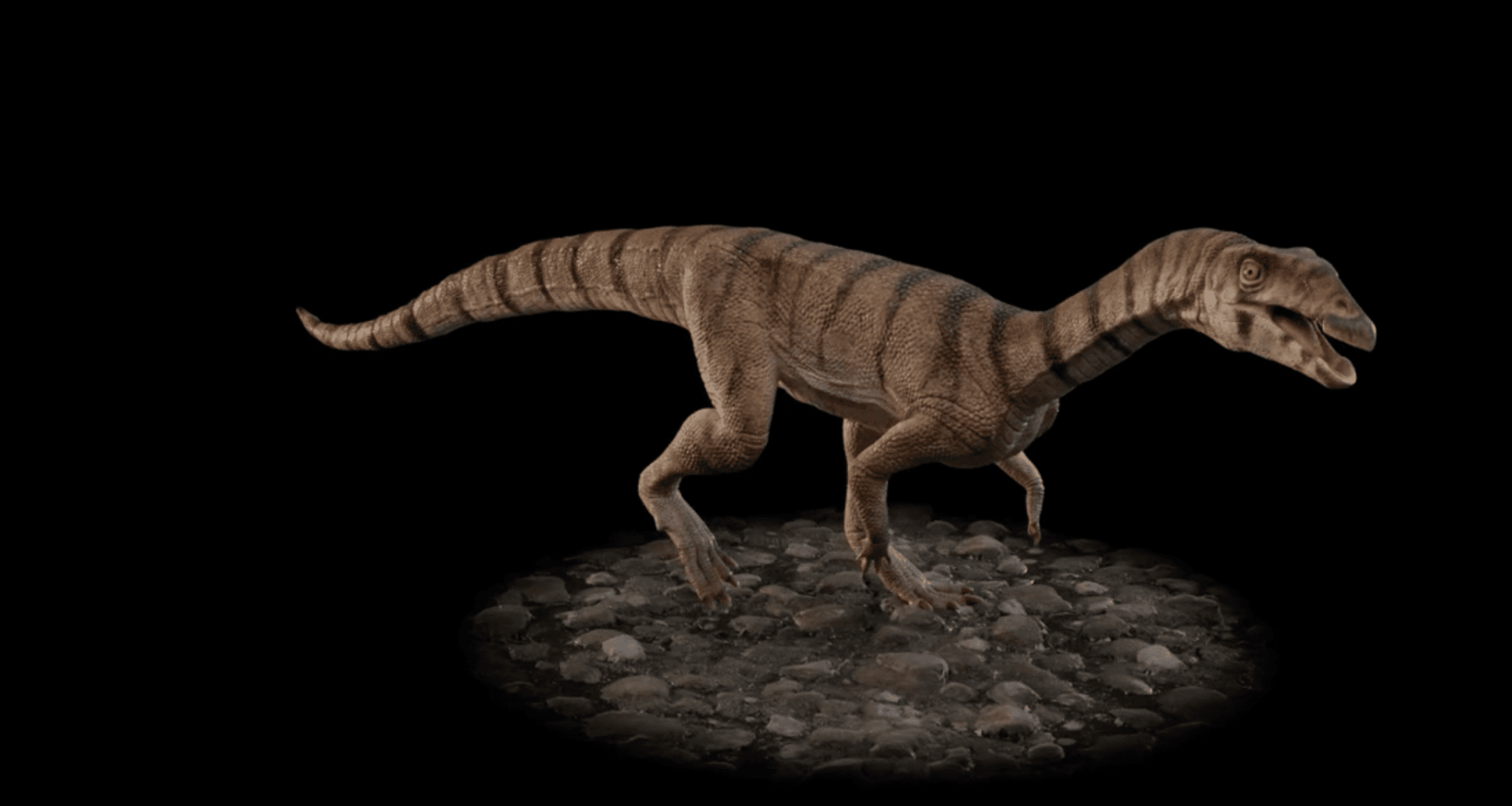
 Video of 3D model of reconstruction of Labrujasuchus expectatus
Credit
Jorge Gonzalez and NHMLAC Dinosaur Institute
Palaeontologists have unearthed the remains of a bizarre crocodile relative that walked on two legs and had a toothless, beak-tipped mouth
Described in the Journal of Vertebrate Palaeontology, the newly identified species is named Labrujasuchus expectatus, or the “Witch Croc.”
The fossils were discovered at the iconic Ghost Ranch site in New Mexico, marking a major milestone as the excavation project enters its 20th year.
An unexpected crocodile relative
Despite belonging to the branch of archosaurs that led to modern four-legged crocodiles, Labrujasuchus looked remarkably like an ornithomimosaur—a group of bipedal, ostrich-like dinosaurs that lived millions of years later in the Cretaceous period.
The creature navigated its world on two legs, possessed tiny arms, and completely lacked teeth. It is only the fifth identified species of Shuvosauridae, a group of ancient crocodile relatives known for mimicking the body plans of bipedal theropod dinosaurs.
Dr. Alan Turner, lead author of the study, noted that many successful survival strategies seen in modern animals and dinosaurs first arose during the Triassic. He explained that shuvosaurs are a prime example of convergent evolution (when unrelated species independently evolve similar traits). While bipedalism is highly unusual for crocodile relatives, it was a path well-travelled by dinosaurs and birds.
Labrujasuchus expectatus
The name Labrujasuchus expectatus carries historical and scientific meaning:
The genus (Labrujasuchus):
A combination of “Ranchos de los Brujos” (Ranch of the Witches)—an old Spanish name for Ghost Ranch—and the Greek word suchus, meaning crocodile.
The species (expectatus):
Palaeontologists had already found shuvosaurs from earlier and later parts of the Triassic in the region. Finding an evolutionary link right between them was highly anticipated, making the discovery an “expected unexpected” find.
Dr. Nate Smith, co-author and Curator of the NHMLAC Dinosaur Institute, explained that local rancheros originally named the site “Ranch of the Witches” to scare people away from cattle-rustling operations. The team chose the name to honor that colorful history and celebrate how the fossil record allows scientists to successfully predict missing evolutionary links.
20 years of excavation at Ghost Ranch
The Triassic period was filled with bizarre reptiles. Alongside shuvosaurs lived lagerpetids (bipedal dinosaur cousins related to flying pterosaurs), Drepanosaurus (a tree-dweller with a single sloth-like claw), and Vancleavea (an armored, aquatic reptile).
Ghost Ranch, made famous by artist Georgia O’Keeffe’s paintings of its vibrant badlands, has spent decades providing some of the world’s most exquisitely preserved Triassic fossils. The ongoing excavation at the site’s Hayden Quarry is co-led by Dr. Smith.
Joanne Lefrak, Director of Experience and Social Impact at the Ghost Ranch Education and Retreat Center, celebrated the 20th anniversary of the excavation partnership. She expressed pride in supporting the research and stated that Ghost Ranch looks forward to collaborating with the scientific team to share the site’s ancient history for years to come.