
The early stages of the NHL’s skyrocketing salary cap have already had a massive impact on team-building strategies and player compensation. Young players are commanding lucrative contracts faster than ever, leaving some teams with tough decisions about specific restricted free agents in line for significant raises.
If the club is fully sold on the player’s ability and long-term fit — and if the player is willing to stay — it’s usually straightforward to agree to a lengthy contract extension that makes both sides happy. However, sometimes there is a gap between the agent and the team’s perceived value of the player or their future role, and that’s when matters can become complicated.
Here, we will examine four fascinating RFA dilemmas that teams will face this offseason. This is not meant to be a list of players who are guaranteed to be out the door in summer trades; it’s just that their contract situations/futures are complex and will require extra thought and consideration. A favorable contract extension would probably be the No. 1 preference for these teams, but if talks go sideways, it could open the door to the possibility of a trade.
Jason Robertson is the highest-profile RFA with question marks about his future, but we won’t be discussing him in this story. Not only is that a relatively well-known storyline by this point, but after Robertson led the team with 45 goals and 96 points in the regular season, and followed it up with a strong Round 1 performance, it feels like a contract extension is the most logical solution for both sides.
Yes, Dallas will need to make a couple of moves to carve out the cap room necessary to give Robertson the bag he deserves, but there are contracts further down the lineup that the club should be able to shed. The Stars’ bottom-six depth would suffer, but it would only be a problem for a year because Tyler Seguin’s $9.85 million cap hit will come off the books at the end of next season.
Once you get past Robertson, it’s interesting to note that the most intriguing RFA situations surround defensemen. Without further ado, let’s dive in.
Simon Nemec, RHD, New Jersey Devils
Contract projection: $8.06 million x seven years (long-term), $4.47 million x two years (short-term)
Nemec’s offensive production, ice time and pedigree mean his next contract, provided it’s a long-term one, will be expensive; he’s projected to carry an $8.06 million cap hit on a seven-year deal.
There are a few factors that could complicate New Jersey’s decision to make such a large commitment to him.
Firstly, while Nemec has shown flashes of high-end offense and puck-moving, his defensive play remains a major limiting factor in his all-around game. The 22-year-old owns some of the worst defensive metrics in the league — as of now, he isn’t worth anywhere close to an $8 million cap hit according to colleague Dom Luszczyszyn’s Net Rating model.

Nemec is still young enough to make a significant two-way leap and grow into a player worth that kind of hefty contract. However, the big question is whether he’ll get the opportunities to maximize his potential in New Jersey, where Luke Hughes gets first dibs on all the prime offensive and power-play opportunities.
The Devils’ cap situation is a bit tricky as well. New Jersey only has $11.9 million of projected cap space with 18 of 23 NHL roster spots filled. If New Jersey re-signs Nemec at an $8 million AAV rate, it would leave only $3.8 million in cap room to extend Arseny Gritsyuk, a rising middle-six forward, and fill out the last two to three roster spots, which simply isn’t enough money. That’s before we even mention the Devils’ desperate need to find another top-six winger to bolster their offense. The Devils also already have $23.5 million committed to Hughes, Dougie Hamilton and Brett Pesce — can they afford another big-ticket contract on the back end?
Perhaps the middle-ground solution would be a cheaper bridge deal, projected at a $4.5 million AAV over two years. You could then try trading Hamilton and elevate Nemec into a surefire top-four opportunity and see what he’s got. On the other hand, if the Devils don’t believe he’ll reach his long-term ceiling (especially defensively), there’s strong merit to the idea of leveraging Nemec as a trade chip while his stock around the league is still high to land the high-end, top-six forward the club needs.
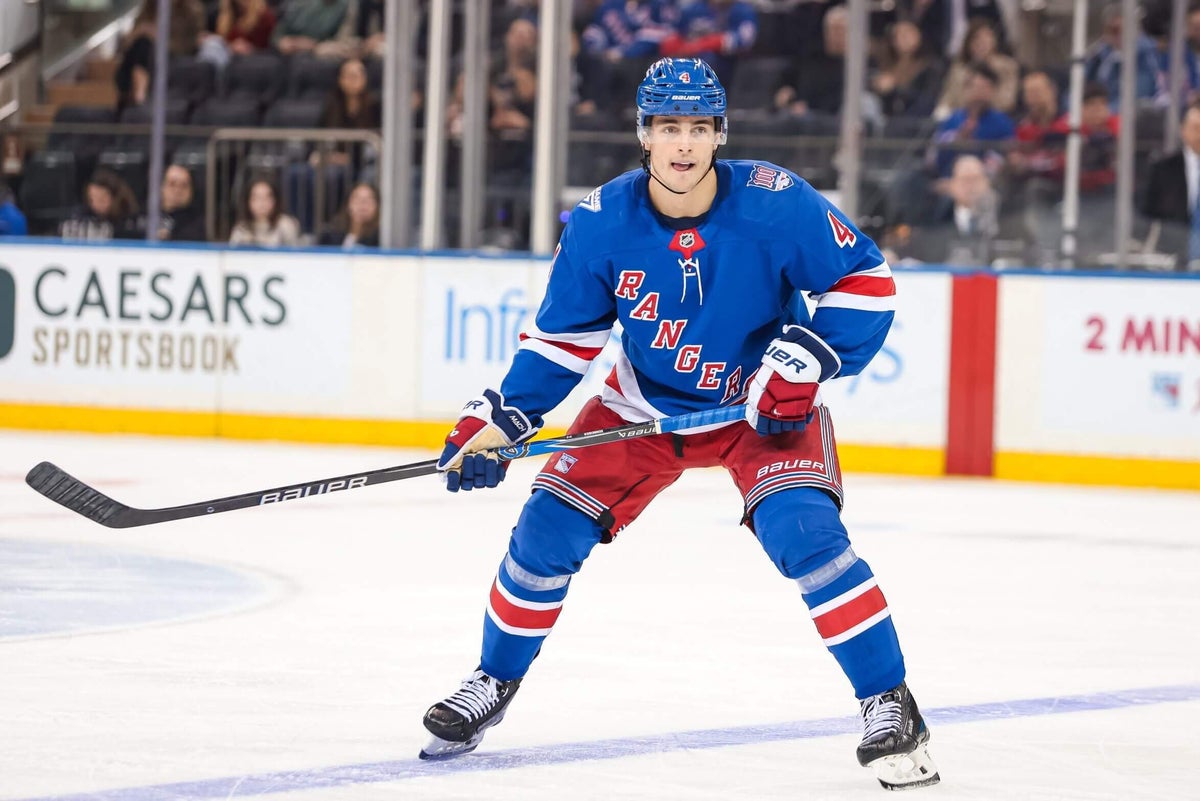
Braden Schneider, RHD, New York Rangers
Contract projection: $6 million x six years (long-term), $4.1 million x one year (short-term)
Schneider has a reasonably high floor as a solid No. 4/5 defender, but the Rangers have been patiently waiting for him to take the next step as a stud top-four piece. That breakout simply hasn’t happened.
New York’s first-round pick from 2020 stepped into a bigger role this year, averaging a career-high 20:27 per game, but his two-way results crumbled under this heavier usage. Schneider drove just 43.3 percent of expected goals during his five-on-five shifts this season, which was the worst mark among Rangers defensemen. He particularly struggled when Adam Fox’s injury forced him to play on the top pair with Vladislav Gavrikov. One of the biggest weaknesses holding Schneider back from being a more impactful top-four driver is how limited his puck play is; he ranks in the bottom 10 percent of defensemen this season in almost every zone exit category, according to Corey Sznajder’s All Three Zones tracking data.
There’s a strong case to be made that the Rangers should trade Schneider for a significant return. He’d likely still be highly sought after because he’s 6-foot-3, right-handed and has a strong draft pedigree, which are traits teams salivate over. And at 24, other teams may still view him as having untapped upside. Put simply, he’s the type of player whose market value arguably exceeds his actual on-ice impact. That would incentivize New York to at least consider trading him rather than signing him to an expensive long-term extension he might not be worth.
Schneider is also only two years away from being UFA-eligible, so if New York isn’t sold on him being a long-term core piece, you’d maximize his return by trading him now rather than a year or two from now when he’d be a bit older and even closer to having the leverage of testing the open market.
Olen Zellweger, LHD, Anaheim Ducks
Contract projection: $6.5 million x seven years (long-term), $3.2 million x two years (short-term)
Zellweger is a talented, smooth-skating puck-moving defenseman, but it’s fair to wonder if he’s truly a long-term fit with the Ducks.
The 22-year-old is terrific at transporting the puck — he ranked in the 78th percentile for defensive zone exits and 86th percentile for zone entries this season, according to Sznajder’s tracking data — but he’s undersized at 5-foot-10, isn’t an elite point producer (22 points in 76 games) and is a work in progress defensively.
Zellweger played a fairly significant role for the Ducks (averaged 17-19 minutes per game over the last two seasons), but he was a healthy scratch for nine consecutive games to begin the postseason. He clearly doesn’t have the full trust of Joel Quenneville’s coaching staff yet. On top of that, there are questions about his fit from a cap and roster-construction standpoint.
Anaheim already has Jackson LaCombe and Pavel Mintyukov on the left side defense depth chart — is there a path for Zellweger to develop into anything more than a third-pair contributor for this team?
The Ducks’ tight cap situation could also complicate the Zellweger decision.
Anaheim has $40.5 million in projected cap room, but Leo Carlsson and Cutter Gauthier are both RFAs in line for huge raises. Carlsson and Gauthier could eat up roughly half of that room if they sign long-term deals. From there, the Ducks would have roughly $20 million in cap space, but with Mintyukov (RFA), John Carlson (UFA), Jacob Trouba (UFA) and Radko Gudas (UFA) all on expiring contracts.
With all these factors in mind, I’d be surprised if the Ducks are willing to pay Zellweger in the $6.5 million AAV range, which is his projected cap hit on a long-term deal. They could sign him to a significantly cheaper bridge deal, but does kicking the can down the road make the most sense? If Zellweger stagnates due to a lack of opportunity and trust from the coaching staff, his trade value could depreciate the way Samuel Girard’s did (a similar player as a speedy, undersized puck-mover who lacks elite offensive ability).
Michael Kesselring, RHD, Buffalo Sabres
Contract projection: $2.9 million x two years
Kesselring entered this season with high expectations after being one of the main pieces in the JJ Peterka trade. Many figured that he’d be a full-time second-pair fixture next to Owen Power, but instead, he had a very challenging, injury-prone season.
Injuries limited the 26-year-old defender to only 34 regular-season games. Sabres coach Lindy Ruff clearly doesn’t trust Kesselring yet, as the latter averaged only 13:24 of ice time per game. He was also a healthy scratch in the playoffs, appearing in just one game against Boston, where he only played 4:25.
Kesselring still has many intriguing tools. He’s an above-average skater and has some legitimate puck-moving talent. He owns a huge 6-foot-5 frame, which is valuable, even though he’s not a rugged, physical player. He showed genuine offensive touch in 2024-25, when his 25 five-on-five points ranked in the top 30 among all NHL defensemen. Kesselring also had strong underlying numbers last year, as Utah controlled 54 percent of scoring chances and had a plus-11 goal differential during his five-on-five shifts last season. That previous success wasn’t just in heavily sheltered minutes, either — he played top-four minutes for lengthy stretches last year because of injuries.
With all this potential in mind, perhaps the solution for Buffalo is to simply sign him to a short-term bridge deal and hope for a bounce-back with better health and greater familiarity with the coaching staff and system.
On the other hand, though, Kesselring may not have a path to a future top-four role anymore after Mattias Samuelsson’s out-of-the-blue breakout this season, plus the continued two-way growth of Bowen Byram and Power. We also don’t know whether Jarmo Kekäläinen is as high on Kesselring as Kevyn Adams was. Kekäläinen may prefer physical, shutdown defenders on the third pair rather than Kesselring’s free-flowing, higher-risk style of play; it’s telling that they added Logan Stanley and Luke Schenn, two stay-at-home defensemen, as rentals ahead of this year’s trade deadline.
Bundle those factors together, and it’s possible that Kesselring could be leveraged as a trade chip to upgrade the forward group.
All contract projections courtesy AFPAnalytics