
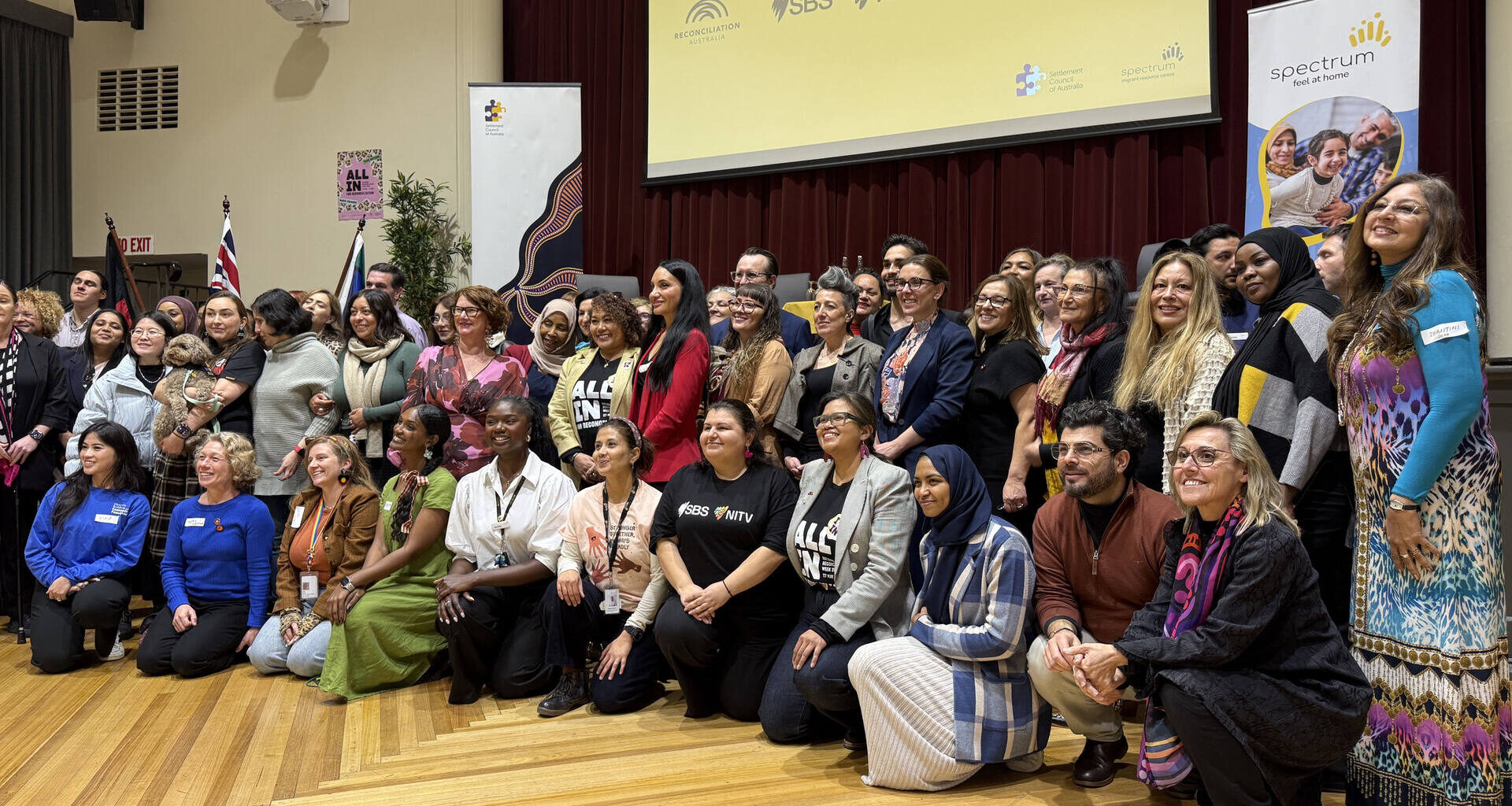
There was something deeply moving about the gathering at Preston Town Hall on Friday.
First Nations Elders, multicultural leaders, settlement organisations, government representatives and community advocates came together for the national launch of the Settlement Council of Australia’s inaugural Reconciliation Action Plan (RAP) — a landmark initiative that seeks to place reconciliation at the heart of Australia’s settlement sector.
Held during National Reconciliation Week, the event also marked the beginning of SCOA’s National Reconciliation Roadshow, a two-year initiative that will travel across the country encouraging settlement organisations to deepen their commitment to reconciliation and develop their own action plans.
Among those present were some of the country’s most influential multicultural leaders, including Vivienne Nguyen AM, Chair of the Victorian Multicultural Commission, Farah Farouque, CEO of the Ethnic Communities’ Council of Victoria (ECCV), representatives from government, local councils, settlement agencies, Reconciliation Australia and First Nations communities.
At the centre of the day was SCOA CEO Maria Dimopoulos, whose vision, determination and commitment to truth-telling have driven the initiative from concept to reality.
Over the past year, SCOA has worked closely with Reconciliation Australia, First Nations leaders and member organisations to develop its first-ever RAP. But as Dimopoulos explained, the process began with a difficult question. “We as a sector had not yet truly grappled with the reality of the very concept and idea of settlement,” she told the audience. A statement that immediately challenged everyone in the room. For migrants and refugees, settlement often represents safety, opportunity and the chance to build a new life. But the event asked attendees to consider another perspective. “While settlement is a journey that many of us as newcomers celebrate, a journey that often means the opportunity to rebuild in a new country, for our oldest living continuous culture on this earth, settlement carries a very different, very painful history,” Dimopoulos said.
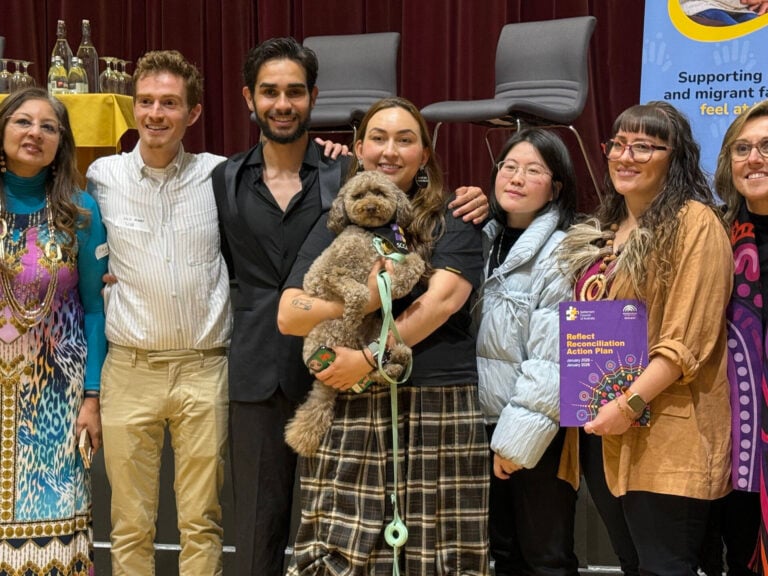 SCOA TEAM, CEO Maria Dimopoulos, artist Amy Allerton and singer Isaiah Firebrace.
It was a powerful reminder that Australia’s multicultural story exists alongside a much older story — one that began tens of thousands of years before the arrival of migrants and refugees.
Dimopoulos said the settlement sector has a responsibility not only to help people settle successfully, but also to ensure they understand the history of the country they now call home. “What the RAP and the National Roadshow attempt to do is place at the heart of that journey the recognition that we are on sacred, unceded lands, that we are here at the generosity of First Peoples and that we have an obligation to learn the stories.”
One of the most memorable lines of the day came when she reminded attendees that reconciliation and settlement are inseparable. “The work of welcome and the work of justice are not separate. They never were.”
The event opened with a heartfelt Welcome to Country by Wurundjeri Elder Uncle Andrew Gardiner, who spoke candidly about survival, resilience and inclusion.
“We weren’t defeated in a war. We didn’t simply give up. We were pushed to the margins and almost eliminated. But we’ve survived.”
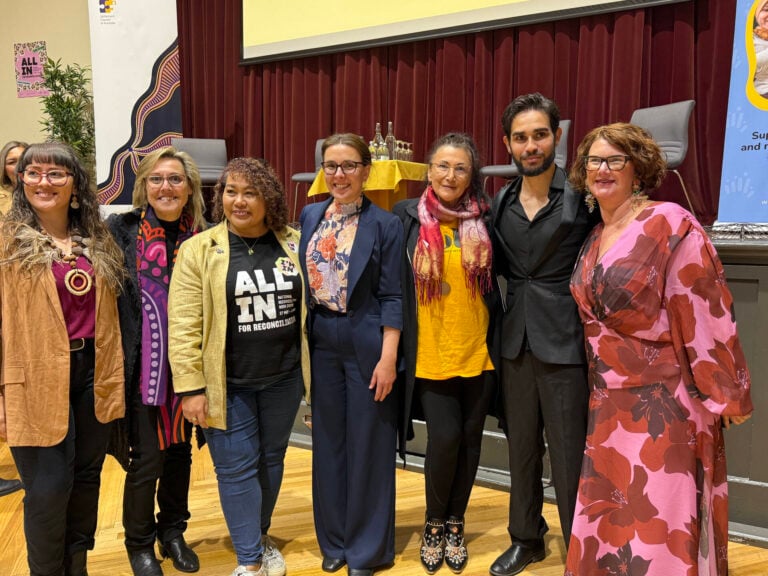 Artist Amy Allerton, SCOA CEO Maria Dimopoulos, Reconciliation Australia CEO Karen Mundine, Darebin Mayor Emily Dimitriadis, Anthea Sidiropoulos, Indigenous singer Isaiah Firebrace and Spectrum CEO Rebecca Power.
Reflecting on the trauma experienced by Aboriginal families during the era of the Stolen Generations, he reminded attendees that behind every chapter of history are real people, real families and wounds that continue to be felt today.
SCOA Board Chair Melissa Monteiro described the RAP as far more than a symbolic document.
“This has not been a symbolic exercise,” she said. “It reflects deep consultation, reflection, listening and a willingness to ask ourselves important questions about who we are as a sector and what responsibilities we carry.” Monteiro emphasised that settlement organisations play a unique role in helping new arrivals understand Australia’s history, values and future. “When we speak about belonging, inclusion, identity and social cohesion, we must also ask honestly about truth-telling, about First Nations history and experiences, and about the ongoing work required to build respectful relationships.”
Spectrum Migrant Resource Centre CEO Rebecca Power echoed those sentiments, describing reconciliation as central to the work of settlement providers.
“We are often the first services people encounter when they arrive in Australia,” she said. “If we don’t approach this well, people could inherit silence or confusion. If we do approach it well, we help create respect, understanding and a deeper connection to place from day one.”
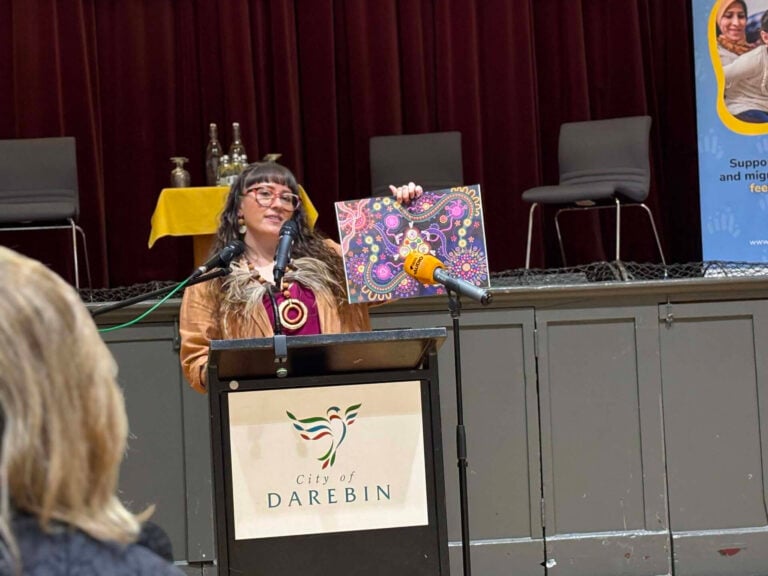 Artist Amy Allerton with her artwork Many Stories, One Home, unveiled during the launch of SCOA’s inaugural Reconciliation Action Plan at Preston Town Hall.
Darebin Mayor Emily Dimitriadis welcomed the initiative, saying reconciliation and multiculturalism must walk together. “The oldest continuing cultures on earth and the newest cultures arriving on these shores all have a role to play in shaping Australia’s future,” she said.
Victorian Parliamentary Secretary for First Peoples Christine Couzens MP stressed the importance of education and allyship.”We need to be out there educating our community. Not just First Peoples, not just migrant communities, but every single one of us has a responsibility to do that.”
A video message from Senator Jana Stewart also resonated strongly with the audience: “So many of you have carried ancient cultures across oceans, bringing languages, traditions and deep connections to homelands that stretch back thousands of years,” she said. “You know what it means when culture is threatened, silenced or erased.”
The moment that summed up the meaning of the day came with the unveiling of Many Stories, One Home, a striking artwork created by Gumbaynggirr, Bundjalung and Gamilaroi artist Amy Allerton. The artwork depicts a very thoughtful aboriginal art painting with many meanings, including migrants and refugees arriving in Australia and walking alongside First Nations peoples through what she described as a “journey of truth” built on truth-telling, truth-listening and truth-acting. “Belonging in Australia should not come at the cost of forgetting whose land we stand on,” Allerton said.
At the centre of her presentation was a simple but powerful idea: reconciliation requires the Head, the Heart and the Hands working together. The Head represents learning and understanding the truth. The Heart represents empathy, listening and genuine connection. The Hands represent action — turning understanding into meaningful change. “Reconciliation can’t exist without truth,” she said.
“Truth can’t be something that we visit occasionally when it feels comfortable. It has to become part of how we think, how we feel and how we act.”
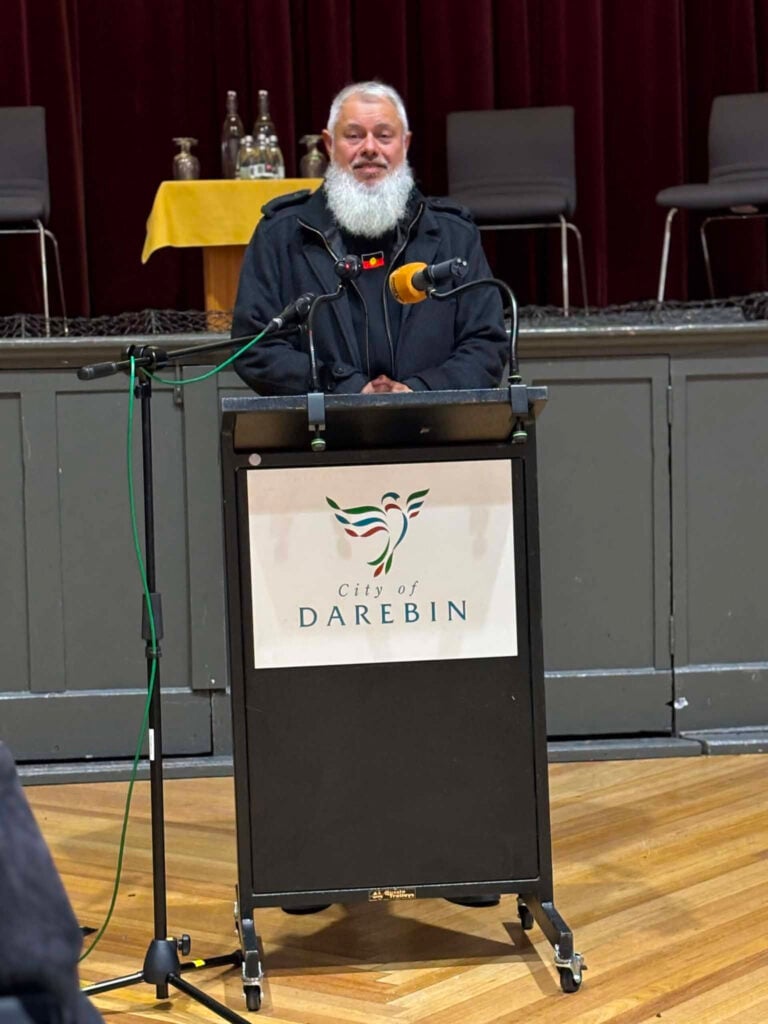 Wurundjeri Elder Uncle Andrew Gardiner delivered the Welcome to Country.
Her message resonated strongly with the audience and was later echoed by Vicky Kyritsis one of Vice Presidents of the Greek Community of Melbourne and Victoria.
“Reconciliation is central to settlement and belonging in Australia is not about erasing the past,” Kyritsis said. “I congratulate the Settlement Council of Australia for leading the way in a national reconciliation roadshow with multicultural communities. Their initiative is bold and authentic.”
Reconciliation Australia CEO Karen Mundine praised SCOA’s leadership and the willingness of the settlement sector to engage in difficult but necessary conversations: “Multicultural Australians are our allies and they will be key drivers of reconciliation now and into the future,” she said.
Over the next two years, SCOA’s National Reconciliation Roadshow will travel across every state and territory, encouraging its 180 member organisations to turn commitment into action and ensure reconciliation becomes embedded within the settlement journey itself.
The event concluded with a stirring performance by acclaimed Indigenous singer Isaiah Firebrace. Before departing, attendees gathered for a group photograph- a fitting image to close the day.
The plan has now been launched. The conversations have begun.
As Maria Dimopoulos reminded the audience, reconciliation is not separate from settlement. It sits at the heart of how Australia welcomes people, builds belonging and shapes its future.