
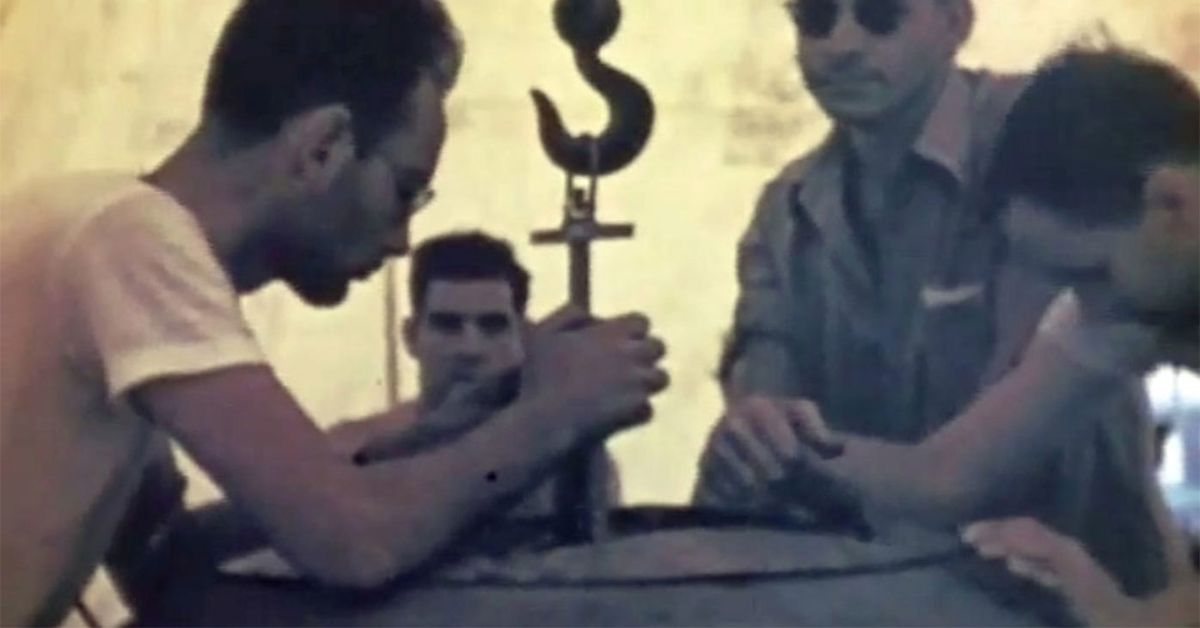
Slotin was conducting an experiment which required placing two half-spheres of beryllium around a plutonium core.
Instead of using shims to separate the devices, Slotin was using a flat-tipped screwdriver.
 Harry Daghlian (centre left) and Louis Slotin (centre right) were both killed while handling the “demon core”. (Los Alamos Archive)
This move would later be described as “tickling the dragon’s tail”.
But the screwdriver slipped, and those in the room saw a blue glow and felt a wave of heat.
Slotin reported having a sudden sour taste in his mouth and a burning feeling in his hand.
But his symptoms soon worsened, having suffered what doctors described as “three-dimensional sunburn” throughout his body.
 Louis Slotin standing next to “the gadget”, better known as the first atomic bomb. (Los Alamos Archive)
Slotin was the second person to die as a result of a nuclear experiment.
The 6kg sphere of plutonium, slightly larger than a cricket ball, would be later nicknamed the “demon core”.
Too valuable and too dangerous to be discarded, the demon core would be melted down to use elsewhere.
 Canadian nuclear physicist Louis Slotin acted recklessly, scientists concluded. (Los Alamos Archive)
Three other scientists would be hospitalised with acute radiation sickness from the accident that killed Slotin.
But they all survived in the short term, dying between 19 and 29 years later.
Slotin was presented as a hero for his actions after the accident.
“Dr Slotin’s quick reaction at the immediate risk of his own life prevented a more serious development of the experiment which would certainly have resulted in the death of the seven men working with him, as well as serious injury to others in the general vicinity,” a statement read.
But scientists regarded him as acting like a cowboy by treating a deadly plutonium core so recklessly.
NEVER MISS A STORY: Get your breaking news and exclusive stories first by following us across all platforms.