
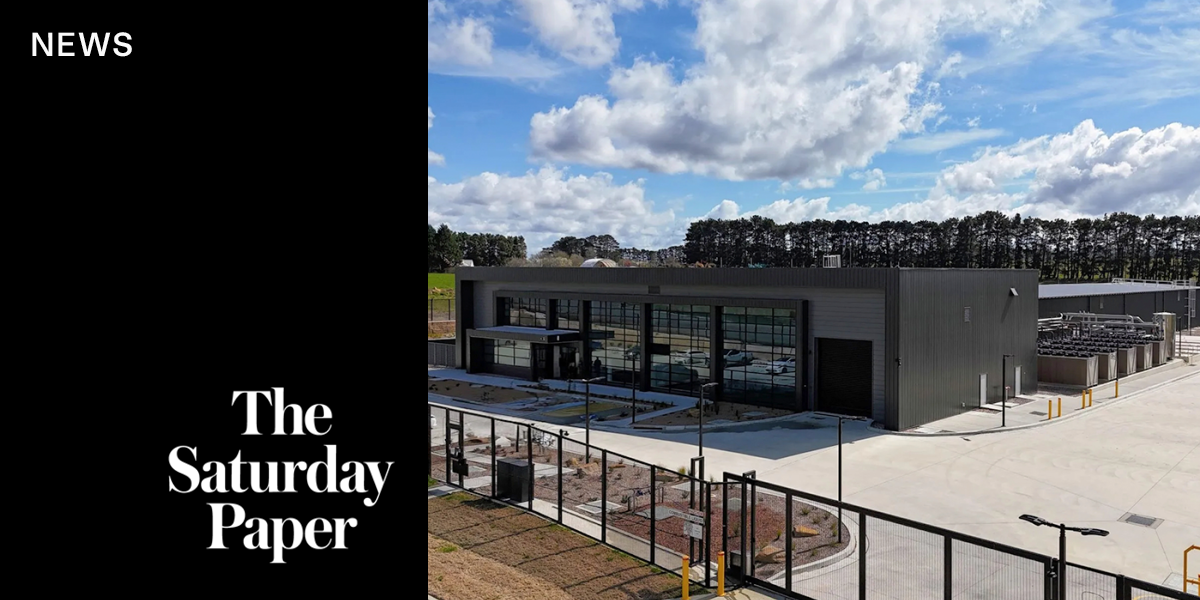
On a recent cold and rainy Friday morning, more than 200 people gathered in a paddock about five kilometres from Moss Vale, in the picturesque Southern Highlands of New South Wales, to protest against plans to build a 16 megawatt power plant and data centre.
By the standards of these things that’s a small facility, but the protest’s immediate focus is part of something much larger.
Another smallish data centre is already operating nearby. Its developer has twice taken the local Wingecarribee Shire Council to the Land and Environment Court for failing to approve expansion plans. It won the first of its appeals, relating to another proposed power unit of similar scale. The second is still in train.
These current actions are tiny compared to what the developer, Cloud Carrier, plans next. In December it put forward a proposal to build a 673 megawatt power station, taking the total generating capacity at its Southern Highlands “data campus” to 700 megawatts.
It would run entirely on fossil gas – a colossal amount of gas. According to the anti-fossil fuel group Lock the Gate, the project would add about one third to the state’s total gas consumption. Its appetite would be three times that of the current biggest gas user, Orica’s ammonia plant near Newcastle. And it would generate a lot of climate pollution, emitting about two million tonnes of greenhouse gas per year, according to a submission by the Climate Council to a recent consultation paper on data centres by Infrastructure NSW, the state’s main planning body.
“If this project were to proceed, it would initially increase NSW’s electricity emissions by about 6%, growing to about 25% by 2035 as the grid decarbonises,” the Climate Council submission said.
Southern Highlands locals have other concerns as well, particularly about the health impacts of particulate pollution emanating from the gas plant’s exhaust stacks.
“The Southern Highlands,” says Heather Champion, a local councillor and an organiser of this month’s Moss Vale protest, “is the canary in the coalmine.
“At the moment there’s no framework coordinating the rollout of these data centres. The process is reactive, unregulated and driven by developer opportunism rather than planning.
“It feels like the Wild West. I suspect that without a clear national and state framework, we’ll see these kinds of proposals popping up all over regional communities,” she says.
She is wrong in only one regard. The Southern Highlands development is not the canary in the coalmine, only one of many. The Infrastructure NSW paper identified 90 data centres already operating in the state. (Nationally, there are more than 270.)
It was very bullish about the economic benefits.
“The value of data centre investments in NSW has been escalating at 65% a year on average over the last 3 years, reaching $2.6 billion in 2024-25 – around 12% of all non-residential building investments,” it said.
The paper noted another $100 billion of projects under consideration, with about $30 billion worth already in the “State Significant Development (SSD) planning pipeline”.
It warned, however, that if the expected growth in energy demand from the proliferation of power-hungry data centres was not met by renewable energy, it “would add to existing challenges for achieving NSW’s legislated 2030 and 2035 emissions reduction targets”.
The same holds true for the nation as a whole. The explosive growth in data centres threatens Australia’s emissions reduction targets by locking in fossil fuel energy generation, unless there is decisive government action. And government regulation of the sector is not keeping up, as Minister for Climate Change and Energy Chris Bowen tacitly admitted this week.
“At the moment there’s no framework coordinating the rollout of these data centres … It feels like the Wild West.”
Bowen had called a media conference to trumpet – justifiably – the fact that power prices had begun to fall as a result of the growth in renewables and battery storage. Some of the questions, however, went to data centres, raising continued criticism of the government’s light-touch approach to dealing with proponents.
In March, the Department of Industry, Science and Resources, under the minister Tim Ayres and his assistant Andrew Charlton, released a list of five broad goals for data centres, which it called “expectations”. Among them were requirements that data centres bring new and renewable energy supply to offset their demand and they pay in full their share of network infrastructure costs to ensure those are not passed on to consumers or businesses.
Bowen was asked for a response to those who complained that mere principles were not enough.
“I think that would be fair criticism if all we were doing was the principles-based approach,” he began, and went on to say the federal government had reached agreement with the states “to look at our regulatory options”.
He said he had asked the chair of the Australian Energy Market Commission (AEMC), Anna Collyer, to come up with new rules. There was a range of options, he said, but the best solution would be if every new data centre came with a firm commitment to run it on renewable energy.
If “properly managed”, he said, this would improve the viability of renewables projects by guaranteeing customers and also help grid stability.
As to when the new regulation would be forthcoming, Bowen said he had asked the AEMC to work “as expeditiously as possible”.
Not good enough, in the view of Greenpeace, which released a report on Wednesday entitled, “Energy Vampires: the AI data centres draining Australia”.
It called for a moratorium on new developments until state and federal governments had implemented binding, legislated standards for new projects, including that they source their electricity from “truly additional, new renewable energy projects”.
Which is to say, the organisation deemed it insufficient for a project to purchase power from a pre-existing renewable source, through what are called power purchasing agreements (PPAs), but must instead prove their project had brought on new supply.
Currently, the report said, data centres were simply fuelling demand and holding back Australia’s transition to renewables by contracting power that might otherwise be used for other purposes.
To underline the point, it cited official figures from the Australian Energy Market Operator showing data centres were responsible for 50 per cent of total demand growth in the 12 months to March this year. The AEMO report also showed that data centres had consumed half of all rooftop solar growth in a year.
Greenpeace also quoted Rod Sims, former chair of the Australian Competition and Consumer Commission, now chair of The Superpower Institute: “The issue is that the PPAs, I think, are not going to be additional. I mean, unless they’re behind the meter, they’re really not going to be additional power. So it’s really ‘renewables for data centres’ and then there’s not enough power left over.”
Greenpeace claimed that “[n]o data centre operator analysed in this report adequately proves their claim of driving Australia’s renewable energy growth”.
Instead, they were driving the extension of existing fossil-fuel generators, it said, noting that the operator of Australia’s biggest coal-fired power station, Eraring in NSW, had delayed its closure “based partly on demand growth from data centres”.
Worse, Greenpeace said, it had identified “early signs of a data centre-fuelled gas boom in Australia, which will come with massive, nationally significant climate costs”.
It cited several developments, including the Cloud Carrier proposal.
If approved, Greenpeace said “Cloud Carrier’s proposed gas-fired project would wipe out NSW’s entire projected 2028 emissions cuts”.
Using on-site gas generation, it said, was actually far more polluting than would be the case if it took power from the grid.
“Even if only 1 in 4 new Australian data centres were powered by new on-site gas, it would result in 2.8x higher total emissions compared to using grid power,” said the report.
This was not a uniquely Australian phenomenon. In the United States and elsewhere, data centres are increasingly being run on gas.
Greenpeace cited data from the US Energy Information Administration, showing the increased use of coal and gas by data centres was responsible for as much as 129 million tonnes of additional greenhouse gas emissions.
There appears to be a genuine problem here, that relates to the relatively short time it takes to get a data centre operational and the longer lead times to get renewable and transmission projects up.
In a statement back in February, in response to the government’s “expectations” announcement, Data Centres Australia, the peak body for the industry, said demands on it had to be “grounded in reality”.
“Suggestions to match 100% from day one are disconnected from renewable project development timelines, particularly the 5-10 year lead times for transmission and [renewable energy zone] augmentations,” it said. “The bottleneck is not off-take – it is grid connection and approvals.”
There may be some truth to that, but the fundamental problem remains: data centres are being rolled out at a pace greater than the renewable energy required to run them. That leads to increased emissions and potentially higher costs of electricity for everyone.
A report done for the government’s Clean Energy Finance Corporation (CEFC) and released last December projected that data centre capacity would rise from 1.35 gigawatts today to between 4.7 and 7.4 gigawatts by 2035.
“Without additional new renewable energy and storage, by 2035 data centre growth could lift NSW wholesale power prices by 26% and Victorian prices by 23%, while increasing grid emissions across the NEM [National Electricity Market] by 14% (6 million tonnes of CO2 annually),” it said.
To contain prices and “neutralise” additional emissions, the CEFC said, would require “3.2 GW of renewable generation and 1.9 GW of battery storage by 2035”.
That scale of additional capacity can’t come from new fossil fuel generation. Someone’s got to pay for and build it, why not the industry that will use it?
Chris Bowen said on Tuesday: “If you want a data centre in Australia, great, we welcome the investment, but you’ll bring your own renewable energy.”
The question is, who is going to make them?