
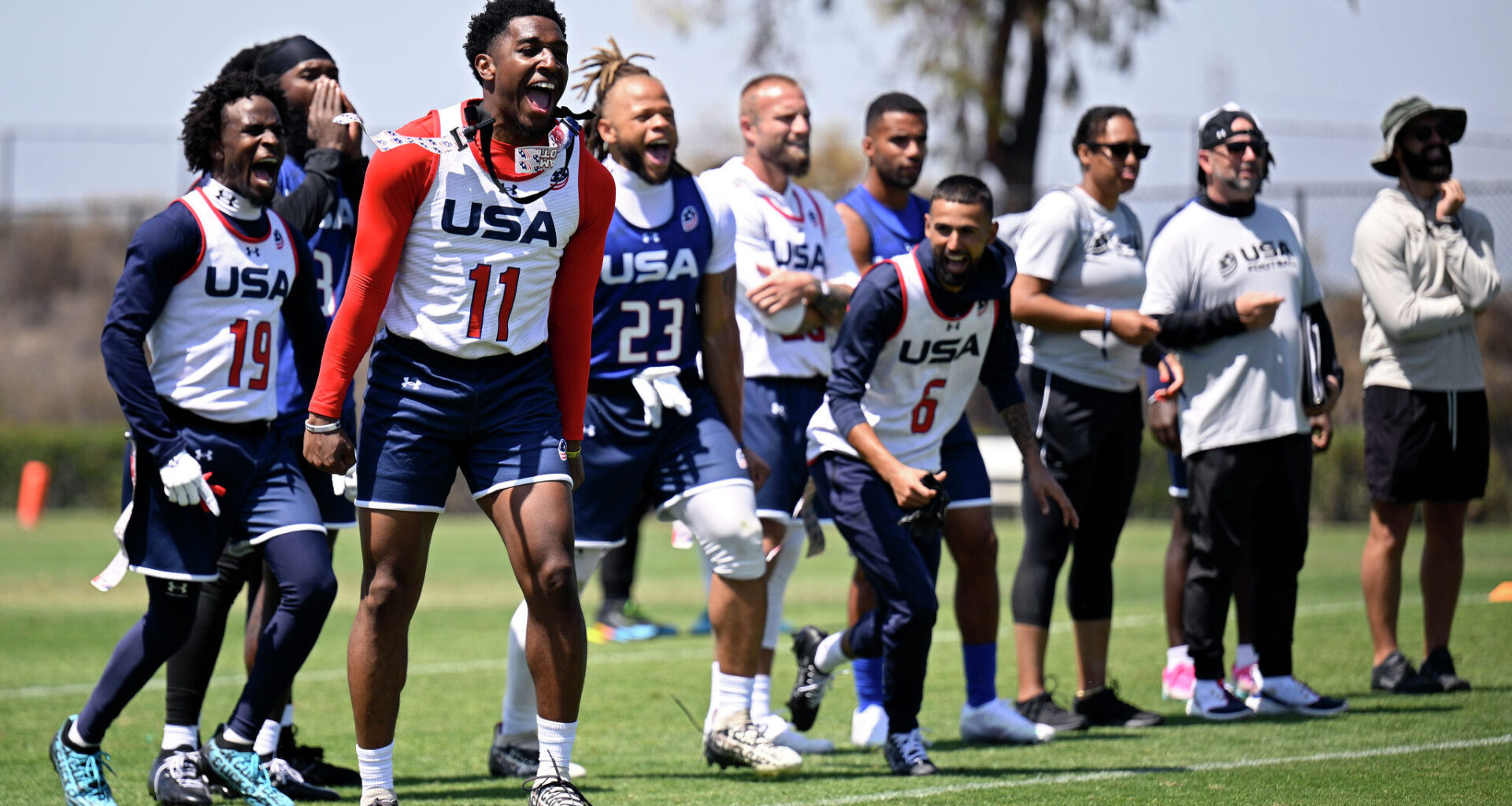
The men’s USA National Football Team cheers on the women’s team during practice at Chula Vista (San Diego County) Elite Athlete Training Center on May 22.
Orlando Ramirez/Getty Images
Loryn Goodwin left, Isabella Geraci and London Jenkins of the women’s USA National Football Team take a break during team practice at Chula Vista (San Diego County) Elite Athlete Training Center on May 22.
Orlando Ramirez/Getty Images
When America’s top male and female flag football players gathered in Chula Vista (San Diego County) this May for their second of three training camps, it was to continue to prepare for the last major tournament held before the sport makes its Olympic debut in 2028 at Los Angeles.
It was also the last time that the player pool fighting for 12 coveted roster spots did not have to deal with a barrage of players coming, as Tyler Davis put it, “out of left field” to fight for spots. Veteran flag players expect this challenge; they aren’t blindsided by it.
In August, the German city of Düsseldorf will host the 2026 men’s and women’s International Federation for American Football flag football world championships. On the men’s side, the team is looking to win its sixth straight world championship, while the women are going for their fourth straight. The tournament will serve as an Olympic qualifier, with the top two non-United States men’s and women’s teams earning their spots for LA 28.
Article continues below this ad
The United States has already qualified for both tournaments as the host country. Even with qualification, the current flag football player pool is not staying complacent, nor do they expect to coast to gold in Düsseldorf or Los Angeles. They know Olympic inclusion is a big deal, and more eyes will be on the sport than ever before.
Adding a new wrinkle to the Olympic journey is the fact that National Football League players will be eligible to join the flag football player pool starting in 2027. At Super Bowl LX, Philadelphia Eagles quarterback Jalen Hurts called playing in the Olympics a “once-in-a-lifetime” opportunity, and said he was going to study up on the rules if he is eligible to play.
Antonio Coleman, left, Aamir Brown and Darrell Doucette III of the men’s USA National Football Team warm up during practice at Chula Vista (San Diego County) Elite Athlete Training Center on May 22.
Orlando Ramirez/Getty Images
The Chronicle spoke with players ahead of the upcoming World Championships to get their thoughts on where their sport is headed. Flag players were mum about NFL inclusion, but said if pro football players were going to be serious about learning their sport and its intricacies, then they may have a shot at competing for a roster spot.
San Francisco Chronicle Logo
Make us a Preferred Source to get more of our news when you search.
Add Preferred Source
Focusing on future NFL player participation risks losing the forest for the trees. The NFL has invested heavily in promoting flag football, and players mentioned rumors about the formation of a professional flag league in the U.S. Their sport is one of the fastest growing in the country, being added at the high school and collegiate level in girls flag football. That burgeoning expansion of participation is just as important, if not more, for the long-term health of flag football beyond Los Angeles 2028, they said.
Article continues below this ad
“For me and my teammates, my brothers, we all are just continuing to control what we can control, and that’s ourselves,” said Darrell “Housh” Doucette, quarterback of the 2021 and 2024 IFAF World Championships. “Of course, we all want to play in 2028, but we can’t think that far ahead right now.”
Quarterback Darrell Doucette III of the men’s USA National Football Team throws during practice at Chula Vista (San Diego County) Elite Athlete Training Center on May 22.
Orlando Ramirez/Getty Images
Doucette and other national team players took part in the inaugural Fanatics Flag Football Classic earlier this year in Los Angeles. The three-team tournament pitted Team USA against two teams of NFL stars, retired players and invited guests. Ahead of the tournament many past and present NFL players assumed they would dominate the field, showing why they would likely be going to LA 28.
That was before Team USA blew out their more famous opponents 106-44, winning all three games played. As surprising as that might seem, it’s not hard to see why. The rules of flag football differ slightly from that of traditional tackle football, which in turn require different skills.
Players in the national team pool have shown that it is possible to make the transition between each discipline, if you’re willing to put in the work. Oakland native Tyler Davis has played tackle football in the United States, Canada and Germany. Despite making the national team, he said he is “still learning” the intricacies of flag football, especially the hand-eye coordination required and the flag-pulling technique integral to the game.
Article continues below this ad
Oakland native Tyler Davis of the men’s USA National Football Team runs during practice at Chula Vista (San Diego County) Elite Athlete Training Center on May 22. Davis, the son of former Oakland Raider Clarence Davis, played tackle football professionally in the U.S., Canada and Germany before making the transition to flag football.
Orlando Ramirez/Getty Images
“If you have good footwork, you can run a route,” Davis said. “If that’s the goal, to play in the Olympics, it has to be something that you actually take the time out of your day and study, and not just study, engulf yourself in that world.”
During the beginning of his flag football career, Davis said he relied on teammates to explain the rules of the game constantly, even in the middle of games to help keep up. He initially treated the sport as something to have fun playing, but soon found just how much passion there was for flag football while traveling domestically and internationally that he quickly took the game so much more seriously.
Relying on his teammates to continue his education while honing his skills, Davis said something that former tackle football players bring to the player pool is situational awareness. At many levels, football playbooks are quite massive, requiring players to digest mountains of information for all kinds of game situations. Bringing that kind of knowledge will be valuable for someone looking to switch disciplines.
Yet, that alone won’t make up for the skill set that tackle players lack once they step on a flag football field.
Article continues below this ad
Quarterback Darrell Doucette III of the men’s USA National Football Team cares for a football during practice at Chula Vista (San Diego County) Elite Athlete Training Center on May 22.
Orlando Ramirez/Getty Images
“I think that’s the fun of it, kind of showing guys that you might have been a great tackle football player, but this is a different sport, and if you don’t respect the sport, then your game won’t translate,” Doucette said. “You won’t be as great as you were playing tackle. But if you respect the sport and want to learn the sport, then your game will be able to translate over.”
Not just a man’s game
While the NFLs participation in LA 28 has dominated the conversation about the men’s team, much of the growth of the sport in the U.S. comes from the participation of children and young women. According to the NFL, almost a half-million girls ages 6 to 17 played flag football at any competition level in 2024. New Jersey became the 18th state to sanction girls flag football as a varsity high school sport this year, and 21 other states have pilot programs for the sport.
That’s a long way from having to create your own team to play on, like Ashlea Klam’s family did in Texas to help nurture their daughter’s development. She now plays center for the national women’s team, after playing the sport in college at National Association of Intercollegiate Athletics college Keiser University and debuting for the U17 women’s national team.
Article continues below this ad
Kennedy Foster of the women’s USA National Football Team warms up during practice at Chula Vista (San Diego County) Elite Athlete Training Center.
Orlando Ramirez/Getty Images
“I was 9 years old, and I was playing on a U14 new girls team, because that was the only age group that the NFL flag nationals had at the time,” Klam told the Chronicle. “When I was younger, I didn’t really have people to look up to, not because they weren’t there, but because they weren’t being broadcasted or showcased. Now that is actually happening.”
She said that she has noticed the NFL sending high-level officials to IFAF World Championships in order to better understand the game when creating its own league and just getting stories out there.
The NFL has laid the groundwork for creating both men’s and women’s professional flag football leagues, although a start date has not been released. The NCAA added the sport to its women’s emerging sports program, the next step in getting flag football sanctioned as an official varsity collegiate sport.
Ashlea Klam of the women’s USA National Football Team makes a catch during practice at Chula Vista (San Diego County) Elite Athlete Training Center on May 22.
Orlando Ramirez/Getty Images
Having the sport financially supported at the collegiate level and a pro league will finally connect the development pathway that exists for many girls, who have to find opportunities where they can.
Maci Joncich played flag football growing up in Nevada, where the sport was sanctioned as a high school sport. As a varsity athlete she made the U15 and U17 national teams, and was a member of the senior team traveling to world championships right after graduating high school. She attends the University of Florida, playing flag football through the National Intramural-Recreational Sports Association.
That experience on junior national teams allowed her to learn and grow her game from senior national team members, providing that pathway to representing her country at a senior world championship. But she also credits living in an area with a rich tradition in the sport, now supported by the local NFL club. She wants that opportunity across all 50 states, something an Olympic golden moment can help spur.
Maci Joncich of the women’s USA National Football Team makes a catch during team practice at Chula Vista (San Diego County) Elite Athlete Training Center on May 22.
Orlando Ramirez/Getty Images
“I have a friend who works with the Kansas City Chiefs, and you know, she is working day and night, after hours, just for flag football to get it sanctioned in Kansas,” Joncich said. “It just goes to show you what the NFL has really put into this. I can’t tell you how many times I’ve been to the Raiders headquarters. It’s almost like I know everybody there, and they know who I am.”
Sydney Bauer is a freelance writer in New Jersey. Email: sydneyerinwrites@gmail.com; Bluesky: @sydney-bauer.com