
When looking across football codes, the NRL’s recent rule changes to speed up play are hard to ignore: six-mores instead of penalties, play-the-balls instead of scrums for certain infringements, and moving the six-more from the 40-metre line to the 20-metre line.
The principle behind each change is the same: keep the ball moving, keep the game contested, reduce the interruptions.
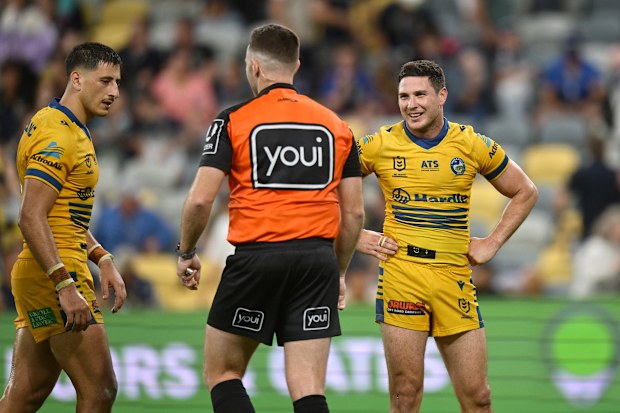
Mitchell Moses (right) debates a decision with referee Liam Kennedy late in the Eels thrilling round 10 win over the Cowboys. NRL Images
The AFL, however, has not had a meaningful rule change directed at ball movement and contest in 24 years. In a competition that prides itself on evolving, even when supporters demand fewer rule changes, that is a striking gap.
In 2002, the required mark distance was increased from 10 to 15 metres. It was the right call at the right time.
Full-time professionalism, salary caps, and national drafts were still in their nascent years, but the direction was clear: better trained players were taking marks more frequently and with greater ease. Increasing the difficulty was appropriate.
What is less appropriate is that nothing has changed since despite continued advances in tactics and training.
This is not unusual in the broader history of the sport. The mark’s required distance has been adjusted repeatedly: from a verbal call in 1859, to a five-yard protected area in 1866, reduced to two yards by 1887, replaced by the 10-yard mark in 1897, and metricated in the 1970s before the 2002 increase.
The game has never treated its rules as sacred, monolithic, nor fixed.
The 2002 change was consistent with that tradition; the subsequent 24 years of inaction is not.
Other codes have not been shy about recalibrating rules when professionalism outpaces them.
The NFL narrowed its hash marks in 1976 to promote an attacking passing game.
Rugby union professionalised in 1995 and found that amateur-era laws needed updating, later adding the referee’s ‘use it’ to speed up the ball leaving the ruck.
Even soccer has adjusted rules to reduce time-wasting, such as limitations on goal-keeper handling.
The principle is consistent: when the level of play changes significantly, the rules should follow.
Even Bill Fallowfield, the late RFL secretary remembered for ruling with an iron fist, stated it is incumbent on leagues to make necessary rule changes to keep the game played in the style spectators most enjoy; this is an open game with the ball in frequent contest.
For AFL, the case for revisiting the mark distance rests on a straightforward observation. The 15-metre mark was set for a cohort of players still evolving to the demands of full-time professionalism.
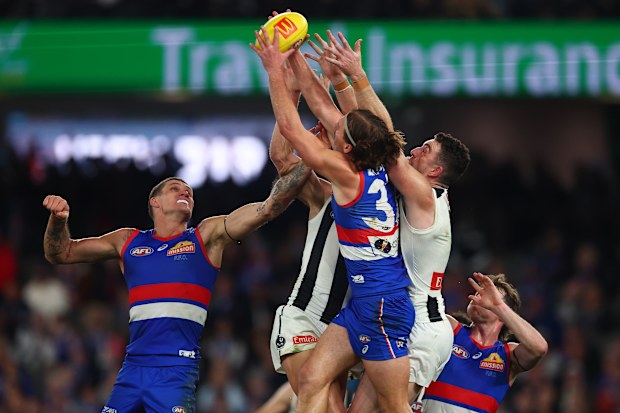
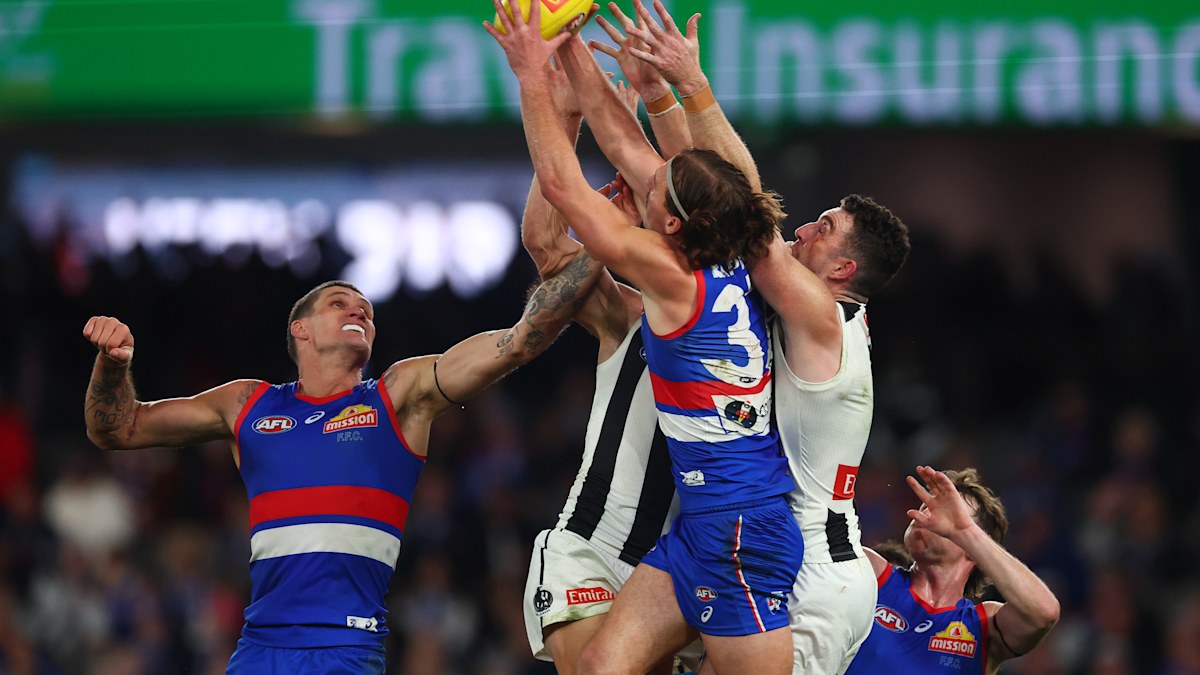
Michael Sellwood takes a game-saving mark in the final stages of the round 12 AFL match between Western Bulldogs and Collingwood Magpies. Daniel Pockett
Today’s players have grown up entirely within that system. Their conditioning, kicking precision, and marking ability are of a different order. The 15-metre standard, once a genuine barrier, now sits comfortably within what elite players do routinely.
The result, visible to anyone who watches the contemporary game alongside footage from earlier eras, is a notably more start-stop product; marks are more frequent. The free-flowing contest that characterised earlier eras is less present.
This is not a matter of nostalgia; it is a structural consequence of rules that have not kept pace with the athletes performing under them.
GAA football, while not a direct comparison, is worth a look; marks were introduced in 2017 but remain limited in application, preserving a style built around continuous movement and contest.
It demonstrates that similar football codes can be structured around flow rather than set pieces.
None of this is to suggest the AFL should simply announce an increase and move on. A prudent approach involves trialling changes at lower or parallel levels before implementing them at the elite standard.
World Rugby trials law changes domestically before moving them to the southern hemisphere, then to the international game.
The NFL and NCAA operate under different hash mark positions, with high school being the widest.
The NRL applies different rules across community, international, and domestic elite levels.
There is no reason the AFL could not do the same: trial an increased mark distance before any decision is made about the elite competition.
What the distance should be, whether 20 metres, 25, or something else, is a question for that process. It cannot be answered without data, and data cannot be gathered without trialling.
But trials cannot begin until the conversation does.
The AFL’s reputation is for changing rules too frequently and getting an earful from supporters. However, meaningful adjustment to the mark in over two decades, during a period in which the athleticism and precision of its players have continued to climb sharply.
Whether or not an increase is ultimately the right answer, the question is overdue. Twenty-four years is a long time to leave this rule unchallenged in a game that has changed considerably around it.