
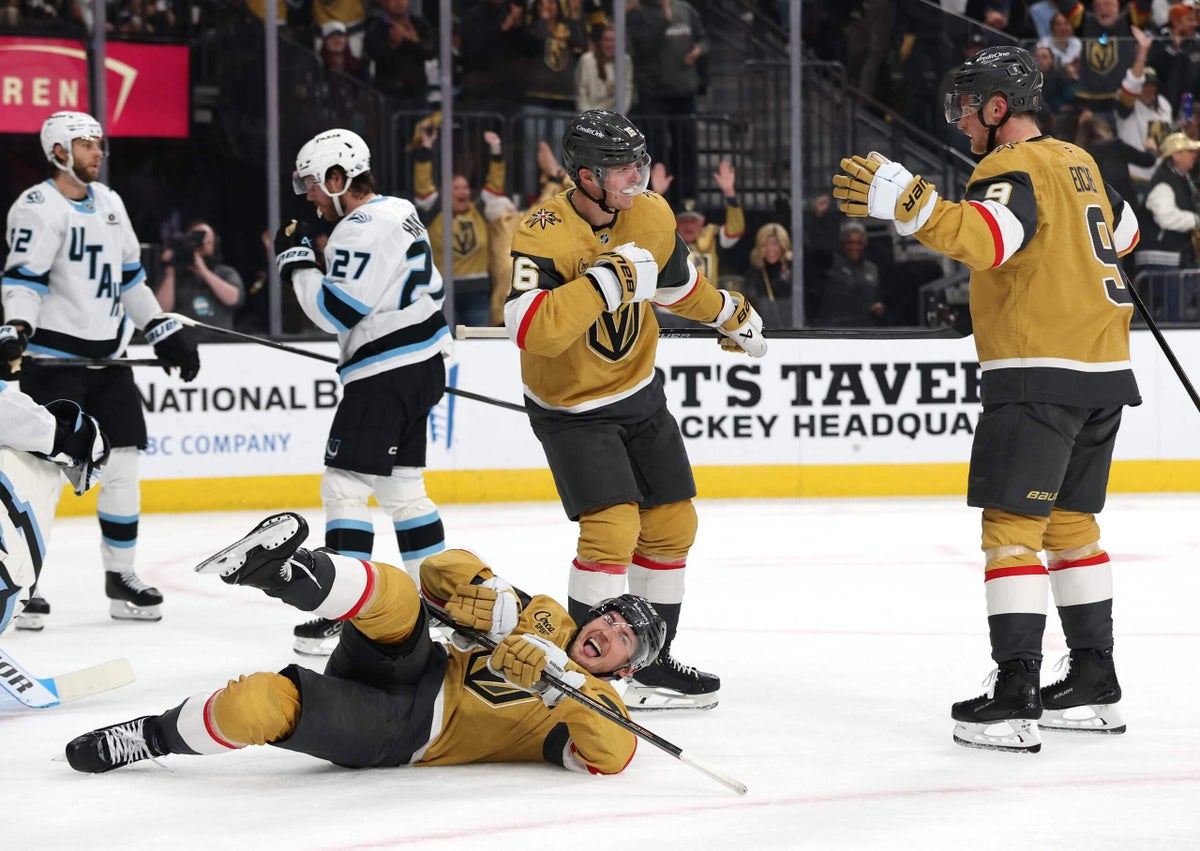
Ivan Barbashev punched the air in celebration. It was early in the second period Tuesday night, and the Vegas Golden Knights forward had just wired a goal past Hurricanes netminder Frederik Andersen to tie Game 1 of the Stanley Cup Final. Coming to a stop along the glass, Barbashev was quickly joined by his linemates, Pavel Dorofeyev and Jack Eichel, who embraced him in a group hug.
As a trio, the two Russian wingers and their American center have formed one of the top lines in the 2025-26 NHL playoffs, helping Vegas roll through the Western Conference and seize a 1-0 series lead against the Carolina Hurricanes.
During the regular season, Barbashev-Eichel-Dorofeyev totaled only 1:10 of ice time together at five-on-five. But under coach John Tortorella — hired to replace Bruce Cassidy with eight games left in the regular season — the line has taken off. So far, in the postseason, it’s logged more ice time than any of the Golden Knights’ lines and outscored opponents 9-5, all with strong underlying numbers, per Natural Stat Trick.
The trio highlights a circumstance that is unique for North American professional sports yet familiar in hockey: In a league that featured players from 17 different countries this season, according to QuantHockey, an English-speaking NHL forward regularly finds himself flanked by two linemates who, in turn, speak different native languages.
Last year, when the Florida Panthers repeated as Stanley Cup champions, they were led by 13 goals from a line that saw Brad Marchand (English) paired with Eetu Luostarinen and Anton Lundell (Finnish). Before his team fell in this spring’s Eastern Conference finals, Montreal Canadiens winger Alexandre Texier spent more than 140 total postseason minutes alongside exactly one fellow French-speaking forward — either Phillip Danault or Zach Bolduc.
According to Eichel, both of his Russian linemates speak English well, in particular the 30-year-old Barbashev, which makes communicating as a line simple enough. Sometimes, though, Eichel requires an assist.
“At times, I’ll tell Ivan something in English to tell Pav in Russian, just to make sure he understands it well,” Eichel said. “They’re inseparable, and it’s been great playing with them.”
In San Jose, Tyler Toffoli played 178:21 in 2025-26 with Swedish forwards William Eklund and Alex Wennberg. Both speak fluent English, but they occasionally slipped into Swedish on the bench after a shift. Sometimes, Wennberg would translate snippets back to Toffoli, but the winger rarely found that essential: He could pick up the gist from context.
“He’s got the Swedish connection,” Wennberg joked. “I bet he can pick it up. I might give him some Duolingo lessons so he can be fluent.”
If possible, though, Wennberg spoke in English when talking to both his linemates at once. That’s typical of how NHLers tend to approach the challenge of a multilingual line.
“I would speak in English unless it’s just the two of us,” said Hurricanes center Sebastian Aho, who has shared lines with fellow Finnish forwards Teuvo Teräväinen and Mikko Rantanen in the past. “It’s out of respect to other people around here.”
“Obviously, if there’s a third guy that speaks English, you’re not going to speak German as a line,” added Edmonton Oilers star Leon Draisaitl, who skated on a line with fellow German Dominik Kahun during the 2020-21 season. “But certainly if it’s one-on-one, there’s some native language going on.”
The bench, though, can lead to more liberal use of one’s native tongue — especially if there’s something a player wants only a countryman to understand.
“If you’re really, really mad, you might throw a little Finnish in there,” Aho said with a laugh.
Regardless of language, linemates often gather to talk before faceoffs. Rantanen, now on the Dallas Stars, said those conversations take place in English, even when he has a Finnish linemate, as was the case when he and Roope Hintz skated with Jason Robertson earlier this season. The team’s set plays all have English names, so players just call them out.
Rantanen’s bench language, on the other hand, comes down to who is near him.
“If we’re together the three of us (linemates), or on the bench if (Robertson) is between us, I think it’s in English,” he said earlier this season. “We’re generous guys, Finnish guys.”

Robertson, center, spent part of the season skating alongside two Finnish speakers in Hintz, left, and Rantanen. (Sam Hodde / Getty Images)
Players were consistent in not wanting to leave a linemate out of the loop, but that courtesy doesn’t extend to opponents. The Red Wings’ Marco Kasper, who hails from Austria but also knows Swedish, said he’ll sometimes try to gain a competitive advantage while on the ice with Swedish teammates.
“Sometimes you don’t want opponents to hear (what you’re saying),” Kasper said. “If you have an American standing over there and he doesn’t know Swedish, (you can say) ‘cover him’ or something in Swedish.”
Three-time Stanley Cup winner Justin Williams, who retired in 2020, heard plenty of unintelligible bench conversations while with Washington from 2015-17. There he played on a line at points with Alex Ovechkin and Evgeny Kuznetsov, who frequently spoke in Russian.
“I would always give them s—,” Williams said. “I would be like ‘speak English!’”
While in Vancouver, now-Maple Leafs forward Dakota Joshua was occasionally deployed on lines with pairs of Swedes. Nils Höglander, Nils Åman and Linus Karlsson all had bottom-six roles while he was there.
“They have their own little talks, and if it’s something that I need to be included in, I make sure that I get the lowdown on what’s being said,” Joshua said. “For sure, I’ve been the odd man out before.”
But Joshua never found that it led to miscommunication. He even briefly picked up some Swedish words, having since forgotten them. Overall, he saw benefits to his linemates being able to speak their native language.
“It makes people feel more comfortable,” he said. “That goes a long way, just the comfortability of it.”
Comfort in communication is good. But on the ice, for NHL linemates, it’s the ability to play together that matters most. Even the existence of a shared native tongue doesn’t always translate to that.
“Chemistry, I don’t think that has anything to do with language,” Wennberg said. “Whoever it is, you have different chemistry in a different way, (same) language or not.”
— Jesse Granger contributed to this report.