
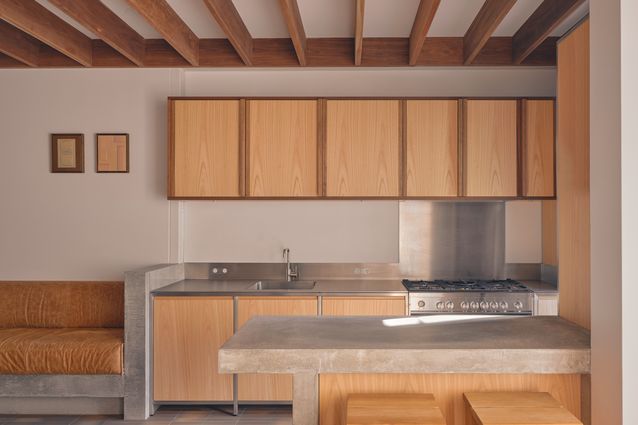
For Kelvin Ho, founding director of Akin Atelier, the measure of a project is generated in the exchange between the people who make it, not only what was resolved on paper or photographed at the end. Life of Riley, an alterations and additions project to a Victorian terrace in Surry Hills, “was so much about design as a springing point, with the build process and client engagement actually being way more fun and satisfying.”
The Surry Hills terrace had been substantially altered across its history with quirky additions and ad hoc interventions. Rather than rationalise these away, Kelvin and project architect Ben Feher worked with what they found. A stepped coursework of bricks in the attic was kept as an architectural detail; an existing window, recontextualised by a raised floor level, now frames a ghost gum; and a trio of internal arched windows was retained to draw light from the rear of the house toward the front. “What we loved most about the project,” Kelvin reflects, “was the actual life of the project, the process.”
View gallery
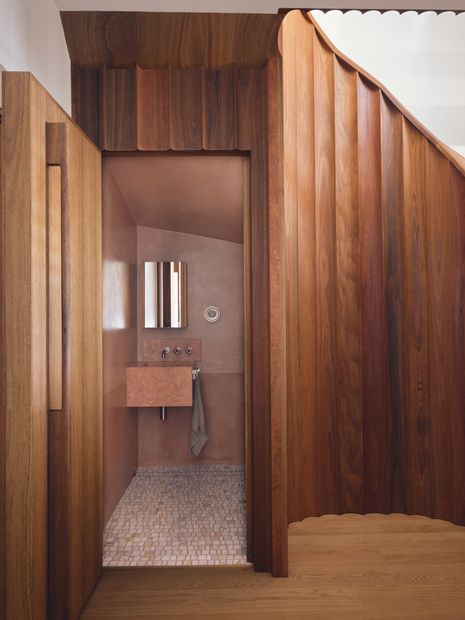
Nowhere is this more evident than in the staircase, a spotted gum-and-steel form fabricated by Cranbrook Workshop that spirals through three levels. The scalloped timber cladding draws the eye up, bringing light down and giving a grand verticality to the space. Wide platform steps spill into the ground floor as though the stair is arriving rather than merely ascending, and tucked beneath is a pink plaster powder room that completes the composition. “Allocating that generous staircase,” Kelvin says, “counteracts the compact rooms and asserts a sense of generosity.” Akin Atelier had worked with Cranbrook on a previous sculptural stair, accumulated knowledge and trust, and had approached this commission with a shared ambition to push further. The result is a piece that belongs equally to the practice and the maker.
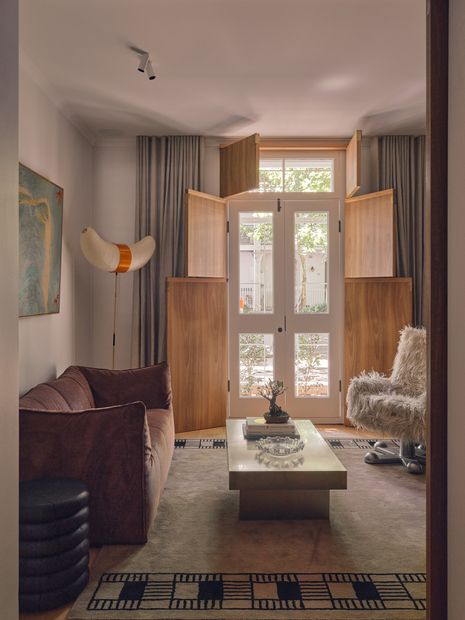
Kelvin traces this way of working to an early lesson: “You have to work with builders and learn from them.” All of it, the stair, the shutters, the tiling and the choice of art belong to this same learning that “champion[s] architecture as a series of collaborations … it promotes good work.” In Life of Riley, that ethos is legible in the way every junction carries the hand of its maker, from structure to surface. The house, like its name, suggests the pleasure is in the making and the living of it.
View gallery