
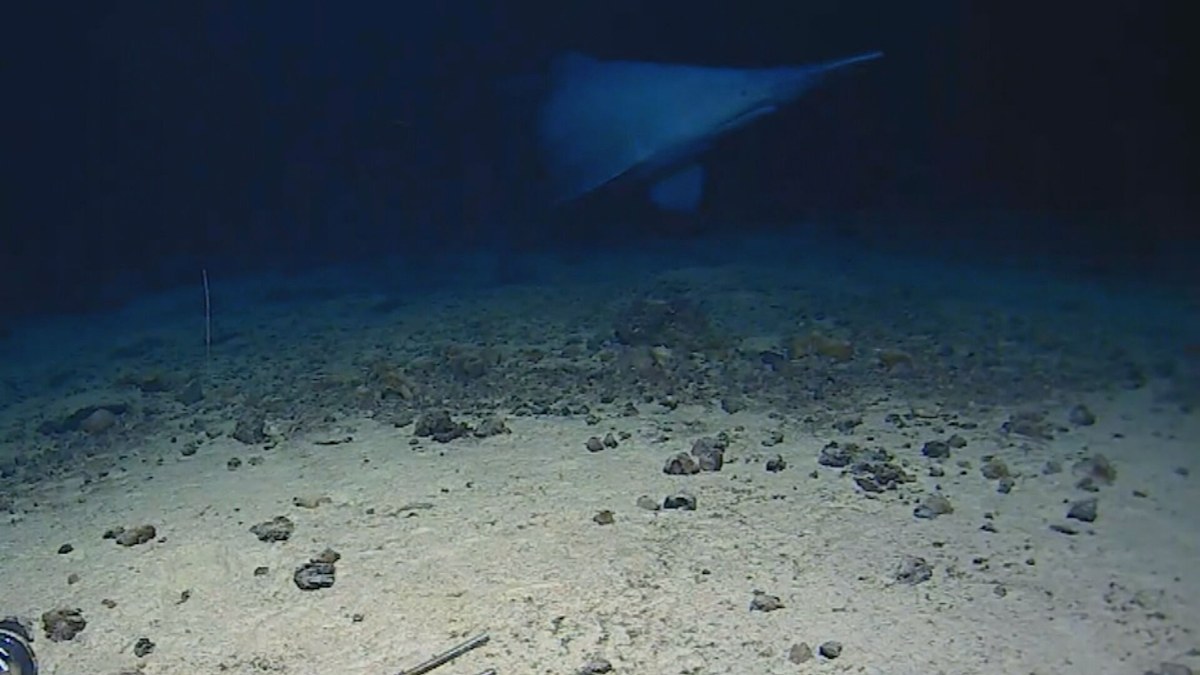
Researchers at the University of Western Australia have caught a rare glimpse of a goblin shark in the Pacific Ocean.
The sightings were on a seamount near Jarvis Island, on the slope of the Tonga Trench, located between Hawaii and the Cook Islands in the Central Pacific.
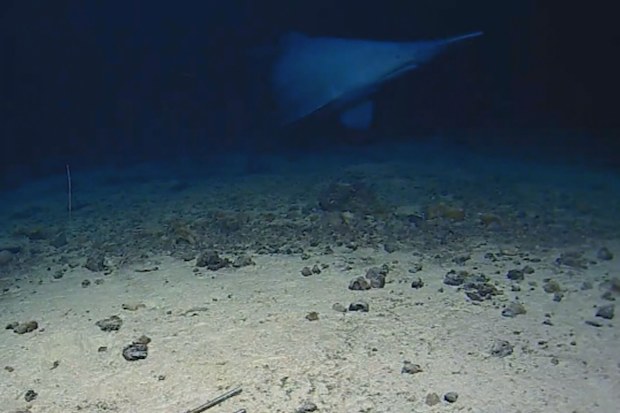
Researchers at the University of Western Australia have caught a rare glimpse of a goblin shark in the Pacific Ocean. Minderoo-UWA Deep-Sea Research Centre and Inkfish
The team only saw the elusive sea creature for about 20 seconds, but it marked a massive milestone: the first live observation in its natural deep ocean habitat.
UWA said that in the past, goblin sharks have only been seen alive after being hooked on a fishing line and brought to the surface, where they died soon after.
The discovery was published in the Journal of Fish Biology, with researchers from Minderoo-UWA Deep-Sea Research Centre and the University of Hawaii at Manoa saying the two live observations extended the known depth and geographic range of the goblin shark significantly.
Co-author of the study Professor Alan Jamieson, Director of Minderoo-UWA Deep-Sea Research Centre, documented the sighting during a 2024 expedition to the Tonga Trench.
“The goblin shark is a deep-sea charismatic animal, and I never thought we’d see one alive,” Jamieson said.
“It’s not only seeing it alive that was fascinating, but also the fact the Tonga Trench goblin shark was 700 metres deeper than previous known, making the deepest-known white shark.
“On that expedition we filmed over 50 days of continuous footage between depths of 800 and 10,800 metres and this observation was a little over 20 seconds long which is testament to how elusive this species is, and how special it is to have two observations in the same study.”
Lead author Aaron Judah, from the Deep-Sea Fish Ecology Lab and Deep-Sea Animal Research Centre at the University of Hawaii, said the new discovery demonstrated “there is still so much to explore in our deep ocean home”.
“Given the newly expanded geographic range of the goblin shark, this species can be included in regional management and a nation’s biodiversity list,” Judah said.
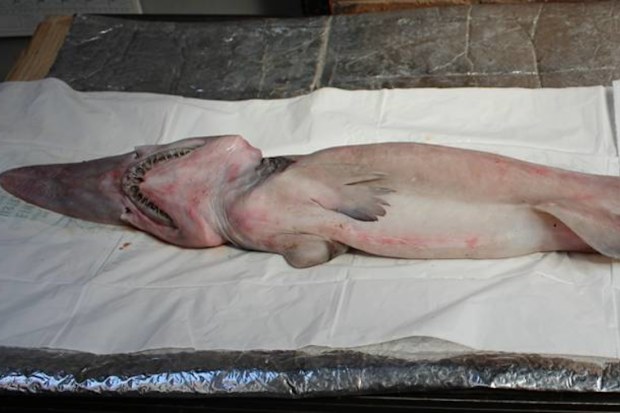
The UWA said that in the past, goblin sharks have only been seen alive after being hooked on a fishing line and brought to the surface, where they died soon after. Photographic
Goblin sharks are believed to be about 125 million years old and are sometimes referred to as “living fossils”.
They’ve previously been found near Australia.