
 Photo: Mitchell Leff/Getty Images
A quick note before we get going: I typically get this newsletter out once a week (or at least try to), but over the past couple of weeks, I made the trip from Denver to Louisville and then back to Denver after spending some time with family. With me back and settled in Colorado, I’ll be back to a more regular publishing schedule. I appreciate the understanding.
In one of the most memorable games of the 2026 NCAA Tournament, Eian Elmer and Brant Byers were the stars.
After being one of the most hotly debated bubble teams in the days leading up to the Big Dance, Miami (Ohio) men’s basketball knocked off SMU, 89-79, in a play-in game in nearby Dayton, giving the RedHawks their first tournament victory in 27 years. In the win, Elmer and Byers were the team’s top two scorers, combining for 42 points while making 10 of their 18 3-pointers.
Miami had been one of the most gripping stories during the 2025-26 season, a mid-major squad that carried an undefeated record heading into the conference tournament. The secret to that success was roster continuity, with many of the RedHawks’ top players from a 25-win team the previous season, like Elmer and Byers, deciding to stick around because of a professed love for the program and a belief in where it was headed.
Within three weeks of their one shining moment, Elmer and Byers were in the transfer portal, with both players ultimately committing to Big Ten programs.
While interesting, their story is hardly unique.
Player movement in college basketball has increased significantly in the years since the NCAA removed the requirement that a transferring player sit out the first year at their new school. This year, nearly 2,700 players entered the portal, about 1,000 more than there were in the portal three years ago.
What was a long-overdue tweak that offered players the same freedom that their coaches had enjoyed for generations has come with consequences both predictable (the number of players in the portal spiking) and more unforeseen (like players who compete for four different schools in their four-year college careers).
Perhaps more than anything else, it has increased the chasm between the sport’s haves and have-nots. A food chain that already existed has become that much more deeply entrenched. Those in college basketball’s major conferences have disproportionately reaped the benefits of the new landscape while those at the mid- and low-major levels have suffered the overwhelming brunt of the negative consequences. Smaller leagues that were once able to develop and retain star players over periods of three and even four years have increasingly become feeder systems, where once-overlooked talent can shine before getting a call-up (and a hefty payday) from a bigger program with more resources than the one they’re leaving behind.
It’s a reality that isn’t lost on most college basketball fans – and it existed to a lesser extent even before the NCAA changed its transfer rules – but one particular stat shows just how precarious things have gotten for mid- and low-major programs trying to hold on to their best players.
This season, 71 players with remaining eligibility from across the 26 leagues outside of the Power Five made their all-conference first team. Of those 71, only 14 are returning to their school to play next season, or 19.7%.
Along with Elmer and Byers, that group includes players like:
Terrence Hill Jr., who scored 34 points in VCU’s dramatic, come-from-behind NCAA Tournament win against North Carolina. Two weeks after the victory, he entered the portal, ultimately signing with Tennessee
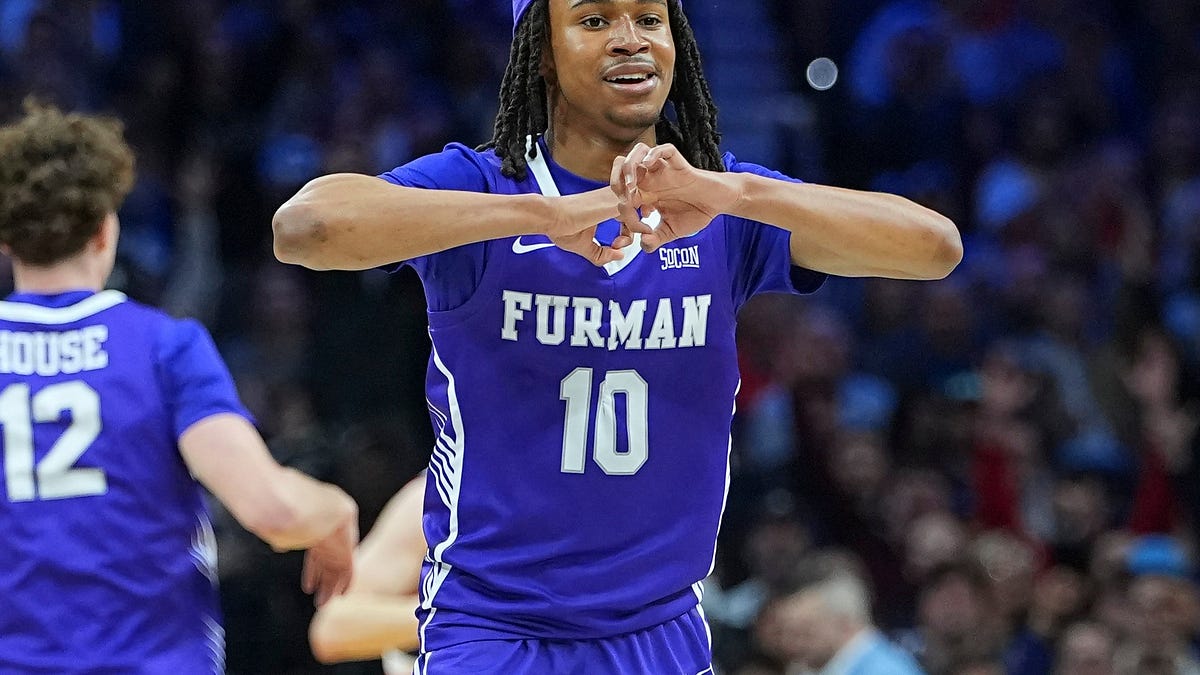
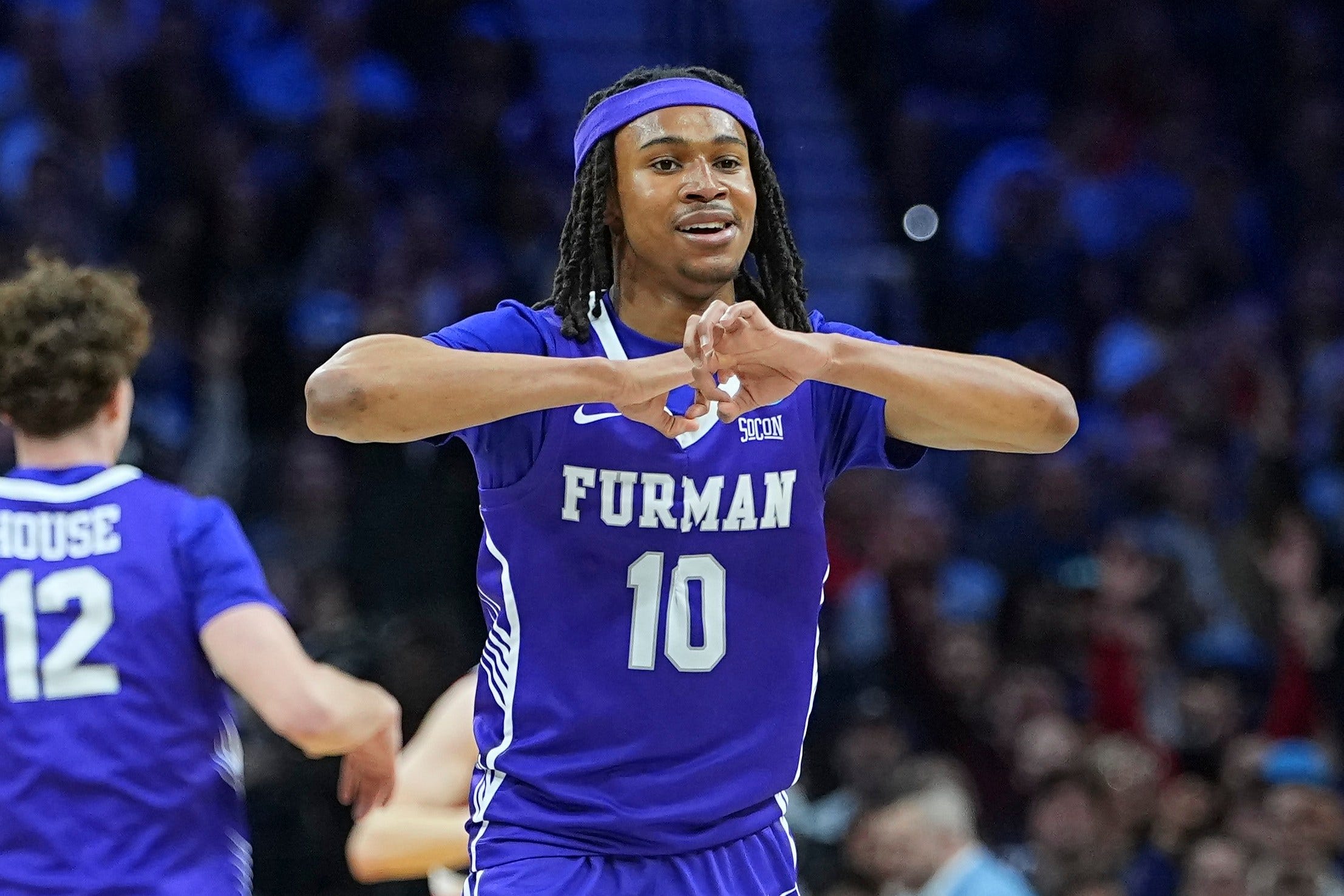
Alex Wilkins, a zero-star recruit 12 months ago who pieced together a stellar freshman season at Furman capped off by a 21-point performance against UConn in the NCAA Tournament. After the season, he transferred to Kentucky
Cruz Davis averaged 20.1 points per game, ranking him among the top 30 Division I players in scoring, while leading Hofstra to its first NCAA Tournament berth since 2001, back when Jay Wright was its 39-year-old head coach. With only one season of eligibility remaining, he transferred to Texas Tech, which will be his fourth college.
Freshman Michael Cooper and sophomore TJ Burch were the top two scorers for a Wright State team that won the Horizon League and gave No. 3 seed Virginia a scare in their first-round NCAA Tournament matchup. Both players transferred to power-conference programs after the season.
For the second consecutive season, Robert Morris produced the Horizon League player of the year, with DeSean Goode taking home the award. And, for the second time in as many years, the Colonials lost the conference’s player of the year to a power-conference school, with Goode leaving for Miami one year after future NCAA Tournament hero Alvaro Folgueiras bounced for Iowa.
While mid- and low-major standouts leaving for bigger programs is hardly anything new, it has become significantly more pronounced the past two seasons. Last season, 20.2% of first-team all-conference honorees with remaining eligibility from those leagues stayed at the same school the following season. Just two years ago, that number was 40.2%. In 2021, the first year players could transfer without the penalty of sitting out a year, it was 65.5%. Among the players who opted to stay put that year were future first-team All-American Johni Broome (at Morehead State) and future first-team All-Big 12 selection Norchad Omier (at Arkansas State)
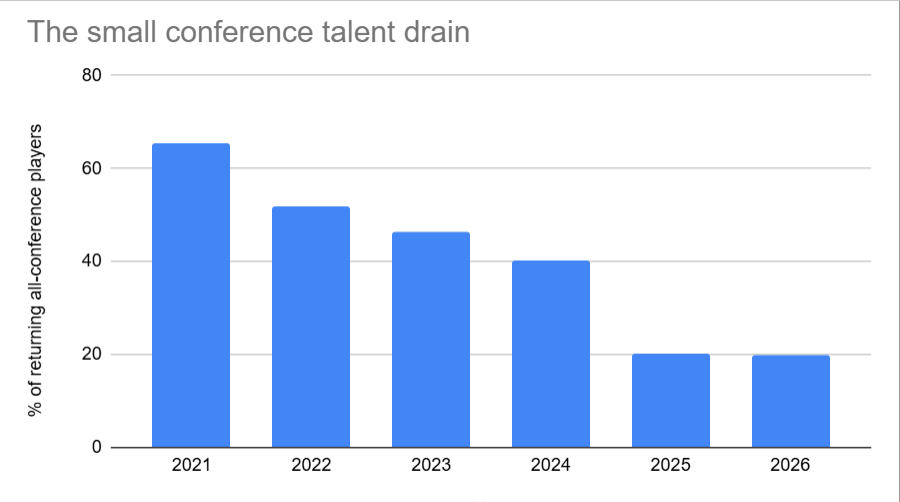
This year, there were seven leagues that had at least three members of their all-conference first team with remaining eligibility, but none of them are returning. That group includes the Southern Conference, which has had particularly rotten luck retaining its best players. Over the past three seasons, only one of its combined 12 first-team players with remaining eligibility came back to their program.
Over that same three-year stretch, the MAAC has held on to only one of its 11 first-teamers with remaining eligibility while the Ohio Valley Conference has kept just one of 13. The Horizon has been shut out entirely during that period, with none of its nine first-teamers coming back to schools where they still had eligibility.
It’s not all doom and gloom, of course.
For one, the majority of the best players in smaller conferences aren’t getting plucked the second they show some measure of promise. This offseason, 48 of the 88 all-freshman or all-newcomer honorees with remaining eligibility are returning to the school where they won the award.
There are some encouraging examples of players with better, more lucrative options staying put. Jake Hall, who averaged 16.4 points per game as a freshman at New Mexico and earned first-team All-Mountain West recognition, is staying with the Lobos after initially entering the portal. Mason Falslev, another first-team All-Mountain West selection, is staying at Utah State despite his coach, Jerrod Calhoun, leaving for Cincinnati. McNeese’s Larry Johnson initially entered the portal, and was one of the top players available once he did, before pulling his name out to return to the Cowboys.
Still, those players are a rapidly dwindling exception at their rung of the sport.
The question of why these departures have accelerated in recent years is a fair one. Maybe the most likely explanation is the explosion of money that top-tier and even middling Power Five programs are now commanding. A sport where a million-dollar-a-year offer was astonishingly rare even two years ago now sees bench players on major-conference teams receive those kinds of paydays.
What was a new system with uncertain outcomes five years ago has now shown how one decision can radically transform a player’s life and career trajectory. The leading scorer on each of the past three national champions – Yaxel Lendeborg at Michigan, Walter Clayton at Florida and Tristen Newton at UConn – transferred in from a mid-major. Seven of the 15 Associated Press first-team All-Americans the past three seasons began their college careers at a mid- or low-major before transferring up.
In this scenario, there’s truly nobody at fault. While there are some cautionary tales of players who would have been better off not leaving a demonstrably good situation at a smaller program, these upwardly mobile athletes are doing what they believe is best for their future while earning what for many is life-changing money. The coaches who bring them in are simply playing within the rules of the sport and making the completely understandable decision to add experienced, proven players to try to upgrade their rosters.
But even in a just system filled with rational actors, there can be victims. And when we get to next year and there are even fewer mid- and low-major teams advancing or even putting up a fight in the NCAA Tournament, one of the factors that has robbed March Madness of some of its charm won’t be much of a mystery.
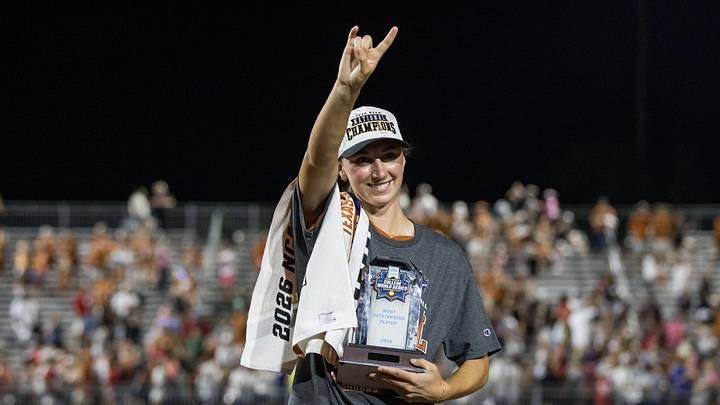 Photo: Brett Rojo-Imagn Images
Earlier this month, Texas softball won its second consecutive national title after yet again defeating Texas Tech in the championship round of the Women’s College World Series.
This year’s title was sealed with a Teagan Kavan strikeout of Mihyia Davis, capping off a two-inning relief effort in which the Longhorns ace fanned five of the six batters she faced.
That it was Kavan who closed out Texas’ latest championship and cemented the Longhorns as the sport’s preeminent program – a title they’ve ripped away from archrival Oklahoma – was all too fitting.
After taking the loss in Texas’ WCWS-opening loss to Tennessee, Kavan was the driving force of the Longhorns’ six-game win streak that followed. After allowing three earned runs in three innings in the 6-3 setback against the Lady Vols, she gave up only four earned runs in 30 ⅓ innings across the six games (four of which she started). That’s an ERA of 0.92, along with 27 strikeouts to just two walks.
Her excellence was hardly limited to that run.
Last week, Kavan became the first player in WCWS history to be named the event’s most outstanding player in consecutive years. Over the past two WCWS championship series, the junior from Iowa has allowed just three earned runs in 23 ⅔ innings (a 0.89 ERA) with 17 strikeouts and three walks.
In 16 WCWS appearances in her three-year college career, 12 of which were starts, Kavan is 10-2 with a 1.20 ERA, 63 strikeouts and 16 walks. She’s been stellar against the best competition, going a combined 6-0 against Texas Tech and Stanford’s NiJaree Canady, Nebraska’s Jordy Frahm and Tennessee’s Karlyn Pickens.
In 10 of her 12 WCWS starts, Kavan has thrown a complete game and in seven of those 12 starts, she recorded a shutout.
Kavan still has a year of eligibility – and with it, a chance to lead Texas to a three-peat – but over these past two years alone, she has built a strong case as one of the greatest players in WCWS history.
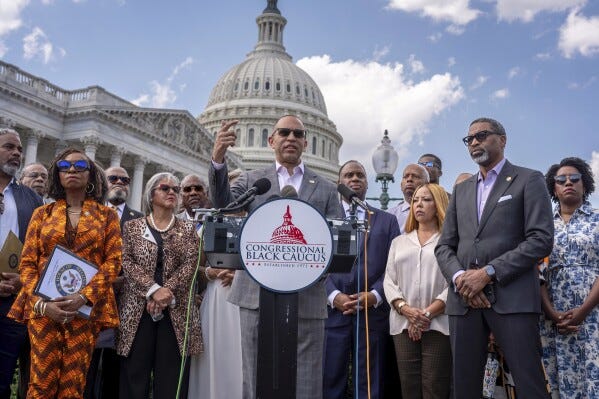 Photo: J. Scott Applewhite/Associated Press
Before a Texas judge issued Brendan Sorsby a stunning injunction against the NCAA and before the Protect College Sports Act began its journey through the halls of Congress, there were few stories that gripped the college sports world more than the NAACP’s call for Black athletes and fans to boycott public universities in states, the vast majority of them in the south, restricting Black voting rights following the Supreme Court’s decision in Louisiana v. Callais.
It’s an issue I’ve largely avoided injecting my own perspective on, at least to the extent of making it the centerpiece of a newsletter. As a white guy in a state with some of the more liberal voting laws in the country, I’m not directly affected by the issue and thus would be asking others, some of whom come from incredibly adverse circumstances, to take a considerable risk with their future while I myself had no skin in the game (though as a then-Pennsylvania resident who didn’t vote for Donald Trump in 2020, I guess there was an effort to throw out my vote).
Still, it’s an incredibly important issue. The Voting Rights Act, which was renewed unanimously by the U.S. Senate as recently as 2006, has been butchered to the point of being unrecognizable thanks to the Supreme Court’s latest ruling. The fact that so many southern states have moved with the speed and zeal they have to redraw their maps showed by Section 2 of the VRA was necessary in the first place. One of the most potentially effective, or at least intriguing, forms of retaliation is to take aim at the greatest source of civic pride and economic force in many of those states.
While I don’t think I’m the best person to write at length about what young Black athletes should do with their lives and careers, a number of talented writers have penned thoughtful pieces on the matter, some of whom support the NAACP’s push and others who believe it to be unfair or misguided.